
The following story originally appeared on the website for W&M’s VIMS & Batten School. – Ed.
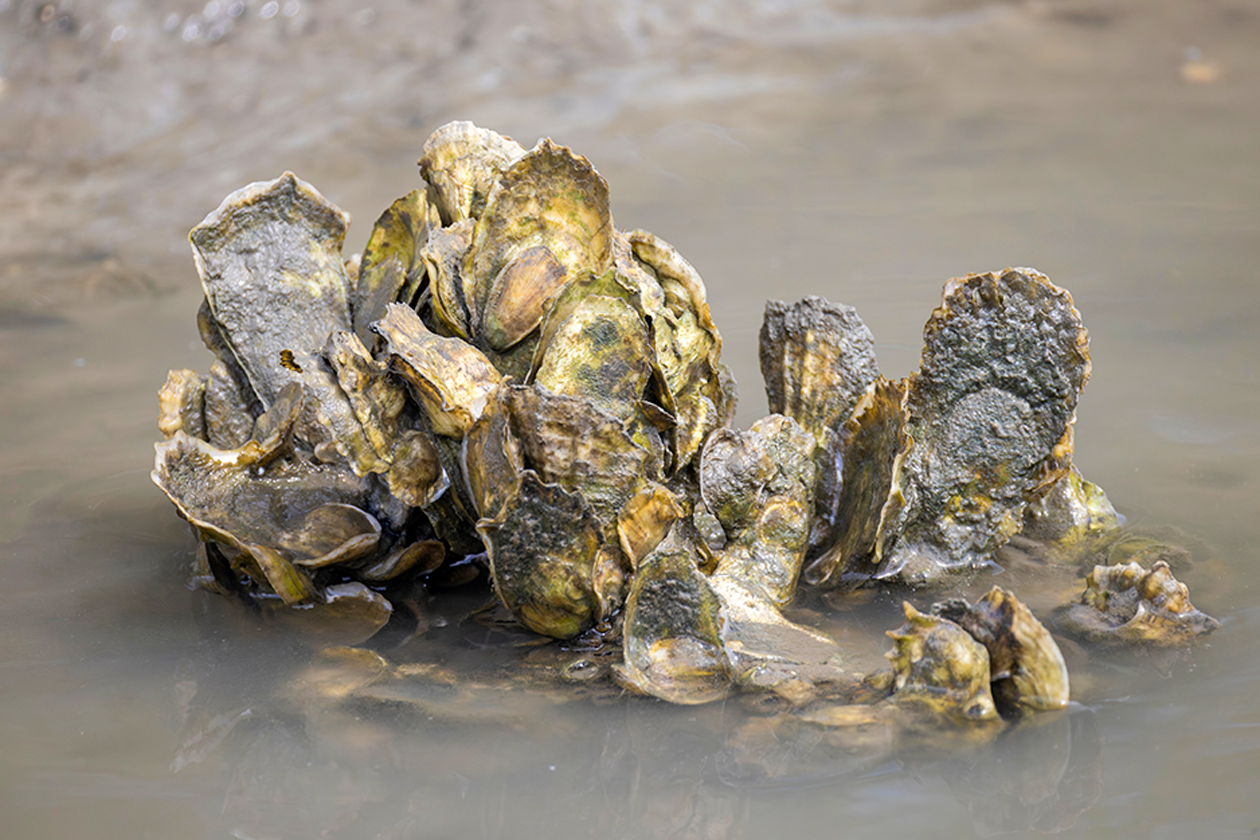
Scientists at William & Mary’s Virginia Institute of Marine Science (VIMS) are spearheading research into restoring oyster populations across the Chesapeake Bay through innovative reef designs, new monitoring technologies and sophisticated computer models that help optimize ecosystem renewal.
Building on decades of research and collaborations with the U.S. Army Corps of Engineers (USACE) Norfolk District, and implementing 3D technology, researchers are analyzing how artificial reefs support not only oyster populations and other marine life, but also communities and economies across Virginia.
Their work is already informing major restoration investments, including a planned effort in Tangier and Pocomoke Sounds involving upwards of $100 million in reef construction.
Building better reefs
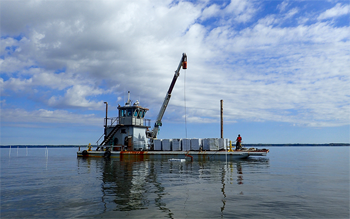
For nearly two decades, VIMS researchers have collaborated with the USACE Norfolk District to monitor and aid oyster restoration projects throughout Virginia’s waterways. Among the most ambitious projects is an ongoing effort in the Lynnhaven River Basin, where more than 28,000 artificial reef balls have been installed across approximately eight acres to aid struggling populations.
Unlike traditional oyster reefs, which are constructed from discarded oyster shells, reef balls are dome-shaped concrete structures with holes and crevices that provide surfaces for oyster larvae to settle.
“Anything but oyster shell is an alternative reef structure,” explained Rochelle Seitz, a professor at VIMS & the Batten School of Coastal & Marine Sciences.
In addition to their structural design, consideration of the height of oyster reefs has also proven to be critical in ensuring their longstanding viability.
“All the other restoration reefs in the past only stood a few inches off the bottom, so sediment took over,” explained Rom Lipcius, another professor at VIMS & the Batten School. “The height of our reefs made our project successful.”
Prior to restoration, the estimated oyster population was roughly six million, with most settlements being constricted to riprap or marshes. The population has since increased tenfold to 60 million across Lynnhaven Bay and other restoration sites, emphasizing the benefits of alternative reef structures for oyster populations.
Additional research is underway at Naval Weapons Station Yorktown (NWSY), where researchers are analyzing the impacts of utilizing hybrid living shorelines at Penniman Spit and the R3 Pier.
“We have different configurations of concrete reefs and granite reefs in different layouts,” explained Seitz. By comparing different reef materials and shapes at these various locations, scientists are determining what works best for the oysters while remaining cost effective.
New technologies reveal reef performance
As restoration techniques become more sophisticated, researchers are also developing new ways to measure their success.
According to Elena Hoang, an M.S. graduate student at the Batten School, three-dimensional scanning is the key. At NWSY, Hoang is using 3D scanning, as well as experimental reef replicas, to investigate how reef geometry affects the growth and survival of juvenile oysters.
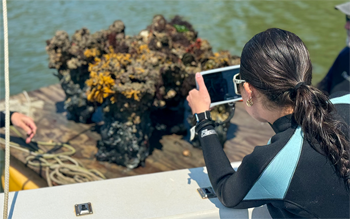
“The idea was actually based on coral reef restoration,” Hoang stated. “This whole process has been mostly self-taught. I started with a 3D scanner from the Swem Library at William & Mary. It was a lot of trial and error, but I think it’s worth it.”
Hoang, who currently works in Seitz’s lab, uses 3D scanning to analyze changes in oyster growth over a period of several weeks, allowing her to observe differences in survival rates among oyster spat in real time without disturbing the restored reef structures. The data helps researchers better understand the ecosystem services these reefs promote, as well as threats from potential competitors, like barnacles.
“The big thing is that it’s not destructive,” Hoang said. “So, it’s a new, non-invasive way to look at growth over time without compromising the integrity of an actual restored reef.”
What also makes 3D scanning an ideal method for Hoang is its potential to engage with the public.
“I really like 3D scanning because it creates models that are colorful, digital and realistic,” Hoang said. “It’s another way for scientists to reach the public and make visualizing restoration more accessible.”
Another novel modeling method referred to as a “particle-tracking model” is being used to track and analyze oyster populations across much larger geographic areas. Developed by VIMS & Batten School Professor Jian Shen M.A. ’93, Ph.D. ’96 alongside Lipcius and other collaborators, this model analyzes the network of local oyster beds and simulates how their larvae drift through Chesapeake Bay waterways.
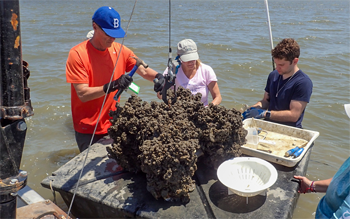
“The particle-tracking model represents oyster larvae as particles and simulates their movement under varying hydrodynamic conditions to predict when and where larvae are likely to settle,” Shen explained.
The model accounts for changes in water conditions, including freshwater inflows, wind, heat and salinity, to estimate where larvae are likely to travel and settle in the bay.
“The connectivity estimates gained from the model provide critical information for identifying suitable sites for oyster restoration and assessing the effectiveness of restoration strategies,” Shen said.
Restoring more than oysters
The benefits of successful oyster restoration extend well beyond rebuilding oyster populations. As oysters colonize artificial reefs, they create habitats that support entire communities of marine organisms, transforming otherwise unstructured bottom habitats into productive ecosystems.
In Lynnhaven Bay, researchers have witnessed a 250-fold improvement in secondary production, which is the growth of additional organisms living on the reefs, such as worms, clams and crabs. However, that value does not include transient organisms that pass through the site, such as diamondback terrapins, who also benefit from life-abundant reefs.
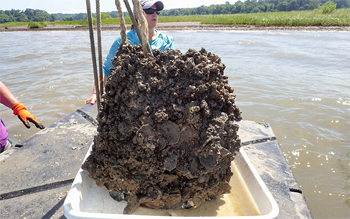
“With the reef balls, we’ve gone a step past restoration, which is ecosystem services in terms of fish and crab habitat, because these reefs form a very architecturally complex system,” said Lipcius.
Alongside increasing secondary production, the reef balls have been observed to act as vital nurseries for numerous species that support Virginia’s commercial and recreational fisheries. Researchers have documented black sea bass using the reef ball system as a nursery habitat, while species such as sheepshead, red drum and black drum visit the reefs to forage for food.
“The recreational fishers in Lynnhaven Bay know that fish like black sea bass hang around these reef balls,” Lipcius said. “They’re all out there fishing around the reef balls.”
Oysters filter out particles from the water, contributing to higher water quality and potentially improving conditions for other marine life. It’s a difference local residents have noticed since the implementation of artificial reefs.
Russell Burke Ph.D. ’10, a professor at Christopher Newport University who studied oyster restoration under Lipcius and continues to collaborate with VIMS researchers, has witnessed how these changes resonate with local communities.
“We met with watermen, some of whom were in their 60s and 70s, and they’re like, ‘We haven’t been able to see nine, ten feet down in the water like this since we were children,’” Burke said. “It’s been those types of declarations and observations that have continue to fuel our passion and enthusiasm.”
Writing the next chapter of restoration
The continued success of these projects has allowed VIMS & Batten School researchers to apply their restoration efforts to other waterways.
In Tangier and Pocomoke Sounds, the scientists have completed metapopulation modeling that is helping guide a major USACE restoration initiative. Rather than evaluating each reef independently, the models examine how oyster populations throughout the region are connected by the movement of larvae. The goal is identifying locations where restored sanctuary reefs can replenish their own populations while also supplying larvae to other reefs, including areas designated for commercial oyster harvesting.
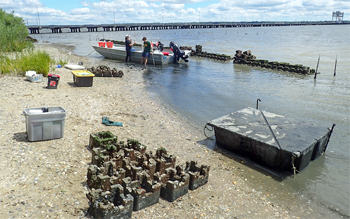
“Using our modeling, the Army Corps are trying a new system where it’s a win-win for the reefs and for harvesting,” Lipcius explained.
This new strategy would also protect oysters from human impacts, such as oil spills, by establishing “stepping-stone” reefs that allow for increased travel of oyster larvae between reefs. If neighboring populations remain healthy, larvae moving through the network could help damaged reefs recover.
“Currently, all of the oyster populations are separated because of currents,” said Lipcius. “But if there were to be reefs in the middle that serve as stepping-stones between each other, oyster larvae can go from one reef to another after a disturbance before returning back to their initial reef once it’s recovered.”
The stepping-stone project at Tangier Island, guided by the new metapopulation modeling, is set to be the world’s largest linked oyster sanctuary-harvest ground, with upwards of $100 million allocated for its construction. VIMS researchers are also collaborating with the Maryland Department of Natural Resources on additional modeling work, while a potential expansion of the approach to oyster populations throughout Virginia has been discussed with the Virginia Secretary of Natural and Historic Resources.
These major collaborations represent a significant evolution in restoration science, as well as the important role VIMS researchers play as they continue to make critical discoveries and provide invaluable advisory services at the national, state and local levels.
What began with identifying the conditions necessary for individual oyster reefs to survive has expanded into research on how reef design, ecosystem productivity and population connectivity can contribute to the recovery of oysters across the Chesapeake Bay. From testing various reef substrates to pioneering new models for monitoring and prediction, VIMS researchers remain committed to helping establish resilient, sustainable reefs that benefit Virginia’s oyster populations, marine fisheries and coastal communities for generations to come.