
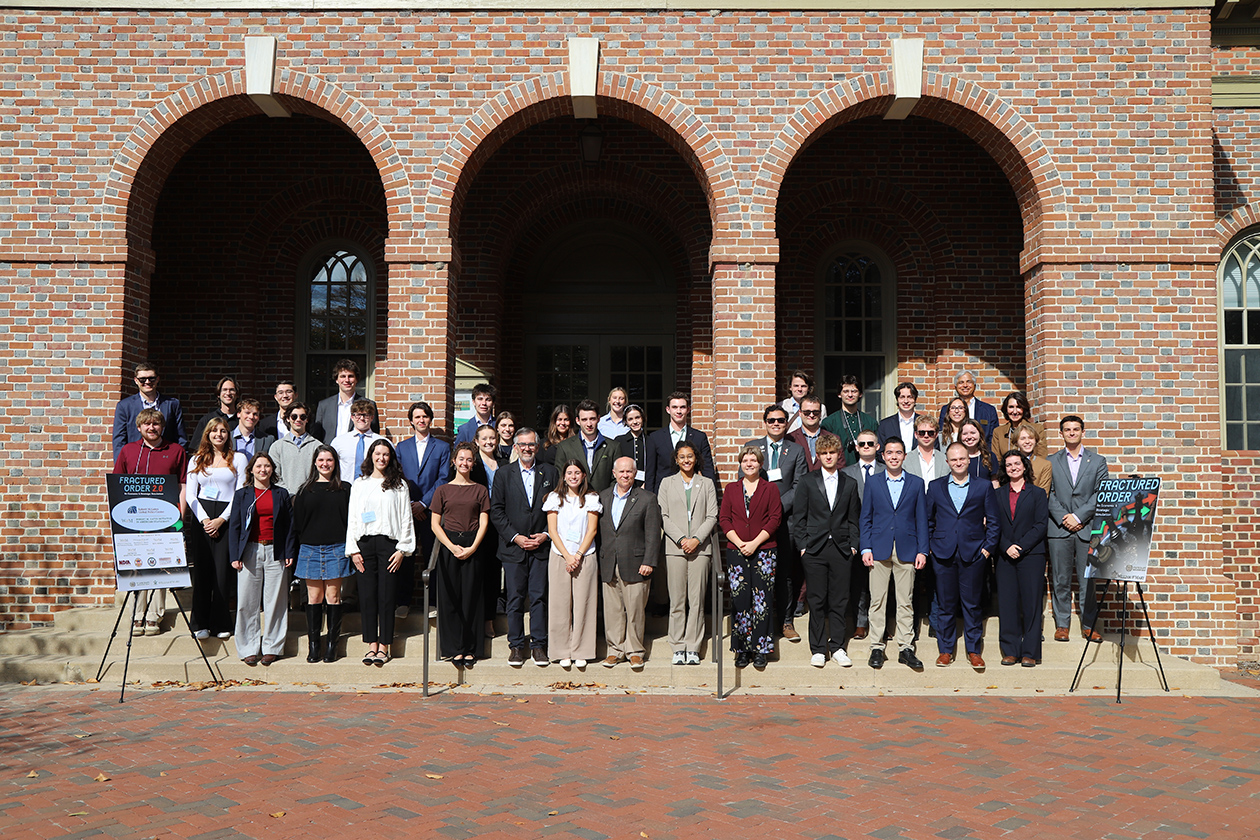
The year is 2027. A U.S.-China trade agreement is about to expire, and leaders in Washington are divided over how to respond. These are the conditions students walked into on Oct. 30 when they participated in William & Mary’s flagship statecraft simulation, Fractured Order 2.0.
Role-playing as policymakers, business and international leaders, students were immersed in a simulated future defined by strategic competition between the United States and the People’s Republic of China. Over two days in late October, they were tasked with making decisions using non-military tools of power — imposing sanctions, controlling exports or developing diplomatic initiatives, for example — under the same constraints real-world decision-makers face.
Organized by William & Mary’s Statecraft Simulations Group, part of the Robert M. Gates Initiative in American Statecraft and supported by the Robert M. Gates Global Policy Center, Fractured Order 2.0 brought students, faculty and professionals working in business, government and national security to Tucker Hall. Academic departments across the university and the Center for Geospatial Analysis were also partners for the event.
The seeds of this effort were sown at the university’s Global Research Institute — an applied research incubator and accelerator. The Geopolitics of Technology Initiative, a student-run research organization under GRI, helped to develop and facilitate the first simulations exploring the non-military tools of U.S. foreign policy.
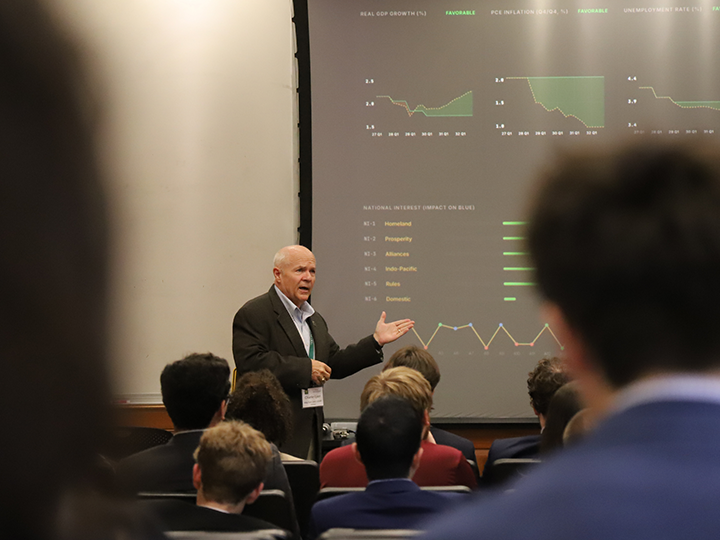
This game was directed by retired Air Force Maj. Gen. Charles Lyon, an adjunct professor of government who leads the Statecraft Simulations Group and has more than 30 years of wargaming experience.
“For the students who are participating in the game, the objective is to help them understand, in this abstraction, how the U.S. government operates, how other nations operate, how our competitors operate, how our business partners operate and the pressures that members of the U.S. government are under,” Lyon said.
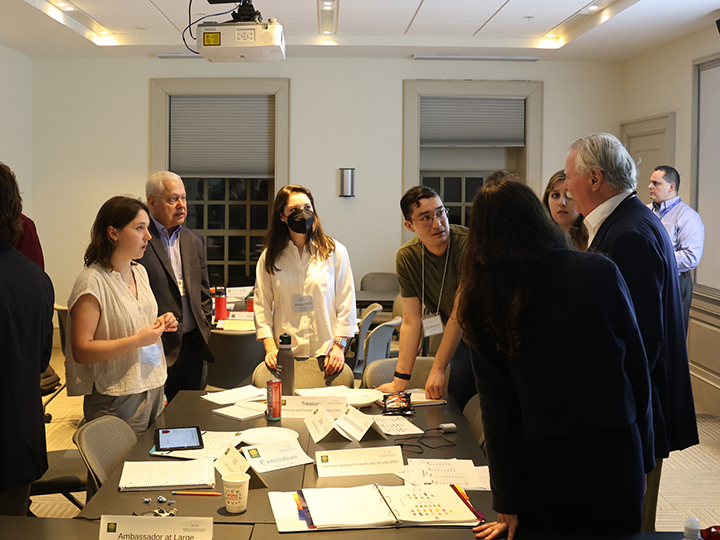
Students from a range of academic disciplines applied to be players in this tabletop exercise, and the selected participants were organized into teams representing different actors in the global scenario. The U.S. team had members representing the executive and legislative branches, while the opposing team represented China and Russia. Eight students role-played as different nations in the Green Cell, while three took on corporate executive roles in the Business Cell. A fifth group, the White Cell, monitored the proceedings and adjudicated the teams’ decisions.
For years, wargaming has been used by military planners to prepare for conflict, but Professor Eric Brown, a director of the Gates Initiative, argued that the same methods could be applied to diplomacy and economic policy to help decision-makers think through challenges before they escalate.
“Why can’t we use these games to develop new concepts, new doctrines, through which we can better use our non-military instruments of power?” he said at the game’s opening session.
Learning by doing
The game’s design intentionally placed participants in situations where they might not have expertise, challenging them to learn quickly and consider perspectives beyond their own.
Beth Kester ‘27, a history major, represented a telecommunications CEO in the business cell. Despite having no business background, she said she quickly immersed herself.
“It was very stressful, but a good kind of stress that keeps me just totally keyed in,” she said. “I have no business experience, but I found that this was such a great way to learn.”
For Dylan Burkhardt ‘27, an international relations major assigned to the legislative branch of the Blue Cell, being inexperienced was an important part of the experience. Just as legislators are not expected to be experts on every issue they face, she said, players were not expected to have in-depth knowledge of every topic in the simulation.
“It can be daunting to take on a subject matter or playing a role that you feel you’re not an expert in, but that’s very much an intentional choice of the game design,” she said.
Having studied the purpose, design and analysis of wargames in Lyon’s Wargaming and Strategic Analysis course, Burkhardt saw the simulation as an opportunity to put those concepts into practice.
“The application of those lessons was the best environment to learn much more than I could in class,” she said.
Making moves
The simulation progressed through a series of “moves,” or rounds of decision-making. The first move lets teams establish their strategic positions. In the following three moves, participants developed and submitted proposals, negotiated with other groups and responded to changing circumstances. Each move represented approximately two years, mirroring the U.S. government’s legislative cycle.
Actions were submitted through PLENUM, a digital platform developed by Sethu Nguna, AidData’s Training and Instructional Design Manager, and students for the simulation. After each move, the White Cell evaluated the submissions and returned the simulated consequences to the teams, shaping the decisions they would make next.
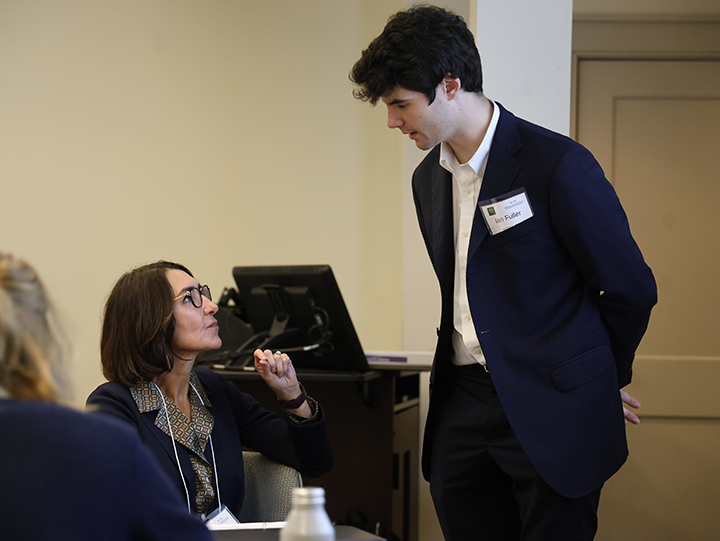
In each room, students were supported by facilitators and mentors who helped them work through their decisions. While facilitators managed the clock, procedures and submissions, mentors challenged students’ thinking and helped them understand the practical implications of their proposed actions.
Burkhardt said her team’s mentor, Michael Butler, an adjunct professor of history and retired U.S. Foreign Service officer, helped her team consider alternative courses of action and anticipate consequences they might otherwise have overlooked.
“It was extremely helpful to have professionals in the room with us during gameplay,” she said.
Kismet Toksu, an executive partner at William & Mary’s Raymond A. Mason School of Business and president of Candor Consulting, facilitated the Business Cell. She said she was impressed by how quickly students absorbed information and embraced the challenges presented to them.
“I was surprised at how thoughtful and how enthusiastically they embraced the challenge that was in front of them,” she said.
‘Building a capability’ at William & Mary
Students were not only participants in the simulation; they also helped design and build the tools that made it possible. Ben Petrihos ‘27, a fellow of the simulation group, led the White Cell and developed the modeling system used to evaluate participants’ decisions.
Drawing on his data science background and working with faculty, he developed the Petrihos Lever Index, which runs a cell’s submitted actions through a system of economic and national interest models to assess their potential effects.
Twenty-one other undergraduate students make up the rest of the simulation group. They all held various game-day control positions, including as facilitator assistants, scribes and analysts. Throughout the semester, they met weekly in teams to develop guides for facilitators, country briefs, videos, maps and the narrative that provided context for the game.
Petrihos hopes the simulation group will continue expanding its connections with government and industry to help policymakers better understand the consequences of their decisions. For students, he said, the simulation is another opportunity to engage with the people and institutions shaping national security policy.
“I think it’s really good for students just to learn by osmosis,” he said. “And just to sit in rooms with sitting government officials and professionals, and to know how things work in government, how to conduct yourself in a room, and really the stakes of national security policy.”
At the conclusion of the game — which saw the U.S. team achieve many of their strategic objectives — students walked away feeling accomplished and confident. Kester said she valued not only seeing the consequences of her decisions unfold, but also gaining confidence in her ability to make decisions under pressure, thanks to encouragement from mentors and facilitators.
“It’s really satisfying to have information and to act on it and then see a difference afterwards,” she said.
Lyon said he hopes to establish a regular rhythm of simulations as part of a broader effort to establish the university as a place where students and professionals can engage with policy-relevant research on non-military tools of power.
“What we’re doing is building a capability and a capacity here at William & Mary to be able to put on events like this to serve our student body, but also professionals and as a form of public service to the U.S. government and to others in the nation,” he said.
The group plans to host another game in the spring semester that draws on lessons from Fractured 2.0 and incorporates greater participation from policymakers.