
The following story originally appeared on the website for W&M’s VIMS & Batten School. – Ed.
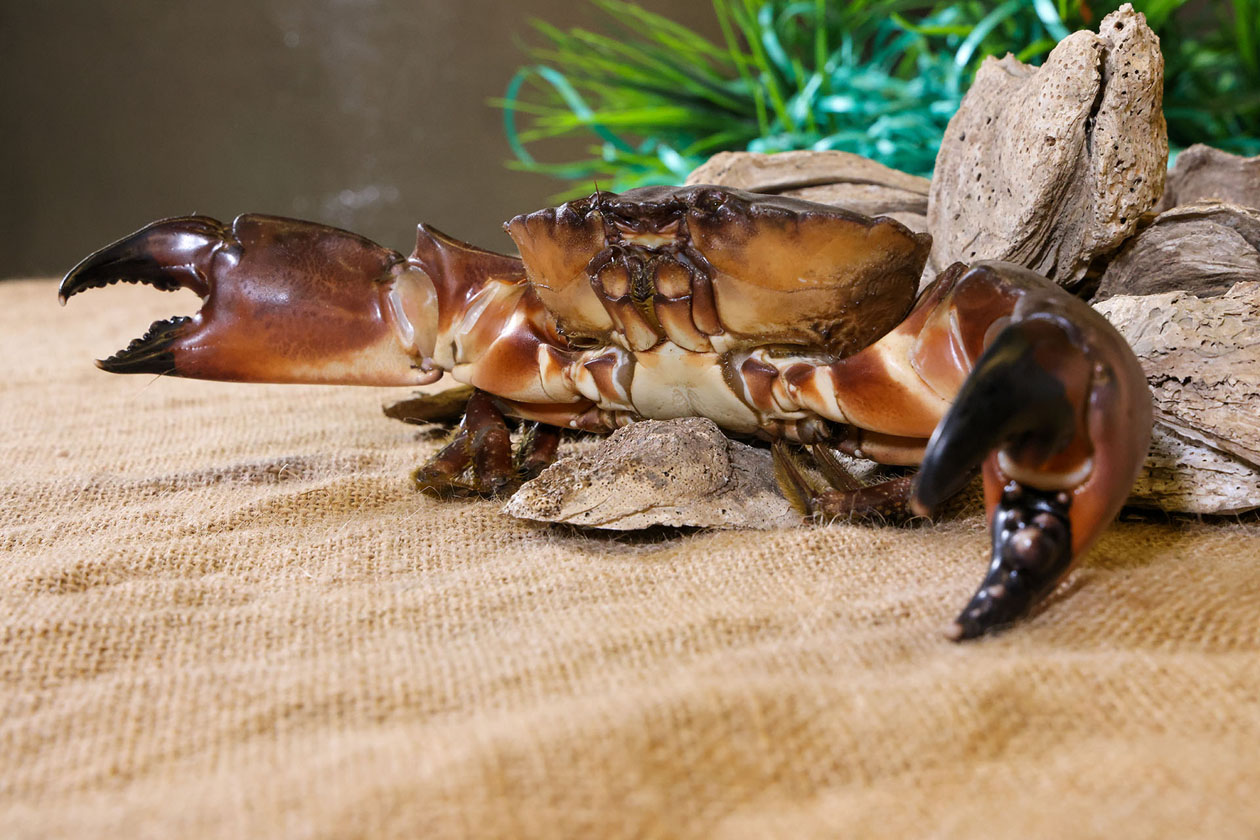
In 2025, a local crabber reached out to Professor Romuald Lipcius with some exciting news: He’d been catching stone crabs in the Chesapeake Bay. Native to Florida, the species had reached its northernmost documented occurrence to date. News got out, and William & Mary’s VIMS & Batten School were flooded with additional sightings from the public. Some were legitimate; many were mistaken identities.
More recently, an egg-bearing stone crab was caught, providing evidence that the crabs aren’t just visitors — they’re reproducing in their new home.
Scientists refer to species expanding their range toward the poles as “climate migrants.” Oceans are warming, and coastal estuaries like the Chesapeake Bay are warming even faster. Water temperature is only one shifting environmental factor, but it is a crucial one, influencing the reproduction and physiology of marine animals.
With broad interdisciplinary expertise and a location on one of the nation’s most ecologically productive estuaries, VIMS & the Batten School are uniquely positioned to understand what these changes mean for marine life.
Turning up the temperature
Warming isn’t occurring uniformly throughout the bay or across seasons, according to research led by former student Kyle Hinson Ph.D. ’23. Since the late 1980s, the bay warmed three to four times faster in the summer than in winter and bottom water temperatures, where hypoxia is of greatest concern, have warmed by approximately 2 degrees Fahrenheit. Hinson and his co-authors in the Biogeochemical Circulation Ocean Modeling program found that atmospheric warming drives nearly 90% of the overall increase, while warming ocean waters play an especially important role near the bay’s mouth.
Marine heatwaves, or periods where water temperatures exceed 90% of the historic seasonal average for at least five consecutive days, are increasing. Piero Mazzini and others in his lab have analyzed decades of data from NOAA’s National Estuarine Research Reserve monitoring stations. Their research suggests the bay could experience marine heatwave conditions for approximately 100 days a year by the end of the century, compared with about 22 today.
Mazzini’s work is helping to redefine our understanding of how heat moves through the water column, offering new classification systems for marine heatwaves and providing a framework for assessing cumulative heat exposure. “Deeper down, the heat is slower to dissipate, and impacts on the surrounding ecosystem aren’t fully known,” he said.
Warmer water holds less oxygen, which makes it likely that additional nutrient reductions will be necessary to offset the impacts of temperature increases on the bay’s seasonal dead zone.
“Fish, and all marine animals, have an upper limit in terms of their ability to adapt to increasing temperatures,” said Angelina Dichiera, a professor at VIMS & the Batten School of Coastal & Marine Sciences and expert in fish physiology. “As temperatures increase, we expect to see winners and losers.”
Dichiera and her students are studying how Chesapeake Bay fishes respond to warming waters and decreasing oxygen. Their research has found differences among species and even among populations of the same species.
“Benthic fishes that stay close to the bottom and do not exert as much energy when feeding may be able to acclimate better to gradual warming, whereas larger, faster-moving predators with higher metabolisms may have a lower tolerance for change and move away from the region,” she said.
The neighborhood is changing
It’s not just animals that are on the move. Eelgrass, an important habitat-forming species, is increasingly giving way to widgeon grass in parts of the bay. Research led by Professor Christopher Patrick’s lab suggests the shift could reverberate through the food web, because eelgrass supports greater animal biomass and larger prey for predators such as fish and blue crabs.
VIMS’ long-running fisheries surveys provide another window into how the bay is changing.
“We’re seeing a bunch more southern species moving into the bay,” said Troy Tuckey, a VIMS fisheries scientist who specializes in juvenile fish populations.
Notable recent catches have included gag grouper, juvenile southern flounder and even a juvenile bonefish. Cobia, red drum and speckled trout have also become increasingly familiar in Virginia waters.
One of the most consequential newcomers isn’t a fish at all. Warmer conditions have helped support a growing white shrimp fishery in Virginia coastal waters that didn’t exist a decade ago. The shrimp also provide a new food source for predators.
“While some new species are showing up in the area, other historically familiar ones are leaving,” said Tuckey. “Summer flounder have shifted their distribution further north, and we rarely encounter winter flounder, which decades ago supported an important fishery.”
Tuckey cautions that climate change is rarely the only explanation. Fishing pressure, habitat, natural population cycles and other environmental factors are also changing. That makes decades of standardized monitoring data especially valuable for distinguishing long-term trends from unusual catches or exceptional years.
Ripple effects throughout the ecosystem
Not all changes are as visible as a cast net full of shrimp.
At the base of the food web, Professor Nicole Millette studies plankton — tiny organisms whose responses to warming can reverberate throughout the ecosystem.
Warmer conditions can favor smaller plankton and certain phytoplankton, including cyanobacteria and dinoflagellates associated with harmful algal blooms. Genetic evidence suggests that Alexandrium monilatum, a harmful algal species that has bloomed in the Chesapeake Bay, originated farther south and gained a foothold here as conditions became more favorable.
Copepods, tiny zooplankton that feed on phytoplankton and in turn become food for fish larvae and other animals, form a critical link in the food web. Changes in their abundance, size or nutritional value can affect how efficiently energy moves up the food web to larger animals. Millette and Dichiera are currently collaborating on research based on this important trophic cascade.
But temperature is only part of the equation. Temperature interacts with oxygen, nutrients, salinity and food availability, making the effects of any one factor difficult to isolate.
“There are so many factors at play at any given time, and they’re all changing,” said Millette. “That’s just part of being in a dynamic, highly eutrophic, temperate estuary like the Chesapeake Bay.”
Those changing conditions also affect parasites and pathogens. Ryan Carnegie, director of the Shellfish Pathology Laboratory, points to Dermo, a major oyster disease caused by the parasite Perkinsus marinus. Warmer temperatures, longer warm seasons and milder winters have increased Dermo activity and helped the parasite expand northward.
Yet “warmer” doesn’t always mean “worse.” QPX, a disease affecting hard clams, is limited by warmer temperatures and could become less prevalent in Virginia as waters warm. At the same time, heat can place additional stress on shellfish, making it harder for them to cope with disease, low oxygen or changing food availability.
Preparing for a different bay
A warmer future won’t simply add a handful of southern species to the Chesapeake Bay. It has the potential to reshape relationships among animals, their food, their habitats and even their diseases. This has consequences for fisheries, aquaculture and the coastal communities that depend on our shared marine resources.
Understanding those changes makes VIMS & the Batten School’s combination of long-term monitoring and experimental research increasingly important. Fisheries surveys can reveal which animals are arriving or disappearing. Physiologists can determine why some species tolerate changing conditions better than others. Plankton ecologists can track changes at the foundation of the food web. Pathologists can identify emerging disease threats. And physical scientists can measure and model the environmental changes driving it all.
White shrimp and stone crabs may be among the bay’s newest residents, but they almost certainly won’t be the last. Understanding what comes next will require watching not only who moves in and out, but how the entire ecosystem changes with them.
Importantly, a changing bay doesn’t necessarily mean a disappearing one. Carnegie points to the resilience already demonstrated by oysters and other shellfish as reason for optimism.
“We shouldn’t just by default go doom and gloom in our expectations,” he said. “For example, oysters have repeatedly demonstrated a remarkable capacity to recover. But the key is to allow the resources to adapt and manage them in a sustainable way.”