
The following story originally appeared on the website for William & Mary’s VIMS & Batten School. – Ed.
Submerged aquatic vegetation (SAV), one of the Chesapeake Bay’s most important indicators of ecosystem health, increased by 7% in 2025, according to researchers at William & Mary’s VIMS & Batten School.
The annual bay-wide aerial survey reported a total of 89,385 acres of underwater grasses in the Chesapeake Bay and its tidal tributaries, an increase of 6,134 acres from 2024. The results represent the highest bay-wide acreage recorded since 2018. The total is just shy of the Chesapeake Bay Watershed Agreement’s 2030 interim goal of 90,000 acres and represents approximately 45% of the 196,600-acre long-term goal.
The results highlight the substantial progress made since underwater grass coverage reached historic lows in the 1980s and the challenges that remain to fully restore one of the bay’s most valuable habitats.
“This year’s survey demonstrates both that we’re moving in the right direction and that there is a lot of complexity in Chesapeake Bay underwater grass communities,” said Christopher J. Patrick, associate professor and director of the SAV Program at VIMS & the Batten School of Coastal & Marine Sciences. “We continue to see strong recovery in the main basin, particularly the saltier portions of the bay, with some setbacks experienced in localized freshwater areas. The mainstem recoveries are particularly encouraging, as they are indicative of watershed-level management yielding positive outcomes.”
Recovery driven by gains in saltier waters
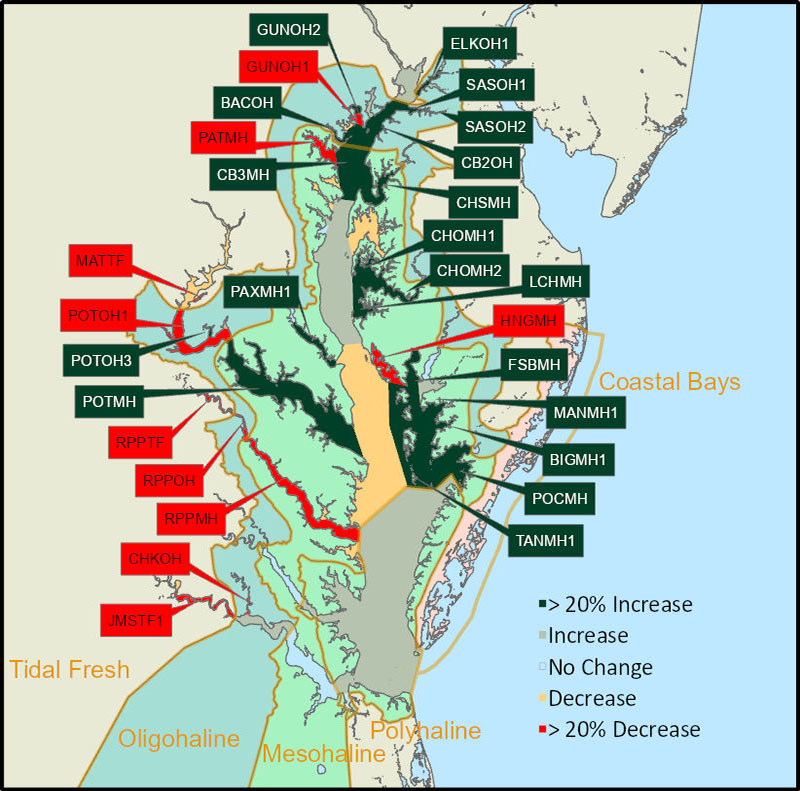
Much of the bay-wide increase was driven by the continued expansion of underwater grass beds in higher-salinity waters. The Polyhaline Zone, which includes the bay’s saltiest waters near its mouth, increased from 25,266 acres in 2024 to an estimated 28,142 acres in 2025, setting a new record for the second consecutive year. The moderately salty Mesohaline Zone expanded nearly 15%, from 33,033 acres in 2024 to an estimated 37,879 acres in 2025.
Researchers attribute much of that growth, and the record-setting expansion of eelgrass, to sustained year-over-year increases in water clarity in the lower bay. Recent work has demonstrated consistent improvements in water quality throughout the entire Chesapeake Bay mainstem over the past several years. The concurrent expansion of eelgrass meadows, both in size and into deeper waters, is consistent with those improvements. Similar processes are likely also driving the expansion of widgeon grass in the middle portion of the bay, which is still recovering from a crash due to exceptionally wet conditions in 2018.
“It’s been remarkable to watch how fast the lower bay meadows are expanding right now,” Patrick said. “It’s another example of how rapidly seagrass can recover when conditions are right and gives us hope that the ultimate seagrass restoration goals for the Chesapeake Bay remain achievable.”
Regional declines underscore ongoing challenges
Despite the overall increase, the survey revealed distinct declines in other portions of the bay.
The Tidal Fresh Zone, a collection of spatially isolated upstream rivers and embayments, experienced a small decline, falling from 20,221 acres to an estimated 18,653 acres. Researchers observed particularly significant losses in several Virginia tributaries, including portions of the upper Rappahannock River. These declines were driven largely by reductions in Hydrilla verticillata, or water thyme, an invasive aquatic plant that has expanded and contracted across multiple river systems in recent years.
The slightly salty Oligohaline Zone remained relatively stable overall at just over 4,700 acres, with gains in several portions of the bay helping to offset losses in other regions.
“The bay is not a single ecosystem but a collection of many distinct habitats,” Patrick said. “Each region responds differently to rainfall, water quality, salinity and other environmental factors and stressors. What we observed this year is a reminder that bay-wide trends are really the sum of many regional stories.”
Researchers say the contrasting patterns highlight the complexity of restoring underwater grasses across a 64,000-square-mile watershed. Geography, land use, rainfall, water clarity and local environmental conditions all influence how underwater grass beds respond from year to year.
SAV impacts ripple through ecosystems
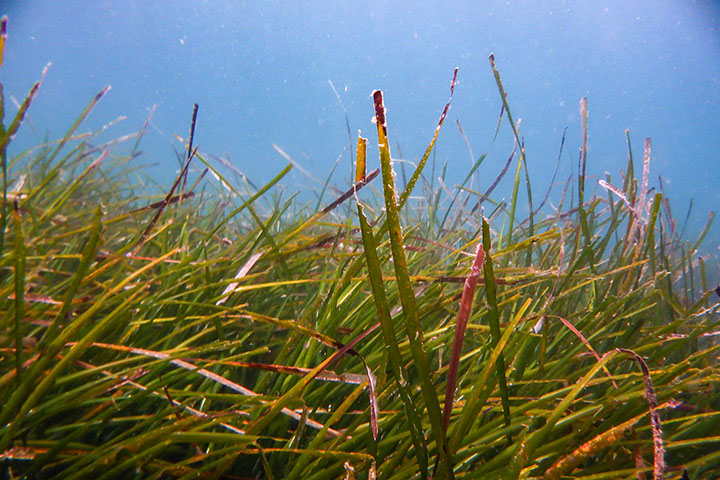
Underwater grasses provide essential habitat for fish, crabs, waterfowl and countless other species. They also improve water quality by absorbing nutrients, stabilizing sediments, reducing shoreline erosion, sequestering carbon and producing oxygen.
Because SAV responds quickly to changes in environmental conditions, scientists consider it one of the most sensitive and informative indicators of overall bay health.
Historical evidence suggests the Chesapeake Bay once supported between 200,000 and 600,000 acres of underwater grasses. By the time systematic monitoring began in 1984, coverage had fallen to approximately 39,000 acres.
Since then, underwater grass abundance has more than doubled, driven in part by nutrient reductions implemented throughout the watershed. The 2025 survey results suggest those investments continue to support recovery, even as climate change, land-use pressures and localized environmental stressors create new challenges.
“We’ve seen that recovery is possible,” Patrick said. “The gains we’ve documented over the last four decades reflect the benefits of cleaner water and sustained restoration efforts. Continuing that progress will require ongoing support of science, habitat conservation and water-quality improvements throughout the watershed.”
For more information about this year’s results, including interactive maps, annual reports and additional survey details, visit the VIMS & Batten School’s SAV Program website. Visit the Chesapeake Bay Program’s website to learn more about SAV restoration goals.