
The following story originally appeared on the website for William & Mary’s School of Computing, Data Sciences & Physics. – Ed.
William & Mary’s School of Computing, Data Sciences & Physics has been selected for a Phase I award through the U.S. Department of Energy’s Genesis Mission, a national initiative designed to accelerate scientific discovery through artificial intelligence.
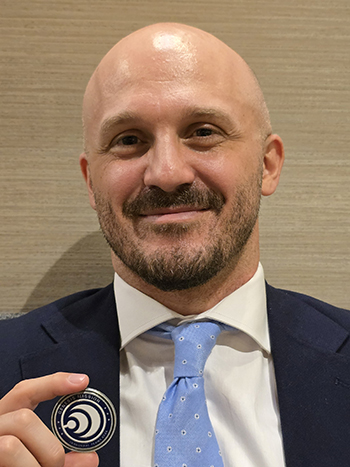
Cristiano Fanelli, associate professor of data science, will serve as principal investigator and lead a team of researchers from William & Mary, Jefferson Lab, Brookhaven National Laboratory and SLAC National Accelerator Laboratory to create a new generation of AI foundation models that could transform how scientists study the fundamental building blocks of matter.
An expert in artificial intelligence for nuclear and particle physics, Fanelli specializes in deep-learning and uncertainty-aware methods for detector modeling and reconstruction, as well as for extracting fundamental physics from experimental data. Last year, he received a prestigious National Science Foundation CAREER Award recognizing his innovative research and leadership in the field.
The DOE Genesis award underscores William & Mary’s growing leadership in harnessing artificial intelligence to accelerate scientific discovery while also highlighting the university’s strong partnerships with the DOE’s national laboratories in tackling some of the nation’s most complex scientific challenges.
Teaching AI to understand the universe
Modern particle physics experiments generate enormous volumes of data as detectors capture the aftermath of high-energy particle collisions. Many traditional analysis workflows process information within individual detector systems before combining into higher-level results.
Fanelli aims to advance beyond that fragmented approach with a single AI foundation model capable of learning from multiple detector systems simultaneously.
“Nuclear and particle physics have traditionally relied on specialized algorithms designed for individual stages of the scientific workflow,” said Fanelli. “Our goal is to develop a unified AI architecture that learns directly from detector-level information across multiple detector systems, capturing correlations before the information is distilled into high-level reconstructed observables. The same adaptable architecture can be fine-tuned for tasks ranging from simulation and reconstruction to noise filtering and can ultimately be transferred across different experiments.”
Inspired by the foundation-model architectures that power modern large language models, the research team will develop a “Mixture-of-Experts” architecture in which specialized AI components learn different aspects of detector data while working together to build a more integrated representation of each particle interaction.
“Large language models have demonstrated the power of a single pretrained model that can be adapted to a wide range of tasks,” explained Fanelli. “We are bringing that same foundation-model paradigm to nuclear and particle physics by developing one of the first models that learns directly from detector-level information across multiple detector systems which can then be adapted to different tasks across the full scientific workflow.”
During Phase I of the project, researchers will demonstrate the approach using data from the GlueX experiment at Jefferson lab. If successful, the framework could ultimately be adapted for next-generation facilities, including the future Electron-Ion Collider being built at Brookhaven National Laboratory, one of the nation’s premier scientific research initiatives.
Advancing AI for scientific discovery
Unlike AI systems designed for a single task, foundation models are built to learn broad patterns from large datasets and then adapt to many different applications. The team’s model will support tasks spanning detector simulation, particle identification, event reconstruction and physics analysis within a unified architecture, potentially improving performance while reducing the time required to develop new AI applications.
“Our ambition is to create an AI system that becomes a common scientific foundation for many different applications. By analyzing detector-level information from multiple detector systems simultaneously, it can make fuller use of correlations across the experiment, potentially leading to better performance,” stated Fanelli. “Researchers could then adapt the same pretrained model to new applications instead of building a new solution from scratch, and even transfer it to other experiments—reducing development time and allowing new ideas to be tested much more quickly.”
The Genesis Mission
The Genesis Mission is a national initiative led by the DOE that aims to build what they describe as the world’s most powerful integrated science discovery platform. By uniting government, industry, academia and philanthropy, the initiative aims to accelerate breakthroughs in energy, scientific discovery and national security through a platform that combines AI, supercomputing, quantum systems, and advanced scientific instruments.
William & Mary’s selection comes from an exceptionally competitive funding process.
According to the DOE, the inaugural Genesis Mission funding opportunity attracted more than 5,000 proposals, with only 278 projects selected for Phase I funding, making it the largest and most competitive response to a funding opportunity in the agency’s history.
Phase I awards are intended to identify promising pathways toward transformative scientific capabilities and establish a foundation for future investment and scale. Research teams will design and demonstrate workflows that integrate AI with scientific investigation while evaluating whether those approaches can accelerate discovery, improve predictive capabilities, enhance experimentation and generate new scientific insights.
“The Genesis Mission aims to build a world-leading AI-enabled platform for scientific research. Just as large language models learn patterns from language, our model will learn patterns from the signals recorded by scientific detectors—helping researchers interpret what nature is telling us and contributing a foundation-model capabilities to that broader platform,” said Fanelli.