
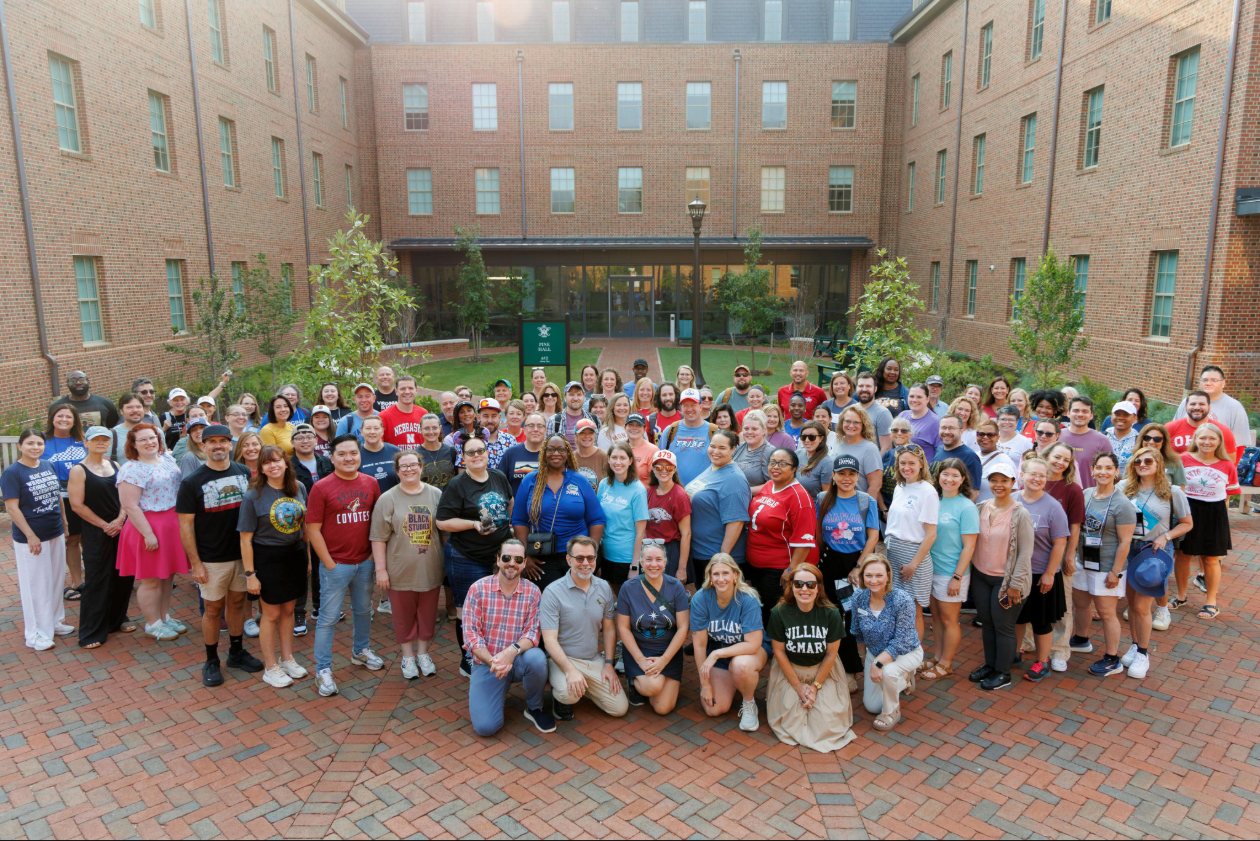
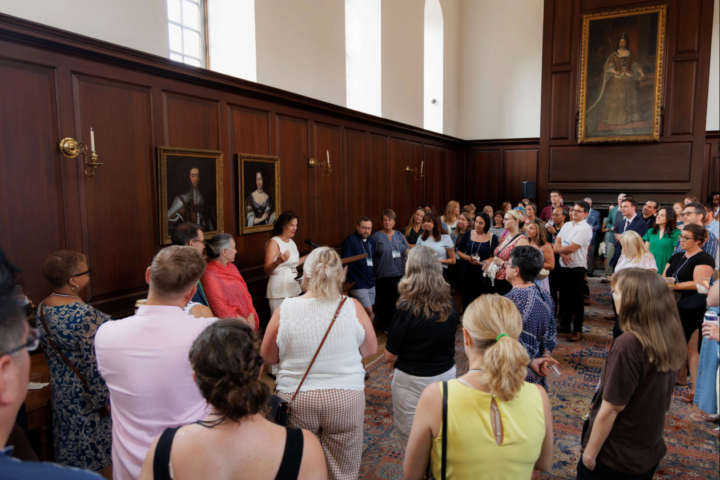
On a Sunday evening in late July, history, civics and social studies teachers stood in the Great Hall of the Wren Building—teachers from Brevig Mission, Alaska, and Memphis, Tennessee; from Honolulu and Las Vegas; from Washington, D.C., and a Department of Defense school in Germany.
The gathering—a cohort of 100 teachers—was the formal welcome to the inaugural Congress of Educators, the centerpiece of We the Teachers: Preparing the Next Generation Through History and Civics, a William & Mary initiative funded by a $2.8 million grant from the U.S. Department of Education.
For Ria Christmas, who teaches World History and African American Experience to high schoolers in Las Vegas, the moment landed with force.
“I stood in the middle of the reception hall at the Wren Building, looking around in awe,” Christmas said. “An Afro-Caribbean woman like myself would’ve been hidden below in the basement, cooking and serving. But that day, I stood in awe with glistening eyes. There I was! Not as a servant, but as a scholar. An educator. I am truly my ancestors’ wildest dreams.”
Led by W&M’s Strategic Cultural Partnerships (SCP) team in collaboration with the National Council for History Education (NCHE), the congress brought educators from all 50 states to Williamsburg for an immersive week of professional learning in American history and civic education timed to the nation’s 250th anniversary.
The congress delivers directly on W&M’s Vision 2026 commitment to expanding democratic engagement—and on the conviction that self-government must be taught.
“William & Mary has convened the important discussions about American democracy since the beginning of the republic,” said Ann Marie Stock, presidential liaison for SCP. “During this Semiquincentennial year, we were thrilled to host the nation’s teachers to learn with us and our partners, to strengthen outcomes for students, and to envision the next 250 years.”
At the start of the week, participants were asked, “What does our journey together look like?”
“We designed this week around a single conviction: that place does something to a teacher that a curriculum alone cannot,” said Mark Hofer, executive director of SCP and director of the project. “You can read about Jamestown. You can teach the founding documents. But standing in those rooms changes what you reach for when you walk back into your own classroom. That’s what we were after.”
By the end of the week, under the theme of Sankofa—the Akan principle of going back to retrieve what matters and carrying it forward—the question had become: “What will we bring back with us?”
The power of place
The answer took shape across the Historic Triangle and beyond. Teachers toured Jamestown Settlement, Colonial Williamsburg and the Virginia Museum of History & Culture, where they spoke to Hasan Kwame Jeffries of Ohio State University and Anthea Hartig of the Smithsonian’s National Museum of American History. Evening lecturers included Declaration of Independence historian Emily Sneff Ph.D. ’24 on how the declaration first reached the public as news.
A single sentence from a Jamestown interpreter—“Complex early America made complex modern America”—reverberated throughout the week.
“That statement challenged me to think differently about how I present history to my students,” said Brittany Knauer, an eighth-grade U.S. History teacher from Texas entering her 17th year. “Rather than looking for simple narratives or easy answers, I want my students to grapple with competing perspectives … and understand how those decisions continue to shape our nation today.”
Teachers as first responders
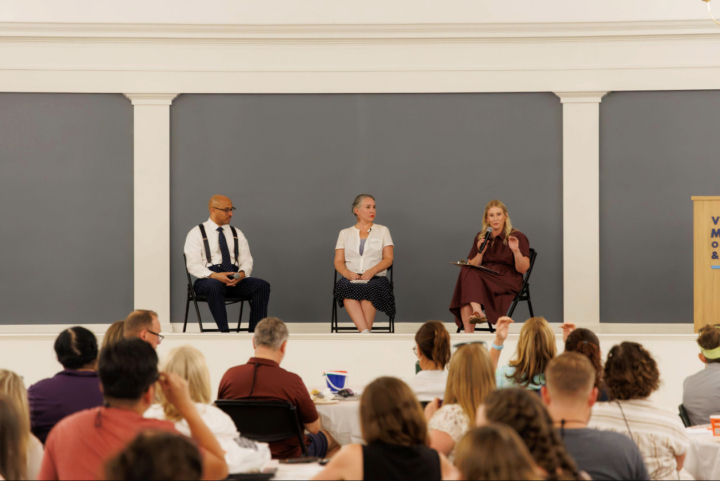
In the closing keynote, “Be the Challenger,” historian Yohuru Williams of the University of St. Thomas called history teachers “first responders”: adults students turn to first when they need to make sense of the world. Democracy, he reminded them—quoting Sandra Day O’Connor, who served as W&M’s 23rd chancellor—is not passed down through the gene pool. It must be taught anew to each generation.
For Bethany Chadwick ’16, a Pennsylvania high school teacher, the phrase named something she already carried. “There may be tragedy, celebration, excitement, joy, grief and everything in between that we address with our students before anyone else,” she said. “We shape the narrative of student learning and perception of the world—not a task we should ever take lightly.”
Building a community to share that burden was a central goal for the NCHE.
“History doesn’t happen in a vacuum, and history teaching doesn’t happen in isolation,” said Jessica Ellison, executive director of the NCHE. “It’s critical for teachers to have a community of practice—colleagues who have a common understanding of what it means to teach history right now. It was such a joy to witness the birth and growth of this community. I can’t wait to see how these teacher delegates continue to support one another from all corners of the country.”
A week that travels home
The congress was built to travel. Before arriving, every delegate completed professional development coursework through lilyPD, W&M’s online learning platform for K–12 educators. After returning home, each delegate is charged with leading a professional development session for at least 15 educators in their own community, turning one week in Williamsburg into roughly 1,500 teachers reached in year one alone.
Two more congresses follow, in Denver in 2027 and Minneapolis in 2028, bringing 300 delegates through the program over the life of the grant. The coursework is open to any teacher in the country through lilyPD, including Educating for the 250th, a microcredential built for the semiquincentennial that extends access to pedagogical skill development broadly. A teacher who never applied to the congress can still take the same courses the delegates did, on their own schedule, for free, with professional development hours certified by the W&M School of Education.
“Over the life of the grant, through leading these convenings, through establishing professional learning communities, and through our digital delivery platform, we anticipate impacting 1 million students,” Hofer said. “At least.”
Delegates repeatedly praised the program’s design, which covered the full cost of attendance—lodging, meals, site fees, and a $2,500 participation stipend—ensuring no teacher was priced out by geography or district budget.
“Most districts can’t afford to send their teachers to events like this,” Chadwick said. “A commitment to funding teachers and treating them as professionals was not lost on me this week.”
What surprised—and affirmed—teachers most, many said, was their camaraderie. “The week with 99 other teachers felt almost like a family reunion of long-lost relatives,” Chadwick said, “people bonded by a common mission, from all walks of life yet with the same mindset and passion for history, civic engagement and civil discourse.”
On Thursday, as the first congress ended, Hofer sent the delegates home with the week’s final question—what will we bring back with us? The delegates, in turn, will spend the coming school year answering that question in a hundred communities across the country.
“Somewhere in my classroom is a student who will never know that I spent a week at We the Teachers,” Knauer said, “but they will experience the difference every day.”