
This story originally appeared on a web page of the College of Arts & Sciences – Ed.
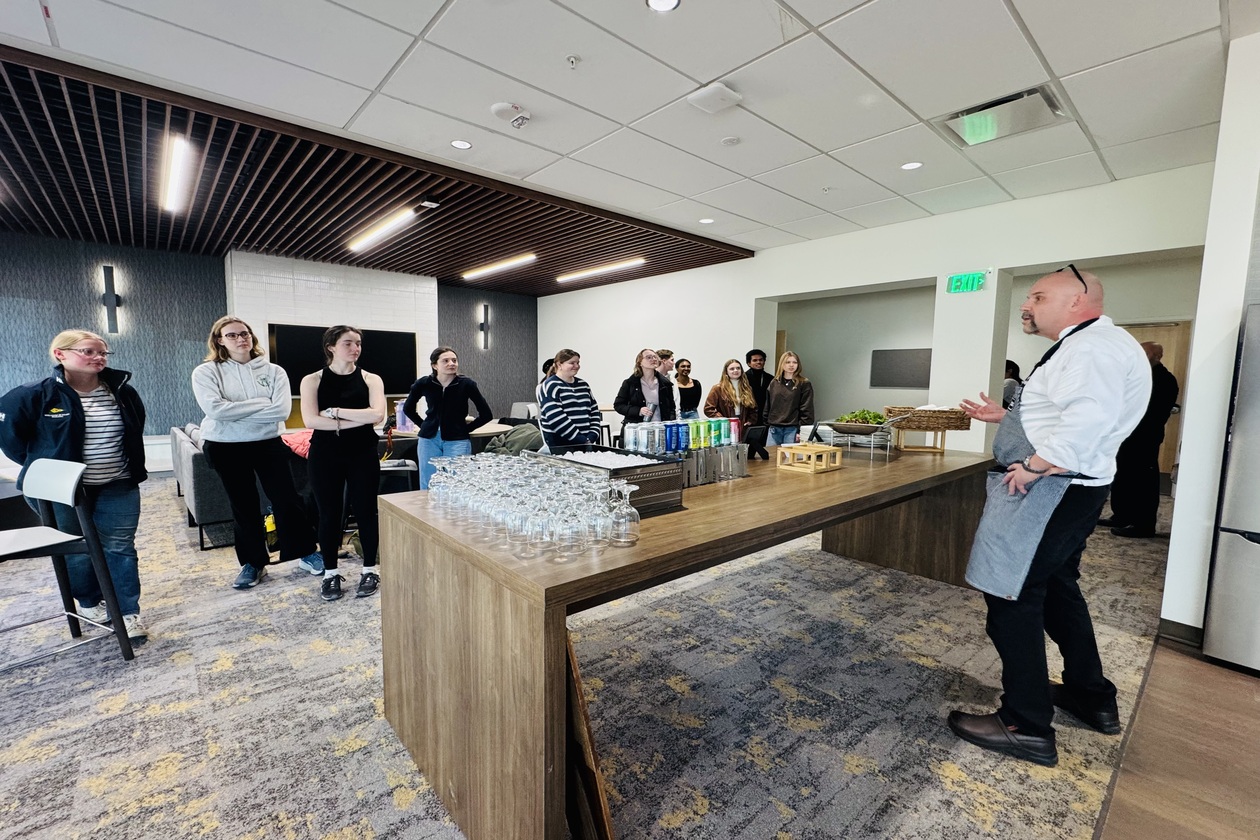
Few things transcend cultural boundaries quite like food. This past semester, students from William & Mary’s French House, one of eight residential language programs on campus, learned that first-hand through a Chef in Residence series, which offered students a chance to explore French culture and cuisine. “Being able to integrate yourself into new cultures starts with food,” said Himani Ravva ’28, whose experience brought a world language deliciously close to home.
“Food is a great medium to bring people together,” said Deborah Lee-Ferrand, professor of French & Francophone studies and one of the creators of the Chef in Residence series. With the goal of building a stronger sense of community among her students, Lee-Ferrand’s COLL 300 course on French and Francophone gastronomy inspired her to create a series inviting chefs to campus.
The idea began with Adam Poling from Aramark Food Services, who contacted Lee-Ferrand to bring it into fruition. Lee-Ferrand partnered with Aramark to have chefs visit the French House. To Lee-Ferrand, programs like this “are not only feeding the students but also feeding the soul of the students.”
“It’s important to have events like this that bring together community members, native speakers and student learners,” Lee-Ferrand said. She noted that Williamsburg’s small size can make it difficult to find authentic French cuisine, making opportunities like the Chef in Residence series especially meaningful. “They help bridge those linguistic gaps and give them an opportunity to practice,” Lee-Ferrand said.
Lee-Ferrand leveraged her own network to find chefs for the series, as well as tapping into Aramark’s contacts. Beyond introducing students to French food, the series created opportunities for students to engage with native speakers, practice the language and experience the culture firsthand.
“The classroom provides the foundation. It builds students’ language skills and cultural knowledge, but programs like the Chef in Residence series transform learning into lived experience,” said Magali Compan, chair of the Modern Languages and Literature department.
Grammar and vocabulary are essential to mastering any new language, Compan said, but the human connection that comes from applied learning experiences takes language learning to a new level.
One visiting chef, Christian Chiron, helped foster a welcoming environment that made students feel comfortable regardless of their language skills, which made a formidable impression on Ravva.
“I can only say so much [French], but [Chiron] was really nice about how I should integrate myself better and how I shouldn’t be afraid to make mistakes,” Ravva said. Students of all language levels were invited to participate, and this mix of students from various classes and French levels was exciting to Lee-Ferrand because it allowed for engaging conversations surrounding French cuisine.
Prior to the event, students learned about food culture in France, including markets, how food is sourced, famous dishes, and the importance of mealtimes and cooking. To prepare, students practiced how to order in a restaurant. Lee-Ferrand saw students who struggled in the classroom become confident after practicing their French with Chiron. This opened her eyes to just how effective hands-on learning is when it comes to experiencing a new language and culture.
To Compan, it’s all about fostering authentic contexts that bring languages to life — a pillar of the Global Village, William & Mary’s residential living-learning community for students pursuing language studies. “The Global Village represents a transformative investment in immersive language learning, creating a place where students can encounter the world without leaving campus,” Compan said.
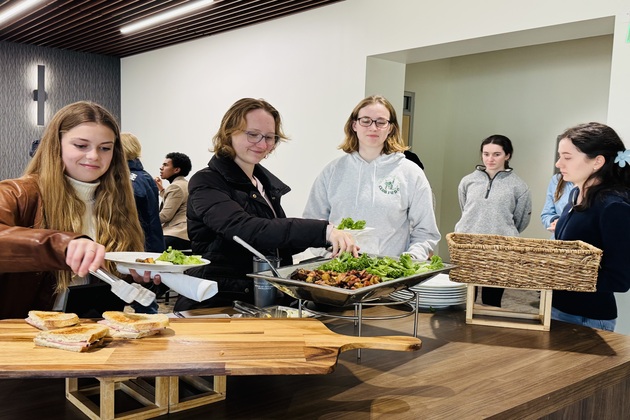
Throughout the demonstration, Chiron prepared a traditional French menu featuring croque-monsieur, a green salad with bacon, grilled onions and hard-boiled eggs, and crepes filled with chocolate ganache and strawberry compote. Phia Bourcier ‘28 emphasized not only how delicious the food was, but how much the experience helped broaden her worldview.
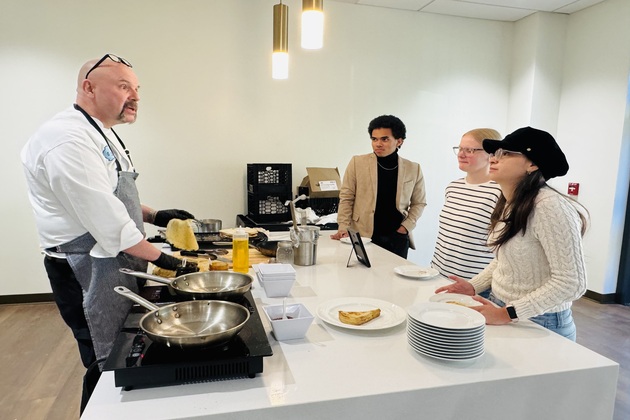
“It was a really good opportunity to learn about the people in my class,” said Bourcier, a double major in marine science and French who participated in the series. “That’s what I like about the French House activities. It humanizes the language and puts names to faces.”
The opportunity to interact with Chiron allowed her to delve more into the cultural aspect of her French studies. “I think the cooking series are my favorite out of all French events,” Bourcier said.
The Chef in Residence series joins a growing number of culinary initiatives at W&M, including the university’s Global Chef program, which also uses food as a gateway to cultural exchange. Compan hopes to see growth in programs like this, especially within the Global Village. “I hope these experiences inspire students to see language and culture as a lifelong pathway to discovery,” Compan said.
After piloting the Chef in Residence series this past year, Lee-Ferrand hopes to expand the collaboration to all eight language houses, likely moving to the Italian House next.
However, in the upcoming academic year, Lee-Ferrand still plans to host more immersive learning events for the French House at their new location in Oak Hall — croissants included.