
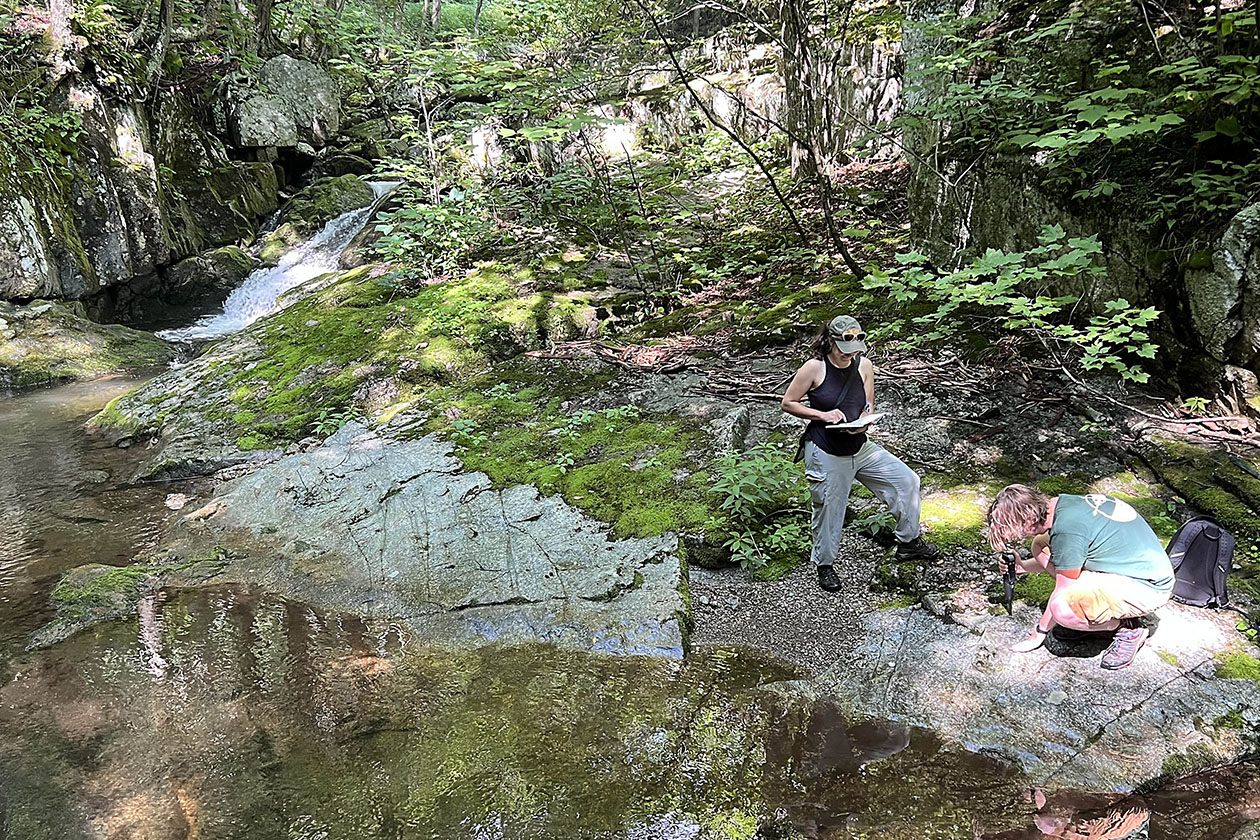
Hike north on the Appalachian Trail and the scenery slowly transforms. Rugged, steep ridgelines in Tennessee and Virginia soften into the broad summits and smooth peaks of Pennsylvania and New Jersey.
According to new research from William & Mary Assistant Professor of Geology Joanmarie Del Vecchio, this contrast speaks to an ancient past. Using climate models of the last Ice Age, her data suggests that temperature patterns from tens of thousands of years ago explain this shift in topography better than modern climate conditions or tectonics.
This research helps to clarify the confusing relationship between climate and erosion.
“It’s tempting to assume that today’s temperature, precipitation, etc., have shaped the landscapes we see,” said Del Vecchio. “And to use the resulting links between climate and erosion to paint a picture of what the Earth looked like in the past. But recent studies show that the statistical relationship between climate and erosion is actually very messy when using modern climate conditions.”
Del Vecchio’s work helps explain this paradox, suggesting that there is a strong relationship between climate and landscape — scientists just need to look further back to find it.
“This research finding isn’t a smoking gun,” she said. “But it’s really good evidence that the Appalachian ridges and valleys we love and live in are the legacy of a climate that disappeared a very long time ago.”
If this cold-climate legacy holds true beyond the Appalachians, as the research suggests, it influences how scientists read the landscape and interpret stories about the Earth’s past.
Published in Geophysical Research Letters, the paper was co-authored with Kinsey Shefelton ’25, a former W&M student, and Del Vecchio’s dissertation advisor from Pennsylvania State University.
Asking hard questions
The confusion surrounding climate’s effect on erosion stems partially from the fact that it’s a very difficult relationship to study. Rock type, orientation and tectonic uplift — the rise of the Earth’s crust caused by deep geological forces — are all powerful influences on erosion.
“The landscape today is like a photograph, a snapshot in time,” said Del Vecchio. “You can see what the scenery looks like now, but unlike a video you can rewind, the snapshot doesn’t tell you how it got here.”

To control for this scientific “noise” and isolate the effects of climate, she turned to the Appalachians, where she’d spent hundreds of hours during her Ph.D. and postdoctoral work.
“The Appalachians are cool to study because you have long ridgelines, made up of the same type of rock, that span multiple states,” said Del Vecchio. “Using these mountains as our ‘living laboratory,’ we identified sites that shared the same bedrock, a very erosion-resistant quartzite.”
To ensure differences in erosion weren’t caused by variations in bedrock structure, Del Vecchio and Shefelton further narrowed their analysis to sites where the quartzite layers were folded and tilted in the exact same way.
“From a scientific rigor standpoint, this is the icing on the cake of our study,” said Del Vecchio. “It was super tricky to find these sites and took Kinsey hundreds of hours. This additional level of experimental control isn’t something I’ve seen other researchers account for.”
Their final 41 sites spanned over 400 miles of latitude, from southwestern Virginia to central Pennsylvania, allowing them to investigate the impacts of the Last Glacial Maximum (LGM), some 25,000 to 19,000 years ago.
“The central Pennsylvanian Appalachians stood right at the edge of the Laurentide Ice Sheet, a massive 2.5-mile-thick glacier that dominated the continent,” said Del Vecchio. “Those mountains existed in what we call a periglacial state — alternating between seasons of freeze and thaw — while the southern Appalachians experienced much warmer temperatures.”
Taking measurements of their chosen sites, Del Vecchio and her collaborators looked for a relationship between different landscape features and climate conditions.
“In the North, we found flatter ridgelines, longer slopes and overall, a smoother, gentler topography. It’s like someone took a spackle knife and flattened everything,” said Del Vecchio. “Whereas our southern sites had sharper peaks and shorter slopes.”
These differences were consistent with freeze-thaw cycles breaking apart, moving and smoothing the northern landscape and were confirmed by statistical analysis.
“When our sites were compared to modern climate conditions, the data was a mess,” said Del Vecchio. “But when run against models of climate conditions during the LGM, a much clearer picture emerged.”
The imprints of an ancient climate
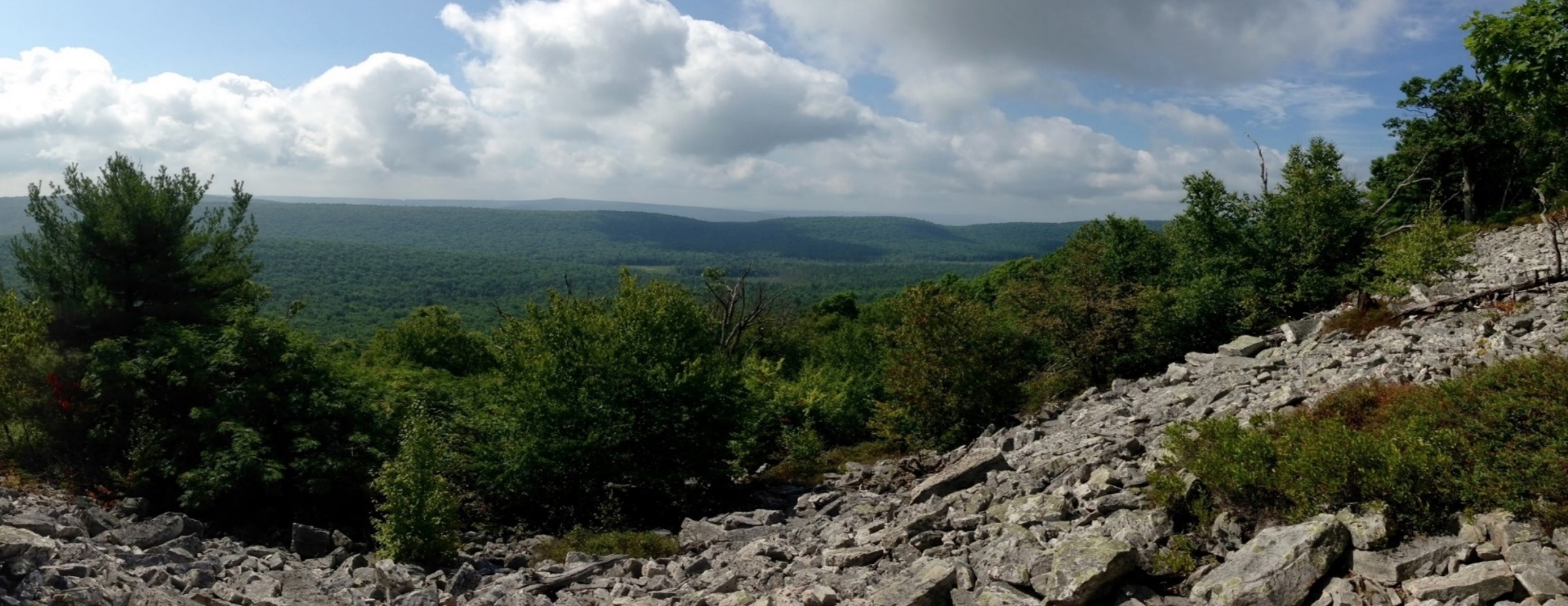
Del Vecchio’s findings warn against an oversimplified view of climate-erosion processes.
“We can’t look at the landscapes we have today and assume they’re the products of a modern climate,” she said. “Beyond the Appalachians many regions may have been shaped by previous glaciations that occurred many years ago.”
This shifts the balance of climate-erosion theory, identifying time as a critical component. It also shows that cold climates can robustly erode landscapes, even without steep slopes, which are typically associated with warm-weather erosion.
“Our research argues that cold climates aren’t dead and boring. Their cycles of freezing and thawing are actually very dynamic, moving around a lot of material,” she said. “The more we study the impact of cold, the better we’ll understand erosion and its relationship to climate — and as our planet warms, that understanding will be essential for making accurate predictions for the future.”
Del Vecchio hopes her findings will help local communities as well as climatologists.
“Because of this thawed permafrost, filling in every nook and cranny and flattening and smoothing the landscape, you have now created super stable hillsides in the north,” she said. “Whereas the same rock in the south, that didn’t undergo that smoothing, might respond to heavy rain with landslides and slope failures.”
Hazard prediction is an angle Del Vecchio plans to investigate in future studies.
Catherine Tyson, Communications Specialist