
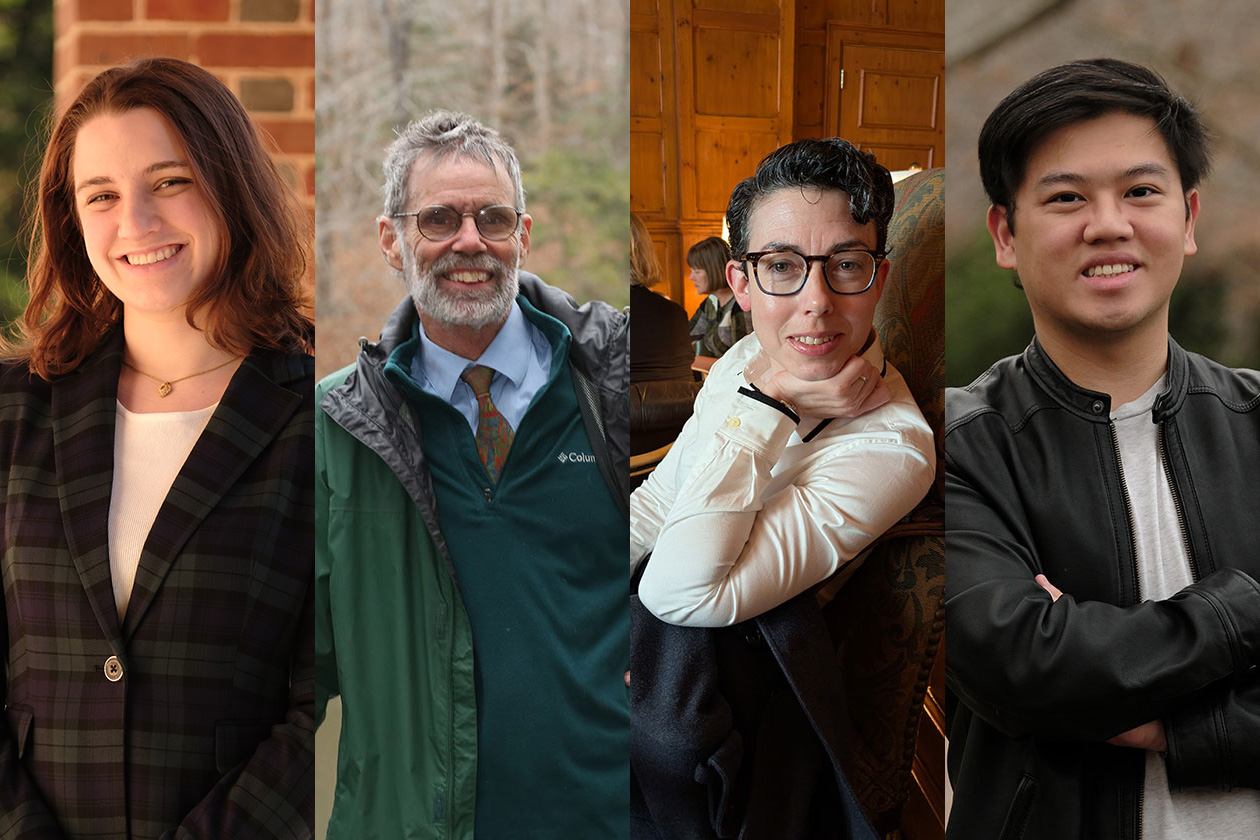
Two students and two faculty members will be recognized at William & Mary’s Charter Day ceremony on Feb. 6 for their outstanding achievements and contributions to the community.
This year’s honorees are:
- Thomas Jefferson Award: Professor of Biology Randolph “Randy” Chambers
- Thomas Jefferson Teaching Award: Associate Professor of English Jennifer Lorden
- Thomas Jefferson Prize in Natural Philosophy: Kate Carline ’26
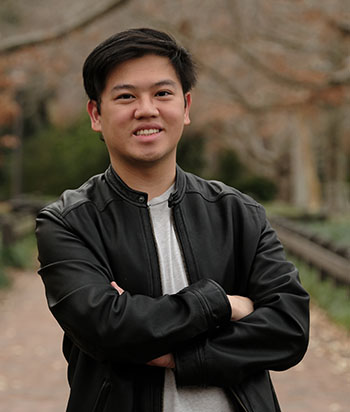
- James Monroe Prize in Civic Leadership: Jason Zheng ’26
In addition to being recognized during Charter Day, they will be celebrated during a special ceremony on Jan. 30 at 4 p.m. in Miller Hall’s Brinkley Commons. That event will also include an announcement about this year’s Plumeri Award recipients.
Thomas Jefferson Award
For his unwavering service and outstanding contributions to William & Mary, Professor of Biology Randolph “Randy” Chambers will receive the 2026 Thomas Jefferson Award — the highest award a W&M faculty member can receive.
In over two decades at the university, he’s built a reputation as a gifted pedagogue, passionate scientist and trusted colleague. But he’s best known for his transformative impact on environmental studies at W&M and unfailing efforts to steward and study the place the university calls home.
“As William & Mary concludes the Year of the Environment, it seems fitting that the person to receive this award has spent the last 25 years studying, educating about and fiercely protecting our local environment,” wrote Biology Professor Helen Murphy and Biology Professor and Department Chair Matthias Leu in their nomination letter.
“Randy has helped the campus of W&M become a living laboratory — a site for high-impact environmental research and for excellent teaching. He is the bedrock of environmental studies,” wrote colleagues Dan Cristol and John Swaddle.
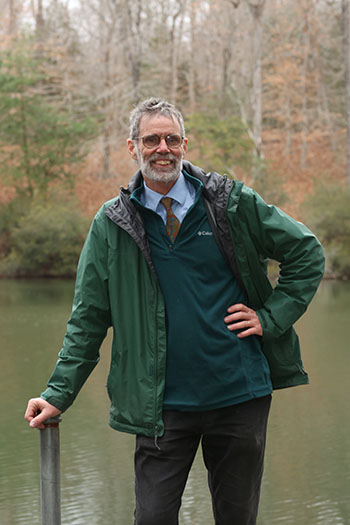
Chambers has taught more than 2,200 students, authored 62 articles and eight book chapters and received more than $1 million in grant funding as a scientist for W&M Biology and the Batten School of Coastal & Marine Sciences & VIMS. But it’s his day-to-day service, often through unglamorous tasks and behind-the-scenes projects, that has earned him this award.
“Randy isn’t driven to serve by a want for recognition, but rather because he has an incredibly creative, kind and generous spirit and wants what’s best for his colleagues, students and the local environment,” said Murphy and Leu.
Central to Chambers’ service has been his leadership as director of the Keck Environmental Field Laboratory, a role he began in 2001. Located on the banks of Lake Matoaka, the Keck Lab serves as a home for experiential learning, bringing environmental science to life for thousands of students.
“For the past 24 years, Randy has been at the helm of the Keck Lab, welcoming faculty, students, community members and anyone else who wants to learn about the local flora, fauna and our amazing Chesapeake Bay watershed,” wrote Murphy and Leu. “He makes everyone feel like they belong.”
Chambers’ leadership of the Keck Lab has helped put W&M on the map for environmental science. In 2003, he secured and led a prestigious National Science Foundation Research Experience for Undergraduates program at the lab. The program brought students from across the country to W&M for 10 weeks of rigorous research each summer for five years.
He has used the lab to spearhead several long-standing data collection efforts, monitoring the quality of the local watershed “simply because he thinks it’s important” and providing the public access to this data, according to nominators. He also helped erect a weather station on Lake Matoaka that has continuously collected data since 2003. It has recorded over one million measurements.
A widely respected researcher, Chambers’ projects reflect a deep sense of responsibility to the natural world, whether he’s working to protect terrapins, combating coastal erosion or monitoring soil quality for the Florida Coastal Everglades Long-Term Ecological Research team.
Chambers has led multiple Green Fee grants, funds that support environmental and sustainability projects on W&M’s campus. His projects include constructing beehives to building a ramp to aid animals navigating under Jamestown Road.
A founding faculty member of W&M’s Environment & Sustainability Program (ENSP), Chambers has helped it grow significantly, serving as its former director and on its executive committee since 2004.
“Randy shepherded ENSP from its initial stages as a small cluster of faculty mentoring a handful of students in self-designed environmental majors to what it is today, graduating over 40 majors annually,” wrote nominators and past and current ENSP directors James Kaste and Brent Kaup.
He’s known for his incredible generosity, serving on dozens of boards and committees and mentoring countless students. A gifted teacher and scientific communicator, his classes are highly sought after, and he’s remembered by his students for his dynamic and captivating lectures.
“He is beloved among students and for very good reasons,” wrote Cristol and Swaddle. “His gentle humor and encouraging words are accompanied by intellectual rigor that pushes students to new heights.”
For his outstanding teaching and research, he has received two Plumeri Awards for Faculty Excellence. Still, Chambers was surprised to receive the Thomas Jefferson Award.
“It’s like someone dropped a meteor in my lap,” he said. “I couldn’t believe they’d chosen me. I was on the verge of tears when I found out.”
For his nominators, the award couldn’t be more appropriate, honoring a person who has left an indelible mark on William & Mary and generations of students.
“Randy is the colleague other faculty aspire to be: principled, generous with his time and genuinely invested in the success of others,” wrote Kirk Havens, director of the Center for Coastal Resources Management at the Virginia Institute of Marine Science and a professor at the Batten School of Coastal & Marine Science. “He epitomizes the teacher, scholar and citizen ideal that this award celebrates.”
Thomas Jefferson Teaching Award
Old English — a Germanic language dating from the seventh century — is notoriously difficult. Radically different from contemporary English, it’s essentially a foreign language to modern speakers. Yet in Associate Professor Jennifer Lorden’s classes, students are not just learning it, they’re loving it.
“In her fervor for building appreciation for the language and literature, she utilizes a unique combination of humor and encouragement to get the entire class to read Old English aloud and translate on the spot – and to enjoy doing so,” said Abigail Cagle, ’26. “She is the best professor I have ever had.”
For her ability to transform a daunting subject into a source of joy and the ways in which she melds her own deep research with student instruction, Lorden will be awarded the 2026 Thomas Jefferson Teaching Award.
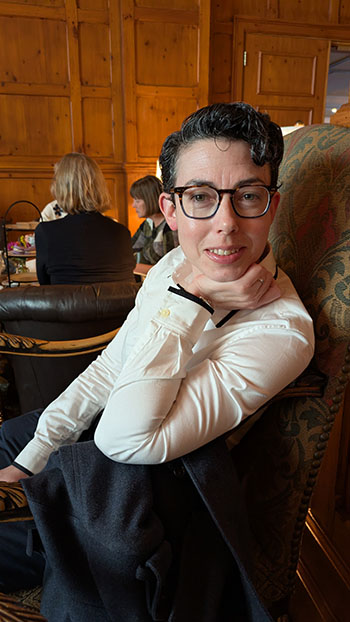
Since Lorden’s arrival at William & Mary in 2019, she has achieved a feat rarely seen in English departments: she has tripled the enrollment in her “Beowulf” classes. She received tenure in 2025.
“Professor Lorden is, by all counts, one of the most impressive tenure candidates, perhaps the most impressive, our department has seen in the past forty years,” wrote Adam Potkay, William R. Kenan, Jr. Professor of Humanities & English, in a nomination letter.
Lorden’s teaching scores confirm her success. “Across the 22 courses she has taught since 2019, students have consistently rated her at 4.70 or higher on a 5-point scale,” wrote Arthur Knight, chair of the English department. “This is particularly notable given that her courses are rigorous, requiring daily translation practice and extensive memorization.”
Colleagues and students describe Lorden as the model “scholar-teacher.” She connects her deep research — including her 2023 book “Forms of Devotion in Early English Poetry” — to a courseload that ranges from Old English Love Stories to Medieval America, a class examining the uses of medieval imagery in U.S. history.
She read “Beowulf” herself for the first time in a high school English class – but only the fight scenes were assigned. “I was stubborn and got the whole book to read the rest. It turned out the fight scenes were the least important part of it,” she said. It wasn’t long after that she was standing outside the gym with friends when she had a vision of herself in an office lined with books. “I said out loud, ‘I think I want to be an English professor.’ As soon as I said it, it felt so right.”
She earned a bachelor’s degree in English from Westmont College, an MSt from the University of Oxford, and a doctorate in English and medieval studies from the University of California-Berkeley. She is working on her third book.
Students say it is the atmosphere she establishes in the classroom that truly sets her apart. They describe her teaching style as a unique blend of “whimsy and absurdity” that cultivates camaraderie.
“She uses a combination of wit and insight to inspire students to whole-heartedly appreciate Old English poetry,” said Cagle, who has taken three courses with Lorden. “Professor Lorden has unquestionably inspired the most enthusiastic foreign language reading and translation I have ever seen in a classroom.”
“I do think that having fun is really important,” Lorden said.
For Hunter Phillips ’22, Lorden’s mentorship completely altered his professional trajectory. Originally intent on law school, Phillips is now a doctoral candidate in English at Cornell University.
“It was through Dr. Lorden’s welcoming and intellectually stimulating courses that I discovered a deep passion for literature,” Phillips wrote in a nomination letter. “I owe so much, if not everything, in my current professional career to Dr. Lorden’s teaching, mentorship, professionalism, and above all, kindness.”
In addition to the Jefferson Prize, Lorden previously received the 2025 William & Mary Alumni Association’s Faculty Fellowship Award and the 2024-25 PBK Award for the Advancement of Scholarship from the Alpha of Virginia Chapter of Phi Beta Kappa.
Thomas Jefferson Prize in Natural Philosophy
To Kate Carline ’26, science is not just a personal calling, but a powerful tool to help communities. A double major in biology and public policy, she has focused her time at William & Mary researching bacteriophages, a group of viruses that can evolve with and infect bacteria. She aims to engineer phages to benefit human and environmental health, from combating antibiotic resistance to fixing soil pollution.
For her work, Carline will be this year’s recipient of the Thomas Jefferson Prize in Natural Philosophy, which is awarded to an exceptional undergraduate student. The prize recognizes excellence in the sciences and honors the relationship between Jefferson and his William & Mary tutor in mathematics and natural sciences, Professor William Small.
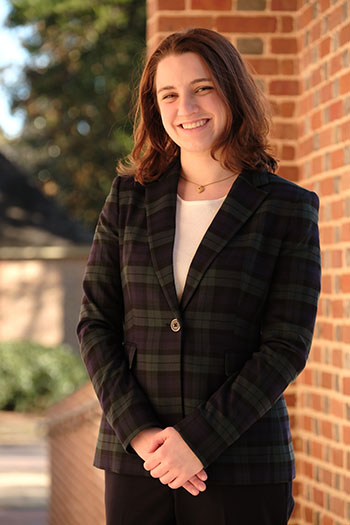
Carline is extraordinary in her drive throughout higher education, applying to various scholarships and proving her capability in her field. Next year, she will attend the University of Cambridge as William & Mary’s first-ever Kanders Churchill Scholar and begin her master’s in public policy with a focus on science policy.
In her senior year at the university, Carline has already published three research papers and given seven major external presentations, including one at Rice University’s Gulf Coast Undergraduate Research Symposium, where she won an Outstanding Presentation award.
“I’m really grateful that William & Mary has given me the tools to make an impact, even as an undergraduate,” Carline said. “I believe this hands-on research is such a core part of the learning process.”
In addition to her extensive resume, Carline was a recipient of the Goldwater Scholarship, awarded to students pursuing careers in natural sciences, mathematics and engineering, as well as the 1693 Scholarship.
“Kate is exceptionally creative and consistently thinks outside all the boxes, which makes discussing new ideas, fresh results, and recent papers with her so stimulating,” said Margaret Saha, chancellor professor of biology and a mentor for Carline. “Her willingness to take risks and embrace challenges makes her not only highly productive, but genuinely fun to have in the lab.”
Carline has worked extensively with Saha, whom she met her freshman year. After seeing Carline’s motivation to analyze a newly sequenced phage entirely by herself, a task that typically takes a team of 16 people several months to do, Saha knew Carline was exceptional.
“She will undoubtedly make breakthroughs in the multidisciplinary field of synthetic and systems biology, while still passionately caring about the ethics and broader implications for society,” she said.
Carline’s research papers have been published in the American Society for Microbiology and Developmental Biology, among others. Her tenacity is recognized across the biology department.
“Kate is one of the very best of the 130 previous 1693 Scholars,” said Dan Cristol, chancellor professor of biology and director of the 1693 Scholars Program. “(She) is a highly effective thinker who makes things happen. Thomas Jefferson would be impressed with her combination of depth and breadth.”
Even after graduation, Carline will continue to remain attached to her William & Mary roots. She’s in the middle of her next research paper and aims to finish the work she began here.
“I’m going to stay connected to William & Mary for a long time,” she said.
James Monroe Prize in Civic Leadership
Jason Zheng ’26 has built a record of public service that is as impressive as it is extensive. At just 21 years old, the William & Mary senior has already distinguished himself as a leader across multiple domains — earning him this year’s James Monroe Prize for Civic Leadership.
A double major in public policy and sociology, Zheng’s commitment to service began early. Growing up in Virginia Beach, he worked in his family’s Chinese restaurant, where he learned the value of community engagement. “Running a restaurant is a kind of community service,” Zheng said. “You know everybody; you know their stories. My parents were always interested in what was going on — schools, housing, hospitals. Those values have been ingrained.”
That foundation has propelled Zheng into a remarkable array of roles. On campus, he has served as a resident assistant, a peer mentor for the Sharpe Community Scholars Program and a senator in the Student Assembly, where he championed food security initiatives. “Growing up in a restaurant, one mantra I have adopted is food is a human right,” he said.
His advocacy extended beyond campus through investigative reporting with the Pulitzer Center, examining how climate change impacts food availability in coastal communities.
Zheng’s leadership also shines in taking proactive steps to foster civil dialogue. As a Better Arguments Leadership Fellow and facilitator for William & Mary’s Democracy Initiative, he has taught thousands of students the principles of constructive debate. “At a time of great division in our nation, we need young, courageous people like Jason,” said Ginger Ambler, senior vice president for student affairs & public safety. “He is an eloquent speaker who compels audiences to attend carefully to what he has to say.”
His passion for justice is evident in his work with the Virginia Poverty Law Center’s eviction helpline and as a fellow at the Center for Criminal Justice Policy and Reform, which operates out of William & Mary Law School. He has also worked on political campaigns, experiences that have sparked his interest in a possible political career.
“I don’t know, but I’m probably willing to consider it,” Zheng said. “My high school debate coach always tells me I walk like a senator.” A key area of personal passion and commitment is finding solutions to the problem of gun violence in America.
Zheng is the first in his immediate family to attend college in the U.S., though his mother earned a degree in Hong Kong before emigrating to the U.S. Looking ahead, graduate school is next — he has been accepted to a master’s program at the University of Virginia and awaits law school decisions.
From organizing to advocating for equity and justice, Zheng’s work reflects a deep commitment to leaving every community better than he found it. “I don’t want to live a life where I’m not helping people,” he says. With his record of service and vision for the future, Zheng exemplifies the ideals of civic leadership that the Monroe Prize celebrates.
Staff, University News & Media