
Where does research show up in daily life? Perhaps it is obvious in a faster diagnosis for patients fighting a drug resistant infection, or in a middle school math class, where new tools can help a teacher follow how every small group is reasoning through a problem. Maybe it’s in the crisis that never comes to pass because policymakers participated in a tabletop exercise that taught them what pitfalls to avoid.
Regardless, at the beginning of a chain reaction that ends with research changing even a single person’s life for the better, there’s often a scholar at a university who’s devoted their life to investigating a specific set of hard-to-answer questions.
And for the answers they uncover to reach beyond the academy and create ripples felt in everyday life, universities need people on the outside supporting that work.
That’s the premise of the Global Research Institute’s Impact Fellows program, bringing together accomplished professionals from government, philanthropy, national laboratories, multilateral institutions and private industry to spend the coming year supporting W&M faculty and students who are working to scale their research beyond campus. The Global Research Institute (GRI), is William & Mary’s applied research incubator whose mission is to accelerate research from ideas to impact — including the projects described above.
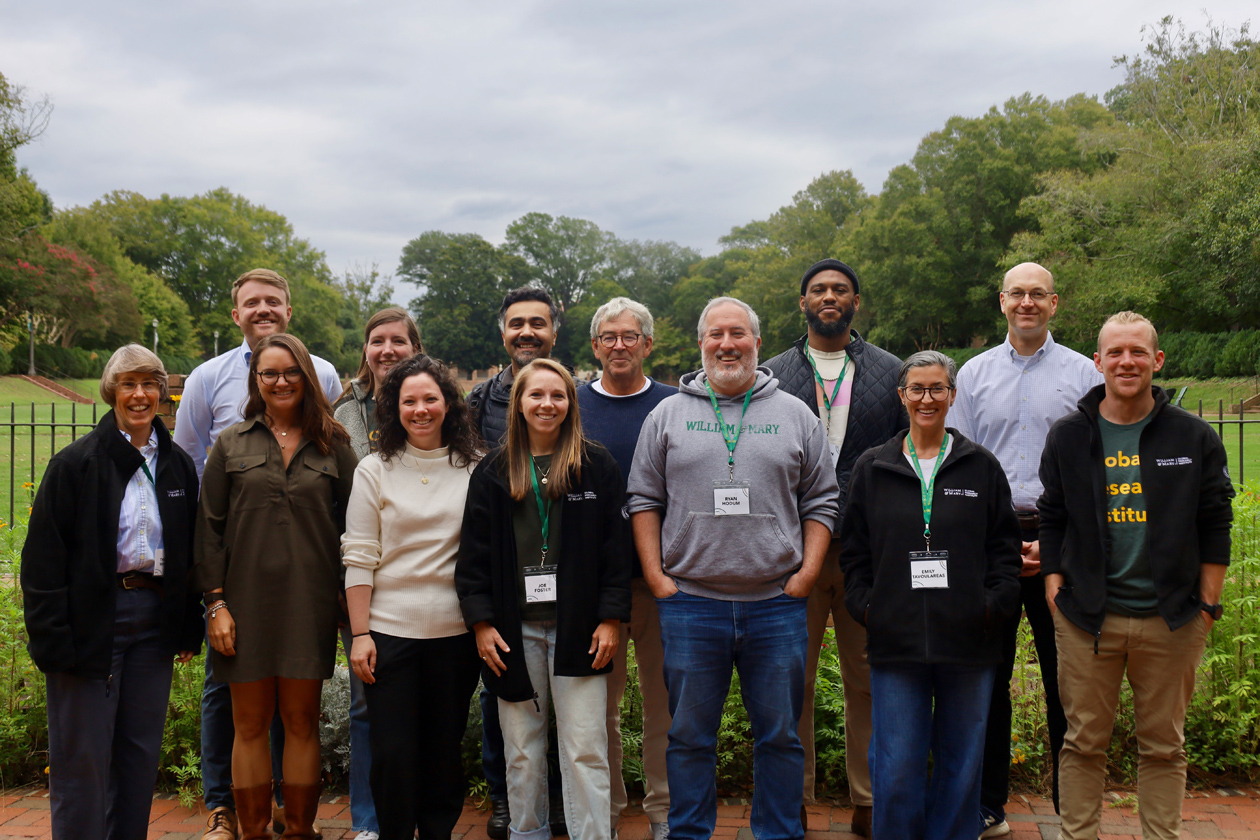
The inaugural cohort of 17 fellows gathered Sept. 24-26 for two days of roundtable discussions with W&M researchers and staff on the role of public universities, research communications, how to find and work with external partners and W&M’s unique role as a research university that values undergraduate teaching.
The fellows’ goal is to support research being incubated at GRI over the next year in tangible ways — whether it’s making introductions to potential funders, researchers at other institutions, or community partners, or providing strategic direction based on their experience in their fields.
The idea for the fellows program emerged naturally from the last two decades of work at GRI, as leadership and staff evaluated what made certain research gain traction outside of academia while other, equally good and important ideas had trouble launching.
“We have become convinced that one of the things we need to do in order to have more impact, for either research at William & Mary or research from universities as a whole, is to build partnerships and engage with folks externally,” said GRI Director Mike Tierney. “It turns out they don’t teach you how to do that in professor school.”
“We have a lot of brilliant minds in higher education, and some of them are well-placed to help solve real-world problems,” added Tierney, but they might not have the skills or resources to connect to the funders, practitioners, community members or media who can help advance their work beyond academia.
In an opening panel on Friday morning, two impact fellows joined a W&M associate dean for research in trying to diagnose breakdowns in research uptake — and whether research for impact still leaves room for knew knowledge for its own sake, a value at the heart of universities.
One challenge to applied research may be the incentive structure of academia, particularly for early career academics. Despite AidData’s undeniable impact, “I don’t know whether building AidData, on its own, would have earned a William & Mary faculty member tenure,” said Impact Fellow Ammar Malik, a former AidData senior research scientist and current program officer at the Gates Foundation. AidData is a research lab at William & Mary that studies international development. Previously accelerated under GRI, it has been successful at shaping policy and garnering attention from international press.
Demonstrated impact can have wider implications for the credibility of public universities at a time of upheaval in the United States and beyond.
“We’re living in a moment of widening trust deficit,” said Impact Fellow Beverley Hatcher-Mbu, the director of policy at Development Gateway, an international NGO that helps provides data to decision-makers in international development. “It’s never been more important than it is today to have universities and the research that they’re doing out in public.”
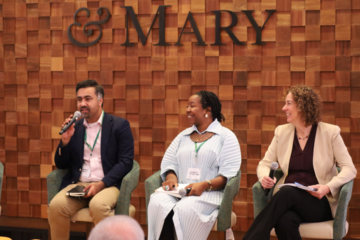
“If we can see a crosswalk between research and practice regularly, almost without thinking about it, that to me is a measure of success,” she said. “I think that should be the north star we’re shooting for when we think about seeding, growing and expanding external partnerships between academia, the nonprofit sector and others.”
But where does that leave so-called “basic” research, that new knowledge creation driven purely by curiosity — without a clear game-plan for “impact” in the real world?
“Universities are going to have a role in both types of science moving forward,” said Megan La Peyre, the associate dean of research and advisory services at William & Mary’s VIMS & Batten School of Coastal & Marine Sciences. “The lesson is really that universities need to think about rewarding both kinds of science,” not least because “curiosity-driven” research often lays the groundwork for research that might have important real-world or industrial implications later.
All three panelists agreed that strong relationships — with partners, other researchers and with university staff — underpin all impactful research. “Infrastructure is more than just how many research vessels do we have, or how well equipped are our labs,” said La Peyre. “Infrastructure is also the people that we work with and the relationships that we build.”
Throughout the weekend, fellows and the W&M community were invited to begin that work of infrastructure-building through relationships, with opportunities for students and researchers to stress-test ideas with fellows in a relaxed environment.
“The Impact Fellows Conference provided a unique opportunity to ‘compare notes’ with practitioners on a wide array of substantive issues from AI developments to nuclear non-proliferation policy,” said Martina Queijo ‘28. “As students, we observe changes to the international environment and emerging technology in an academic setting, but it is always valuable to engage with practitioners who are working through these developments every day.”
That connective tissue between the academy and the fellows will grow over the next year, as fellows continue to engage with projects being incubated and accelerated through GRI. Fellows will meet again in person in March in Washington, D.C., with fellows helping with everything from facilitating site visits for researchers or facilitating roundtable discussions with researchers and practitioners.
“There’s no replacement for breaking the algorithm,” through human connections, said Hatcher-Mbu. “The algorithm tells you what you like and don’t like, but there’s nothing like sitting across the table from someone you’re going to work with.”