
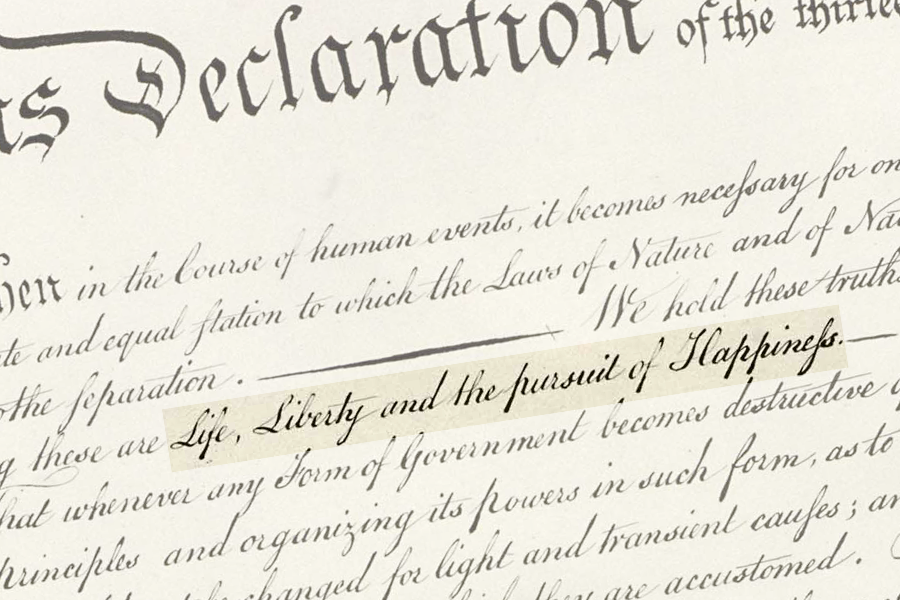
Few phrases are more closely associated with the Declaration of Independence – about to celebrate its 250th anniversary – than Thomas Jefferson’s assertion that all people possess an unalienable right to “Life, Liberty and the pursuit of Happiness.” Yet the phrase has often been misunderstood, according to Adam Potkay, the William R. Kenan, Jr. Professor of Humanities at William & Mary.
“I think a lot of people think ‘pursuit of happiness’ is a pretty unique phrase,” Potkay said, “but it means something very different today than it did at the time Jefferson wrote it.”
Potkay, who has written books on the philosophical and historical antecedents of both happiness and joy, says understanding what Jefferson meant by the “pursuit of happiness” requires tracing the phrase back through centuries of political thought.
“The idea of happiness goes back to ancient Greek philosophers who distinguished between two different kinds of happiness,” said Potkay. “The first, often called hedonic happiness, refers to pleasure and positive feelings. It is the happiness associated with enjoyable experiences: food, love, a great vacation, career success.”
This is the kind of happiness most people mean when they use the word today.
“The second type, eudaimonic happiness, is derived from the Greek concept of ‘eudaimonia,’” Potkay said. “It refers not to a temporary feeling but to human flourishing.”
For philosophers such as Aristotle, flourishing meant living a life characterized by virtue, wisdom and service to others. Happiness was not simply something one felt; it was something one worked toward through the cultivation of their character.
For the common good
A flourishing life, Aristotle argued, was built through ethical action and civic responsibility.
Potkay says this distinction helps explain what Jefferson and his contemporaries meant by happiness.
In an 1819 letter to fellow William & Mary alumnus and American diplomat William Short, Jefferson acknowledged that pleasure was a goal, but virtue was the foundation of genuine happiness. The pursuit of happiness was not a pursuit of pleasure alone.
This definition of happiness rests on the conviction that knowledge carries responsibility and that wisdom must be placed in service of the common good. It’s the guiding principle of William & Mary’s Year of Civic Leadership, as the university works to cultivate a community that is rooted in the values of service and integrity.
So how did happiness evolve from something virtuous to something based more on sensory pleasure?
Etymologically, happiness is related to “hap,” meaning luck or chance. For much of human history, happiness was seen largely as a matter of luck.
But by the 18th century, attitudes toward happiness were changing. Scientific advances and improvements in living conditions fostered a growing belief that humans could exert greater control over their circumstances.
Improvements in medicine, sanitation and housing eased the hardships that had dominated daily life. If people could shape the world around them, perhaps they could also shape their own happiness.
These developments coincided with the Enlightenment, an intellectual movement that profoundly influenced the American founders.
Political leaders throughout the colonies were deeply engaged with the prominent writers and philosophers of this period. John Locke’s theory of natural rights – the idea that individuals were entitled to “life, liberty and property” – profoundly shaped Jefferson’s political thought.
“Jefferson notably swapped ‘property’ for ‘pursuit of happiness,'” Potkay said, “reflecting the Enlightenment view that individuals have the right to seek well-being free from government interference.”
That said, Jefferson’s conception of happiness was still inseparable from civic virtue. A free society depended on virtuous citizens capable of governing themselves. Liberty could survive only if citizens possessed the moral character necessary to use it responsibly.
Over time, the meaning of happiness gradually shifted again. While Enlightenment thinkers increasingly emphasized individual rights and personal fulfillment, Romantic writers elevated emotion. As modern consumer culture developed, happiness became increasingly associated with personal satisfaction and positive feelings.
The ancient connection between happiness and virtue weakened.
Efforts like W&M’s Year of Civic Leadership are aimed at restoring that connection, bolstered by research that increasingly suggests people who are actively engaged in improving their communities are happier. Purpose helps people rediscover a version of the eudaimonic happiness that Aristotle described more than two thousand years ago.
Today, as Americans search for happiness, the older meaning of the phrase remains relevant.
The surest path to happiness may not mean good vibes only, but pursuit of the common good.
“It’s also a lifelong pursuit,” Potkay said. “It’s what the good life truly is.”
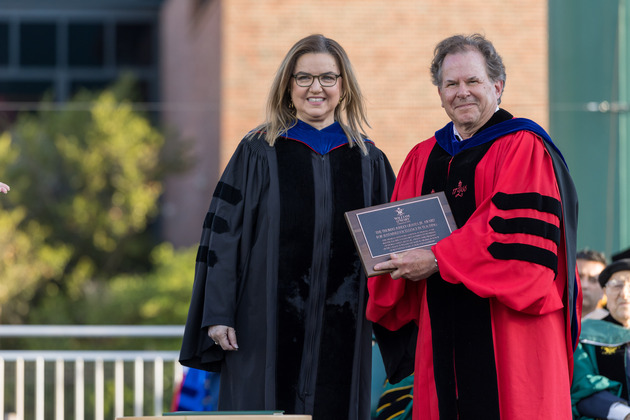
In May, Potkay won one of William & Mary’s most prestigious honors, the Thomas Ashley Graves, Jr. Award for Sustained Excellence in Teaching, presented annually to a professor of exceptional renown. He was also recently named editor of PMLA, the flagship journal of the Modern Language Association. Since 1985, its editors have all come from Ivy League or top ten public research universities.
“This puts William & Mary on the masthead of the most prestigious journal in the modern languages field,” he said.
He is pretty happy about both honors.
Susan Corbett, Communications Specialist