

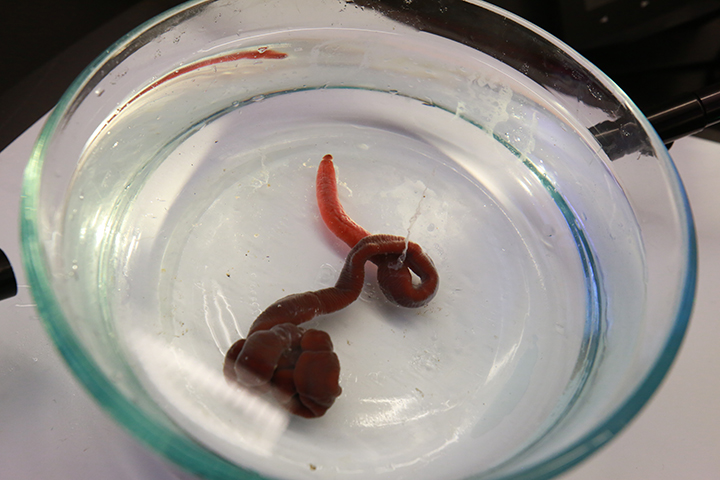
Penicillin, X-rays, vulcanized rubber — some of the greatest scientific discoveries happened by accident. Thanks to his love of invertebrates, William & Mary Biology Professor Jon Allen has added another entry to that list of happenstance achievements. Meandering around the mud at the bottom of a tank in Allen’s lab lives the world’s oldest ribbon worm on record. His name is Baseodiscus the Eldest, or B, for short.
B is estimated to be around 30 years old, although his exact birthday is unknown. A faithful companion to Allen for over 20 years, his longevity was never intended to be an experiment.
Year over year he eked out a humble existence in the slime, content to munch on peanut worms and rest in the cool, quiet confines of his tank. But after performing a genetic analysis on B in 2024, Allen confirmed his exact species and realized that he had a biological anomaly on his hands.
In a recent paper published in the Journal of Experimental Zoology, Allen, his former student Chloe Goodsell ’24 and collaborators from the Oregon Institute of Marine Biology set the record straight about how long ribbon worms can live.
Beyond scientific curiosity, B’s age holds broad value for marine biologists, with implications for how this diverse and widespread class of predators impacts marine ecology.
For the love of invertebrates
Despite their unassuming nature, ribbon worms (phylum nemertea) have a big claim to fame — they are the longest known animals on the planet. One worm found in 1864, on the coast of Scotland, measured a whopping 180 feet. That’s the equivalent of two blue whales put tail to tail or 720 gummy worms.
While they may outperform other animals in the length category, until now, no one knew how long they lived. Biologists speculated they might have long lifespans, yet the previous lab record stood at just around three years.
B changes all that. Although, if it hadn’t been for the kind heartedness of one Ph.D. student, his story might have been a lot shorter.
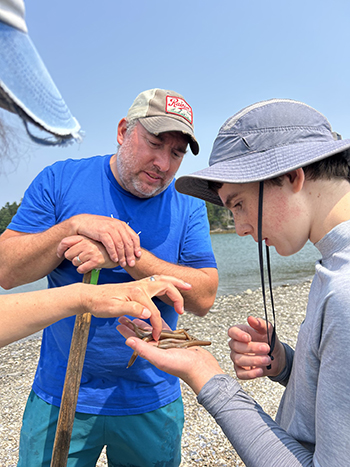
The year was 2005. Allen was finishing up his doctorate in biology at the University of North Carolina, Chapel Hill. In a department meeting one day, he learned that major renovations to one of UNC’s science buildings would leave a tank of invertebrates without a home. Naturally, he agreed to adopt them, including one little ribbon worm that had been collected as an adult sometime in the late 90’s. Packing up for his postdoc in Maine at Bowdoin College, he carefully perched the tank in the back of his truck along with a smattering of furniture and books and set off on the 15-hour drive.
After three years in Maine, B accompanied Allen to his first teaching post at Randolph-Macon College and then, in 2009, to William & Mary. For the past 16 years, he’s been happy to rest in his squishy underwater world, quite content and quite alive.
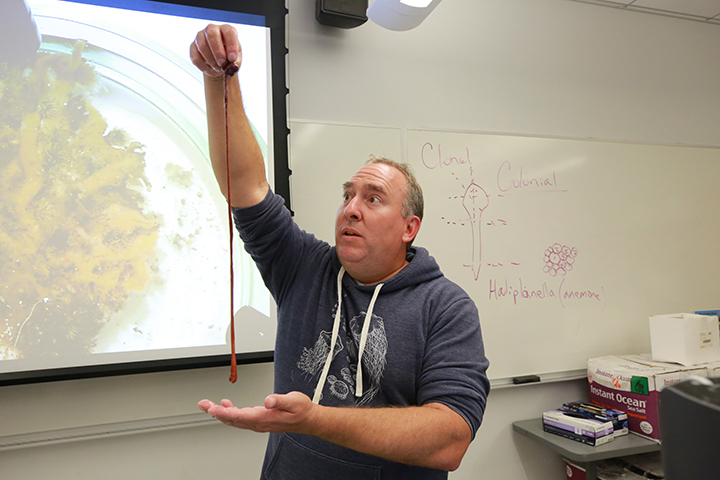
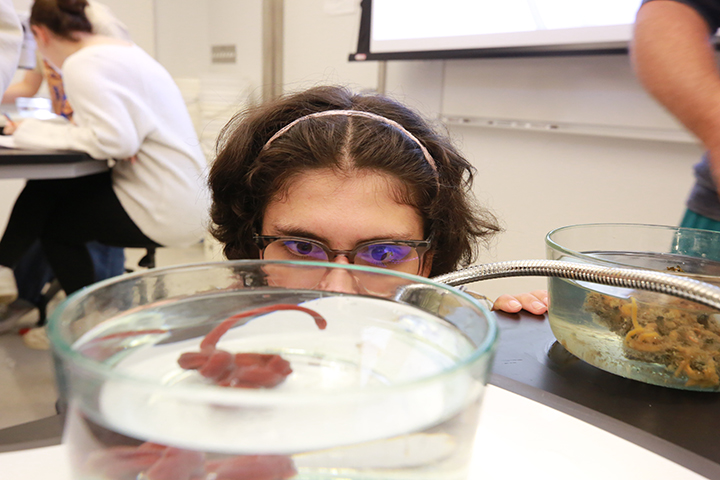
He’s only disturbed once a year, in the fall, when Allen, with the care of someone handling a cherished antique, fishes him out of the murky depths of his tank and takes the three-foot worm to class for show and tell.
Breaking records
It never occurred to Allen to investigate the worm until his former student Chloe Goodsell ’24 asked him its age. When she learned it was decades old, Goodsell, who’d completed a National Science Foundation Research Experiences for Undergraduates program at the Oregon Institute of Marine Biology, suggested that he send a sample there to Svetlana Maslakova, a leading expert on nemertean genetics.
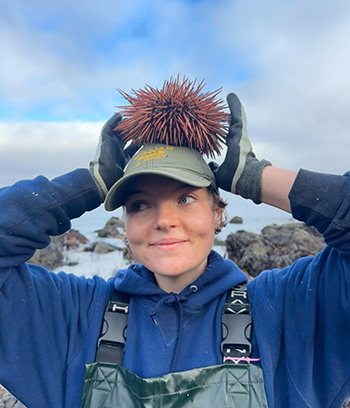
Gingerly, Goodsell excised a tiny piece of tissue from the worm and sent it off for analysis. The results positively identified B as a nemertean of the species Baseodiscus punnetti, making him the oldest ribbon worm ever recorded by more than 23 years.
This realization changes current understanding of the species, impacting the way scientists think about the ribbon worm’s life cycle and basic biology.
“Ribbon worms are an incredibly diverse and widespread phylum, yet almost nothing is known about their natural longevity,” said Allen. “This finding fills a genuine knowledge gap, increasing their known lifespan by an order of magnitude. This shifts our understanding of an entire major group of marine predators. Future research can leverage this knowledge to develop lifespan estimates for these creatures to better understand their ecological impact on marine ecosystems.”
Furthermore, it’s currently impossible to tell how old ribbon worms are. So having a living specimen with a generally well-defined age allows other researchers to look for biological and physiological characteristics that may correlate with age.
For Goodsell, this finding also holds importance for longevity research.
“Understanding how animals evolve long life spans has implications for human health research,” she said. “Our finding contributes to the growing body of knowledge of what it takes to avoid senescence — or ‘getting old.’ Longevity research could eventually help us develop ways to treat progressive, age-related diseases like Alzheimer’s or dementia. It’s cool to get to add a piece to that puzzle.”
A season of gratitude
The worm isn’t the only one who owes Allen its gratitude. Goodsell, who transferred to William & Mary her sophomore year because of the university’s reputation for undergraduate research, credits the biologist with transforming her path.
“Jon is so excited about his work and passionate about helping his students pursue science,” she said. “He really helped shape my path as a researcher. I’m so thankful for his mentorship and for William & Mary as a place that faculty like him are drawn to.”
Now a first-year Ph.D. student at the University of California, Irvine, Goodsell plans to continue her passion for science as an ecologist studying marine invertebrates, just like Allen.
Catherine Tyson, Communications Specialist