
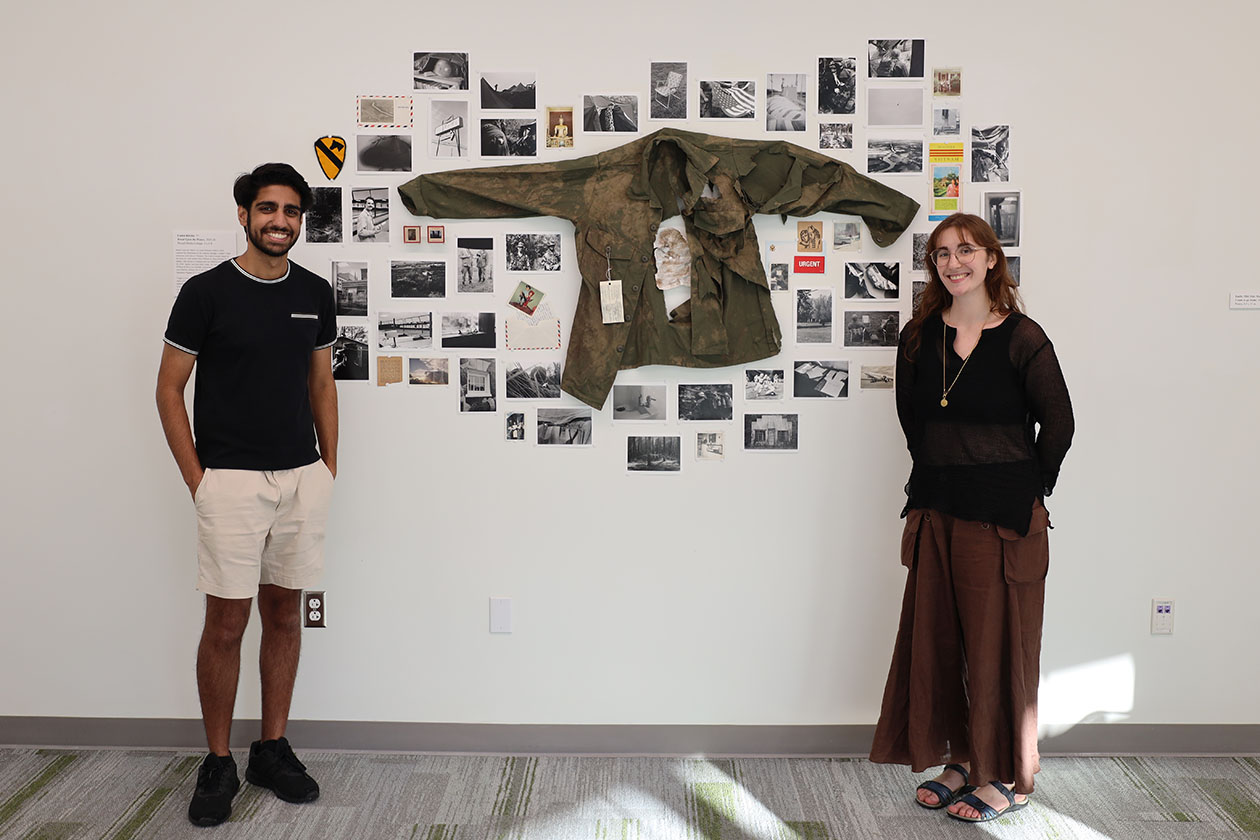
Collecting works from student artists and building an exhibit by hand, the student curators at William & Mary’s Hart Gallery have pieced together a story of strong connection and service in the William & Mary community. The new exhibit, “Ties That Bind,” opened Tuesday, Oct. 13 and will remain open until Nov. 1.
The Hart Gallery, located in the Sadler Center and managed by Student Unions & Engagement, provides students with opportunities to showcase their artwork and gain hands-on experience in curating exhibitions. It originally opened in 2021 through an endowed Senior Family Gift from Janet Hart P ’22 and Richard Hart P ’22.
Student curators Rebecca Graber ’27 and Gibran Adnan ’27 developed the exhibition from start to finish, from choosing its theme and reaching out to student artists to selecting and installing the artwork. Now in their second year as curators, the two have gained experience in everything from project management and communication to the practical work of installing an exhibition.
“Timing during the Year of Civic Leadership was important and intentional,” said Zoe Beaver, assistant director for programming at Student Unions & Engagement. “Each piece is a visual representation of what community and serving your community means to each artist.”
The gallery contains pieces that highlight the inherent interconnectedness of community members. For example, Caden Ritchie’s ’27 semi-fictional, mixed-media piece, “Bread Upon the Waters,”focuses on Ronald David Sparks, a former William & Mary student who died while serving in the Vietnam War. Through artifacts and images of objects and people that could have been a part of his community both in the military and at home, the piece explores what Ritchie describes as “the dissolution of old America through a soldier’s final memories.”
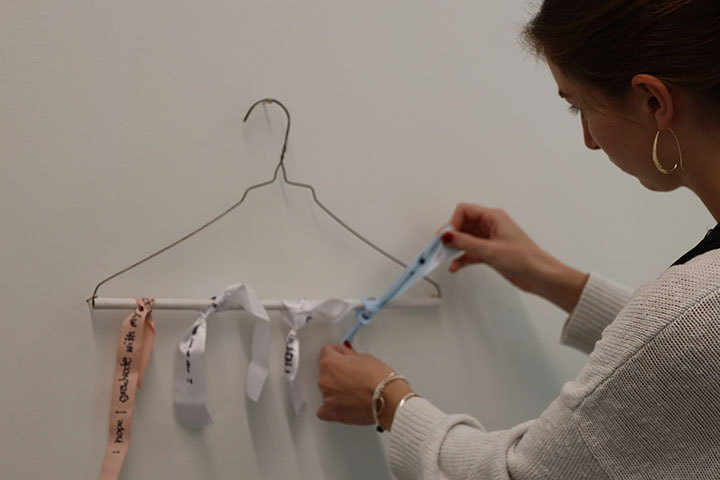
The highlight of the exhibit, “Ties that Bind,” is interactive. Visitors can write down their aspirations on a piece of fabric before tying it to clothes hangers on the wall, adding their own contributions to the connections represented throughout the gallery.
Graber said she hopes the art helps viewers reconsider how they fit into the larger community.
“Each of us is a complex tapestry of the people we’ve loved and lost, and we all weave together to create one great story that will become history as we know it,” she said. “At William & Mary, it’s a common joke that you are one degree of separation away from anyone else on this campus. I hope viewers come out of this exhibit curious about how they are somehow connected to the stranger sitting behind them in lecture hall.”
Graber and Adnan said the interactive piece was the most challenging yet rewarding aspect of the exhibit. It was inspired by a similar installation Graber encountered in Marseille, France, while attending a summer painting intensive at the Leo Marchutz School for Painting and Drawing in Aix-en-Provence. The experience was made possible through funding from a Catron Scholarship with the Charles Center for Undergraduate Research and a Concord Travel Scholarship with the Department of English.
The curators wanted visitors to contribute to the artwork while reflecting on their own connections to the community.
“Conceptually it was difficult to find the balance between creating something with genuine meaning,” Adnan said. “The piece comes together more and more as people put up more of their aspiration-filled fabrics on the wall, but [it] was also easy and fun enough for the average visitor to partake in.”
In creating the exhibit, the curators faced several logistical roadblocks, including late deliveries of materials and markers that did not work on the fabrics. But, by using problem-solving skills they had learned from previous exhibits, they were able to come up with some creative solutions.
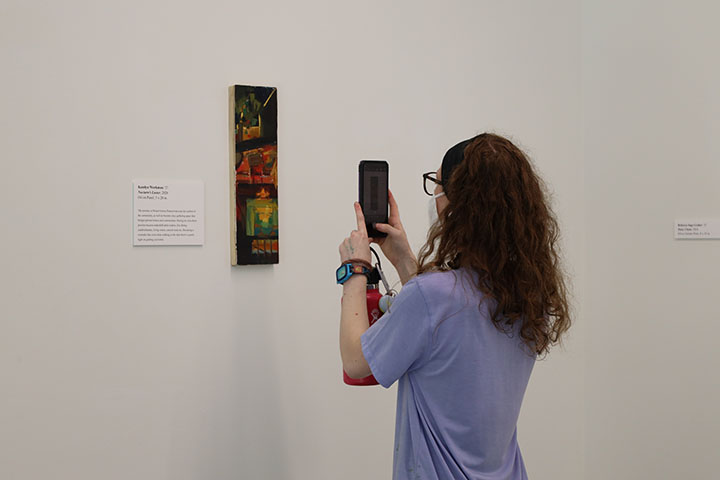
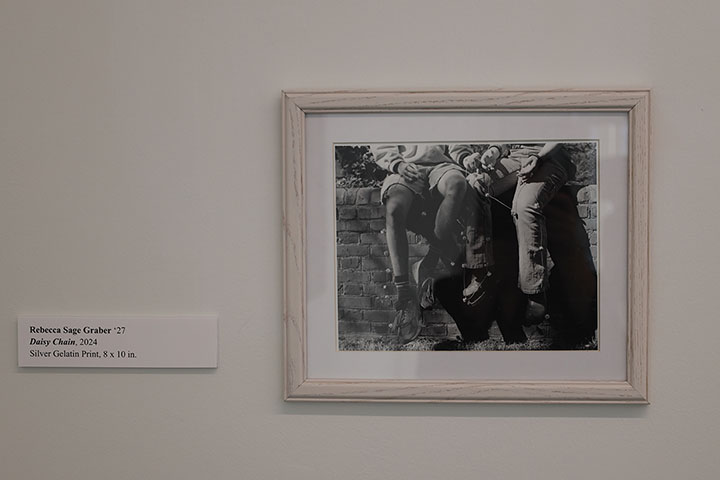
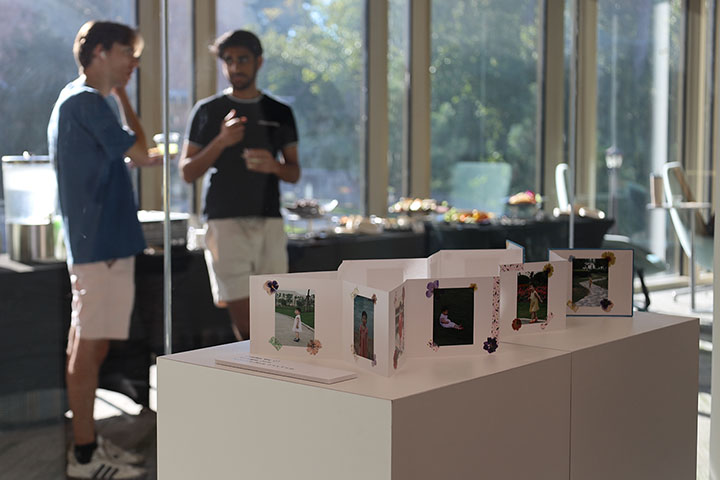
Through applied learning, the students have developed skills ranging from communication and problem-solving to the hands-on work of managing an art gallery.
“I can now confidently paint walls, hang frames and handle delicate art however it needs to be handled, but I also have a better ability to assess which pieces of art should be next to each other to make the gallery more cohesive,” Adnan said. “Additionally, the teamwork that I’ve been able to build with Rebecca and Zoe has been one of the most invaluable skills that I’ve been able to hone and utilize in my day-to-day life at William & Mary.”
Adnan, a senior double majoring in government and public policy, hopes to pursue a career working with election campaigns. While being an art curator may not seem directly related to that field, he said the connections he has made with his fellow curators and artists have helped him develop relationship-building skills he hopes to use professionally.
Graber, who is double majoring in art & art history and film & media studies, also sees the communication and problem-solving skills she has developed at the Hart Gallery as valuable to her future career. Her work as a student curator has opened her eyes to a possible career in gallery work that she had not previously considered.
“What it has brought me most is confidence and self-assuredness in my capacity to complete a meaningful project. I am always moved at openings when I see my peers respond to their art in an actual gallery space,” Graber said. “I think it makes people a lot more emotional than they expect and being able to provide this space for the community is a gift. It’s how we uplift each other throughout the toils of William & Mary, knowing that your art is worth being seen.”