
The following story originally appeared on the website for W&M’s College of Arts & Sciences. – Ed.
As Arjun Fischer ‘20 was waiting on the tarmac in Virginia to fly back to Los Angeles, where he currently attends graduate school at the University of Southern California, his phone suddenly lit up. It was a phone call that changed everything.
Fischer, an alumnus of William & Mary’s film studies program, had been disappointed that his documentary, “Artificial Love,” did not get picked up by film festivals for distribution earlier this year.
In June, as he waited to take off, Fischer was notified that he was a semi-finalist for the Student Academy Awards, a global student film awards program run by the Academy of Motion Picture Arts and Sciences. “Artificial Love” had placed in the top 15 student films in the documentary category.
“I was trying to send out texts to everybody before I went in the air for five hours,” he said.
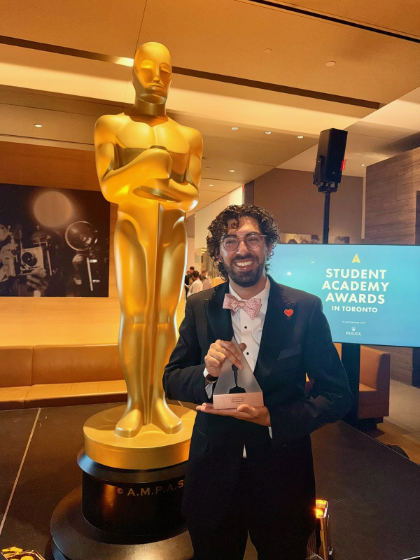
The process was a whirlwind of notifications. The academy made another cut, announcing the finalists, comprising only seven films that included Fischer’s. Finally, he found out his film was in the top three documentaries. Fischer’s film ultimately finished in third place with a bronze award in the documentary category at the Student Academy Awards, which held its awards ceremony on Sept. 14.
Much like finding out about his film’s success, Fischer’s start into filmmaking came unexpectedly. He arrived at William & Mary intending to study math, but that changed when he took an Intro to Film class his freshman year.
“I fell in love with it, and the rest is history,” he said.
From attending the Ampersand International Arts Festival — a film-based festival co-hosted by William & Mary and Williamsburg annually — to discussing art and film with his friends, his passion for film was cemented during those formative four years on campus.
“My curiosity just exploded,” Fischer said. “I felt like I was constantly learning, not just from my professors who were incredible, but also from my classmates and everybody around me.”
His love for studying film culminated in a sports documentary production internship with the NFL his senior year. Upon graduation, Fischer was supposed to join the company full-time, until the COVID-19 pandemic paused film and production jobs from hiring.
More than two years later, when the job market opened up, Fischer took his original job offer as an associate producers for the NFL’s film division. During his time there, he helped produce documentary television and film works, a few of which received Emmy nominations.
After almost two years in the role, Fischer reflected on his long-term career goals and returned to his hopes of being a director. On a last-minute whim, he decided to apply to USC’s School of Cinematic Arts; he even wrote much of his application the day it was due.
“I didn’t put too much pressure on myself. I just wrote from my heart and wrote about my experience and the things that I wanted to do and the kinds of projects I wanted to make,” Fischer said.
His efforts paid off when he was accepted into USC’s graduate film program, and he soon embarked on a cross-country move from Virginia to Los Angeles.
As a graduate student, Fischer was looking for subjects to film. He had an “aha” moment after reading an article about human relationships with artificial intelligence chatbots. Even though he had been trying to shift away from documentary, when he learned of his film program’s selective documentary production class, his idea solidified.
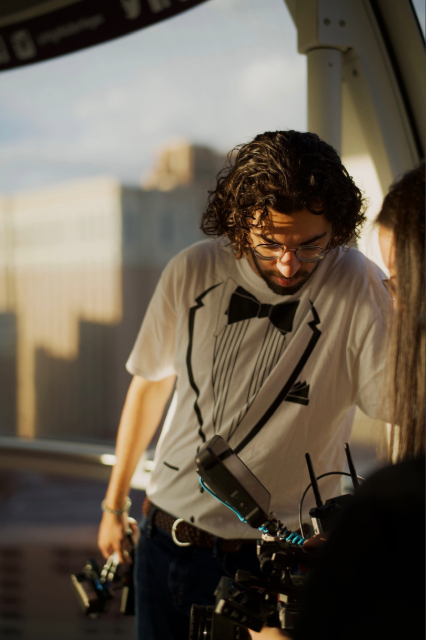
The course funds three graduate students to direct and create a documentary short. State-of-the-art equipment and a team of two producers, two editors, a cinematographer, and two sound designers are fully funded through the course, along with mentorship from USC professors. Fischer applied and was accepted into the course.
Through this unique opportunity, Fischer began the creation of “Artificial Love,” a short documentary about the relationships between humans and AI.
He spent the first three months developing the story, conducting pre-production research.
“I was really just kind of immersing myself in the culture of the world and trying to learn as much about it as I could,” Fischer said.
He spent even longer finding his main character for the film, interviewing more than 100 people around Los Angeles who were directly involved with or affected by the growing trend. Fischer finally found his main subject, a middle-aged man named Patrick who had developed a relationship with a female chatbot.
“I think such a big part of making documentaries is getting the people that you’re going to be putting on film to feel really comfortable with you,” Fischer said. “It’s making sure that the people are going to trust me to tell their story well.”
In production and post-production, Fischer utilized the knowledge and skills he acquired from both W&M and USC to create an award-winning film. William & Mary’s focus on film history, theory and practice gave Fischer a strong foundation to direct his own work.
“Our curriculum sees theoretical and practical knowledge of filmmaking as integral to each other: as we contemplate the why, we consider the how; as we contemplate the how, we consider the why,” said Keith Johnson, teaching professor of English and film & media studies.
Fischer found the theory-based courses integral to his later work.
“It really set me up to figure out how to actually learn the tools and skills that I needed to make the film,” he said. “They worked in tandem with each other in a way that really complemented the education that I was getting in undergrad and now the education that I’m finishing up here in LA.”
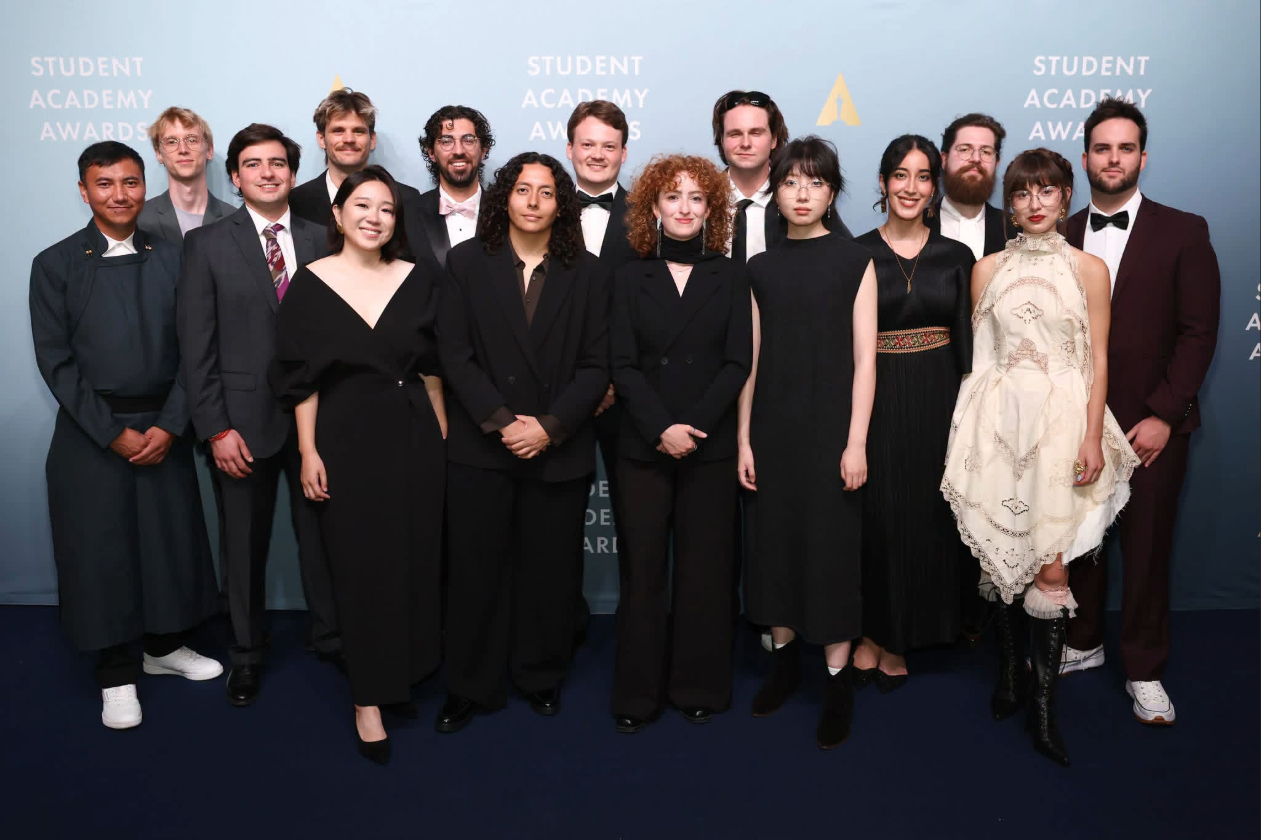
After months of pre-production, filming and editing Fischer’s film received international recognition at the Student Academy Awards ceremony, held in the Toronto International Film Festival’s TIFF Lightbox theater. Fischer, along with 11 other finalists — spanning the categories of animation, documentary, live action narrative and alternative/experimental — were flown to Toronto for the event.
The Student Academy Awards ceremony emulated the Oscars, complete with a red carpet, Getty photographers and guest appearances to present awards. Fischer brought along his film crew as well as his mother and delivered a speech upon accepting the bronze award for his film.
“It was incredibly surreal to be there. It hit me like, ‘It’s really happening’,” Fischer said. “It was an honor and very validating.”
Post-ceremony, Fischer reflected on the experience fondly. “It’s been so exciting, both in terms of this has given the film an opportunity to get seen by more people,” Fischer said. “But also in terms of hopefully being able to set my own career up for continued opportunities down the road.”
The success of “Artificial Love” continues, with the Student Academy Award qualifying it for nominee contention in the Oscar’s short documentary category. Fisher also hopes that the added exposure may give the film a second chance to be picked up for a film festival circuit.
This fall, Fischer will graduate from the USC film program and is already looking forward to his next project, while feeling appreciative for where he started.
“I’m, very, very grateful to William & Mary for helping me fall in love with film and shaping me and the way I think about art and movies and making me into the student that I am.”