
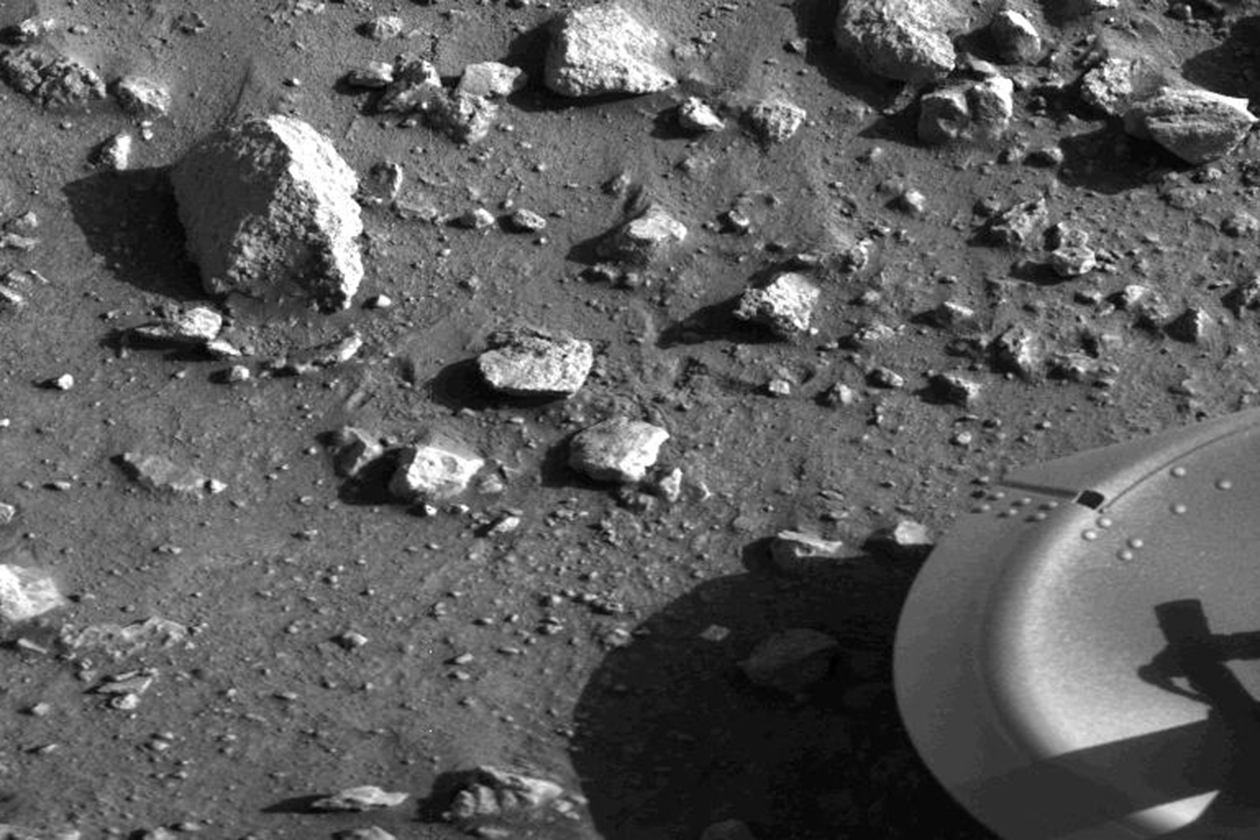
Even the greats like musician David Bowie have asked: Is there life on Mars? In a symposium held earlier this month at William & Mary, Research Professor Joel Levine said we may have answered that question 50 years ago.
“The Exploration of Mars & the Search for Life: Viking to Humans” symposium was held in the Sadler Center on Sept. 18 and focused on the findings of the Viking Project. The project included humanity’s first two successful landings of operational spacecraft on the surface of Mars in 1976; they are, to date, the only missions to look for present-day life on Mars.
The event served as a public forum to hear that life may have been discovered during the mission and also review NASA’s developing plans to send humans to the surface of Mars.
“William & Mary has a strong tie to the underlying development of a human mission to Mars,” Levine said. “The university ran two international symposia on human exploration of Mars for NASA, and two books were based on that.”
Levine was appointed adjunct professor and head of the atmospheric sciences track with W&M’s Applied Science Program in 1990 and is a key voice in teaching graduate students about atmospheric science and chemistry, planetary science and climate science and policy — all crucial topics for space exploration.
The event opened with remarks from Provost Peggy Agouris highlighting the importance of the Viking Project.
“Today we celebrate not only an extraordinary technological achievement, but the curiosity behind it, the willingness to ask an enormous question, the ingenuity to travel 250 million miles looking for an answer and when the answer proved complicated, the determination to keep asking,” she said. “Fifty years later, we’re still asking. That may be Viking’s greatest legacy.”
Dean of William & Mary’s School of Computing, Data Sciences & Physics Doug Schmidt ’84, M.A. ’86 noted how far technology has come over the past 50 years, saying that each Viking lander carried computers with only 54 kilobytes of memory, while his Android has over 155,000 times more memory and is 2 million times faster in its processing speed.
Even with these limitations, he noted, the people behind the mission were vital to the exploration of Mars.
“Technology didn’t make Viking happen — people did,” said Schmidt. “Behind every computer, radio, instrument, line of software, test procedure and engineering decision were extraordinary men and women who spent years solving problems that have never been solved before.”
Understanding Mars
Multiple experts involved with the Viking Project and NASA spoke about the impact the project has had on the field today.
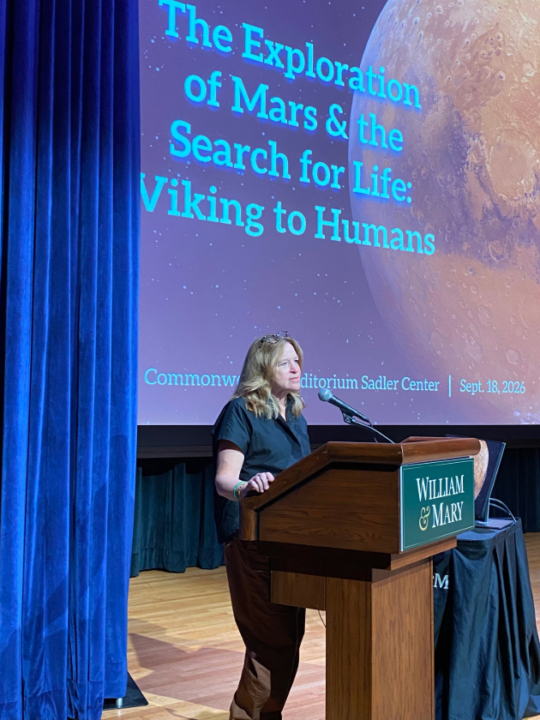
Ellen R. Stofan ’83, D.Sc. ’16, P ’10, P ’14, under secretary for science and research at the Smithsonian Institution and former NASA chief scientist, gave an overview of Viking, contextualizing how the race to Mars occurred around the same time as the Apollo missions. The Soviet Union had invested heavily in Mars missions around the time,but was unsuccessful in landing any probes on the planet. Similar to its ambitions for the moon, the U.S. wanted to beat the Soviet Union to the red planet.
“By the time Viking launched in ’75 and landed in ’76, Mars was not a completely unknown place,” she said, referring to the Mariner Mission, where probes explored the inner solar system and brought back data from planets like Mars and Venus. “We knew something about the surface of Mars. We knew something about the atmosphere, so there was much left to learn by the time we got around the Viking.”
Stofan noted that scientists at the time knew a variety of results could come from the mission, including inconclusive data. They went in prepared for all outcomes and set expectations for themselves and the public.
“The scientists went into this saying, ‘Don’t overinterpret the results we’re going to get from this because Mars is going to be complicated,’” she said.
Life, or something like it
Steven Benner, director of the Westheimer Institute of Science and Technology, outlined what the findings from Viking meant and how scientists were able to come to their conclusions. One test scientists ran was the carbon assimilation pyrolytic release experiment, to measure if there were any organic cell compounds in the atmosphere. The test found positive results of around 1,000 cells of fixed carbon, a positive life detection.
“It didn’t prove life; you won’t hear the word ‘proof’ from me,” he said. “That’s what they saw, and it’s not really disputed.”
Scientists did a label release experiment, where a sample of Martian soil was mixed with a nutrient solution. They found that cells were also measurable there, another promising result to indicate some sort of organic life on Mars.
“What they’re looking at is bioloads in the Martian surface which are compatible with bioloads in resource-sparse environments on Earth,” Benner said.
Everyone at the time understood that these two experiments were affirmative signs of life, according to Benner. But then data from a gas chromatography-mass spectrometry (GC-MS) test, which can identify small trace elements in materials previously thought to be beyond identification, was misinterpreted as indicating no organics, and therefore no life. Scientists, hoping to avoid a false positive, grabbed onto the misinterpretation, even though the GC-MS actually did see organics, according to Benner.
“A mystery oxidant was theorized, but never found and was theorized to explain the failure to see organics,” he said. “The anomalies in the theory were dismissed, often with transparent logical contradictions, invoking results of experiments not yet run.”
Flaws were tolerated since explanations supported a “groupthink” mentality, according to Benner, and as a result, misdirected Mars exploration for 50 years. To fix this type of system and not let a mistake of this nature occur again, Benner says NASA’s Innovative Advanced Concepts Program, which nurtures visionary ideas for future NASA missions with the creation of breakthroughs, could offer hope within the system.
“The lesson for the students is that this happens all the time in science and probably in the field of science that you are going into,” he said.
Implications for years to come
Other speakers for the event included:
- Tom Young, Viking Mission Director
- Gentry Lee, Viking Director of Science Analysis and Mission Planning
- Hans-Peter Biemann, author of “The Vikings of ’76,” a book on the Mars program
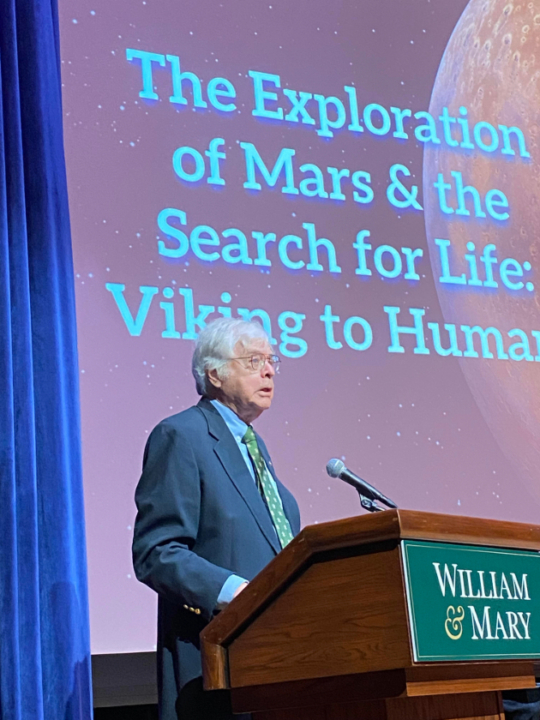
The symposium concluded with a talk by Levine on “Planning for the Future of Mars Exploration: A Human Mission to Mars — Scientific Goals and Objectives.” This talk was based on material from two NASA workshops at the Lunar and Planetary Institute in Houston, Texas, that were organized and co-sponsored by William & Mary in 2017 and 2020.
It included video of what the next stage of Mars exploration would look like, including a human mission, with a rocket launch and capsule carrying astronauts to a transfer vehicle stationed just outside of Mars’ atmosphere. That vehicle would then transport the astronauts to the planet’s surface.
NASA has a 20-year plan designed to maintain and advance U.S. leadership in Mars. Levine thinks that this symposium is one of the first steps to the public truly understanding the implications of what’s next not just for NASA, but for human civilization.
“What I hope the general attendee appreciates is the effort the United States is making in the exploration of Mars,” Levine said. “One major question in all of science is, is there life outside of Earth? I think this has a lot of implications. It will affect not only science, but how we think about ourselves.”
William Oster, Communications Specialist