
The following excerpt is from a story that originally appeared in the winter 2026 issue of the W&M Alumni Magazine. – Ed.
It was a tense scene at Chancellors Hall on the evening of Oct. 20 as the newly relaunched chapter of Turning Point USA at William & Mary prepared to hold its first public meeting.
Anticipating a protest based on social media reactions to news of the revived chapter, organizers had requested a W&M Police presence at the event. As the protesters stood silently holding signs along the wall in the hallway outside the meeting room, an attendee confronted them in a video later circulated on social media.
The protesters remained respectful, continued their silent dissent and the meeting proceeded uninterrupted.
While the encounter may have felt uncomfortable for those involved, it illustrates William & Mary’s commitment to providing an environment in which students can disagree respectfully, explore ideas and challenge assumptions.
As the United States commemorates its 250th anniversary, William & Mary remains resolved to cultivate leaders who understand the nation’s founding principles, who embrace the rights and responsibilities of citizenship, and who can listen and speak to each other across deep differences.
Events nationally during the past year have tested that resolve. There have been shocking acts of political violence, including the targeted killings of Turning Point USA founder Charlie Kirk and former Minnesota House Speaker Melissa Hortman. Religious communities in the U.S. and beyond have been attacked. Social media has stoked separation of citizens into opposing camps that deride, ridicule and dehumanize those with different beliefs.
According to a Quinnipiac University poll released in September, 79% of American voters say the nation is in a political crisis, 54% think political violence will worsen over the next few years and 53% say they are pessimistic about freedom of speech being protected in the United States.
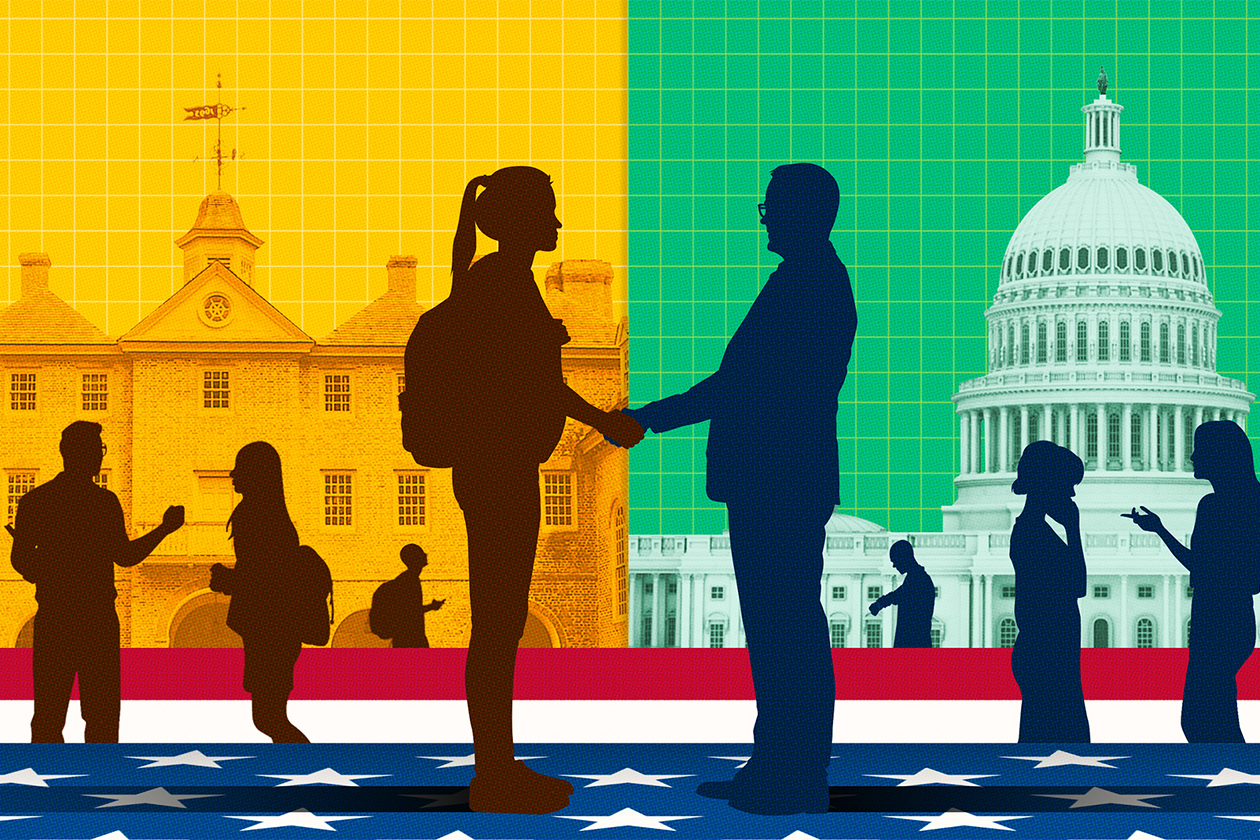
As the Alma Mater of the Nation, William & Mary represents a powerful antidote to the division tearing at the country’s fabric. On Charter Day in February, the university will launch the Year of Civic Leadership, emphasizing its role in shaping the United States government and preparing future generations of leaders. W&M continues to do this today by supporting a campus culture that values belonging, models civil discourse and encourages student self-governance and leadership development.
Beyond campus, William & Mary will deepen its influence across the country when the university hosts 100 teachers from all 50 states as part of a three-year initiative called “We the Teachers: Preparing the Next Generation Through History & Civics.” Made possible by a $2.8 million grant from the U.S. Department of Education, the initiative is intended to strengthen K-12 history and civics education nationally. Through teachers attending in-person and online programs, “We the Teachers” aims to reach over 1 million students nationwide.
As the late U.S. Supreme Court Justice and W&M Chancellor Sandra Day O’Connor once said, “Bringing high-quality civics to every school in every state of our union is the only way that the next generations will become effective citizens and leaders.”
Revolutionary education
If it feels like we’re living in contentious times now, imagine how it was during the years leading up to the American Revolution, when colonists were divided on the issue of whether to break free of British rule.

Those tensions will be explored as part of the “We the Teachers” initiative led by W&M’s Strategic Cultural Partnerships. The grant is the largest award to a Virginia institution of higher learning under the Seminars for America’s Semiquincentennial program from American History and Civics Education-National Activities. At William & Mary, “We the Teachers” includes $100,000 to support related student internships.
The first year of the initiative focuses on events leading up to the Revolutionary War. Teachers from around the country will visit the Wren Building, Jamestown Settlement, Colonial Williamsburg and other sites such as Historic St. John’s Church in Richmond, where Patrick Henry delivered his “Give me liberty or give me death” speech. They will hear from Willliam & Mary faculty and alumni, among other experts.
“The goal is to have an in-person experience that will position teachers from across the nation to be leaders back in their home states and districts and regions,” says Mark Hofer, executive director of Strategic Cultural Partnerships, professor of education at William & Mary and “We the Teachers” project director. “We will complement that with online microlearning that will be accessible for educators anywhere.”
Looking at history from different points of view and equipping teachers with tools for productive classroom discussions are priorities for the initiative.
“For us to be a functioning republic, we have to be able to disagree respectfully. We have to be able to engage with ideas and find ways to come together,” Hofer says. “We’re going to have teachers from red states and blue states, rural schools and urban schools, so they’re all going to be coming from different contexts. The focus will be on how we engage with this history and these ideas, and how we bring them to the classroom in ways that are productive and generative.”
Engaging across differences
Just ahead of the 2025 state and local elections, Senior Vice President for Student Affairs & Public Safety Ginger Ambler ’88, Ph.D. ’06, P ’24 sent a message to students sharing information about what is considered protected speech, highlighting principles for engaging productively with others and encouraging connection with campus resources.
Her message noted that William & Mary is one of just 47 campuses nationwide to earn the Platinum Seal from the nonprofit All In Campus Democracy Challenge for reaching an 82.4% voting rate on campus.
“Equally important to this participation is how we engage with one another,” she wrote, reminding students of ways to practice civil discourse through the Better Arguments framework. Launched at William & Mary in 2021, the nonprofit Aspen Institute’s framework uses five principles for engaging across differences: Take winning off the table, prioritize relationships and listen passionately, pay attention to context, embrace vulnerability and make room to transform.
“It’s part of the campus culture that we are working to create,” which also includes strong relationships between students and administrators, Ambler says. “When I hear that the Better Arguments principles are in a syllabus for a class, that’s really affirming.”
Better Arguments is included in the university’s orientation for new students, as well as training for resident assistants and orientation aides. In 2025, W&M held professional development days for faculty and staff emphasizing tools for conflict resolution using the framework.
“For more than 50 years, self-determination has been the guiding philosophy of residential living at W&M. Our students live in environments built around representative self-governance,” Ambler says. “They make decisions about their community, they talk about how they want to reinforce the norms that they establish for themselves and they take responsibility. All those democratic practices are consistent with Better Arguments.”
This spring, the initiative is expanding its reach with the help of 15 Better Arguments Leadership Fellows who will act as ambassadors to draw attention to the framework’s principles among students. One of the fellows, Selah Watkins ’27, is serving as a conflict resolution specialist through the office of Conflict Resolution & Education (CRE). She says she took on that role to help her peers navigate difficult situations, improve her own conflict resolution skills and better serve her community.
“Being able to live according to the Better Arguments principles is something we’ve been talking about with students, faculty, staff and alumni for five years now,” Ambler says. “This isn’t new, but it feels more important than ever. Leaning into our history and enduring values gives us a firm foundation on which to do this work.”
Preparing leaders
Before classes started his freshman year, Alex Vanik ’21 participated in a program called 7 Generations that introduced incoming tudents to civic engagement and volunteer opportunities in Williamsburg.
“We got to go to the city hall and learn our way around the community,” he says. “That set a strong foundation for me to stay active in the community throughout college.”
For the next couple of years, he returned to lead 7 Generations and he joined Aim 4, now known as the W&M Civic Leadership Program. Through that, he connected with other students who wanted to make a difference in the community. He recalls meeting with elected officials and being invited to dinner at a city council member’s home.
Vanik, an international relations major, also became a leader in the Branch Out Alternative Breaks program, which included a service trip to Mullens, West Virginia. There, he witnessed effects of rural poverty that he had not seen growing up in Northern Virginia — and he learned how to line dance. He worked alongside volunteers with AmeriCorps, an organization he later joined himself with encouragement from mentor Elizabeth Miller ’11, M.Ed. ’18, associate director of civic & community engagement at W&M.
Vanik says these experiences helped prepare him to communicate effectively with a wide range of people — a skill he relies on for his current job as a program development officer with Serve Virginia, a state agency that coordinates community service and volunteer work.
“It’s important to approach any community you’re working with as an active listener and with dignity for the people who live life differently than you do,” he says. “That’s really the heart of civic engagement, just getting out and doing things in your community to improve it alongside other people, regardless of what your differences in opinion or lifestyle might be.”
Hannah Wolfe ’26, who participated in the Civic Leadership Program in 2024, received the President’s Award for Service to the Community last summer in recognition of her leadership as a literacy tutor at The Arc of Greater Williamsburg, a nonprofit that serves adults with intellectual and developmental disabilities. A neuroscience major from Suffolk, Virginia, Wolfe serves as a resident assistant and vice president of philanthropy and community service for the Panhellenic Council at William & Mary.
Although she first learned about The Arc through her sorority, Pi Beta Phi, Wolfe says being around other students in the Civic Leadership Program inspired her toward greater involvement.
“I was working with 15 students who were completely mind-blowing to me in the way they listened to communities and worked with people,” she says. “Hearing from their experiences and being in that environment led me to become more community driven.”
To increase students’ interest in community engagement, William & Mary recently introduced a Civic Action Scorecard that allows students to earn points and recognition for activities such as attending a court hearing or government meeting, going to a worship service of a faith other than their own or participating in a sustainability workshop.
Starting this fall, students who want to explore democratic principles, civic engagement and community life in a residential setting will have an opportunity to join the new Democracy Scholars Living Learning Community. The new community for first-year students is inspired by the legacy of the 1970s-era Project Plus program and supported by alumni. It is designed to create a foundation for leadership and civic involvement.