
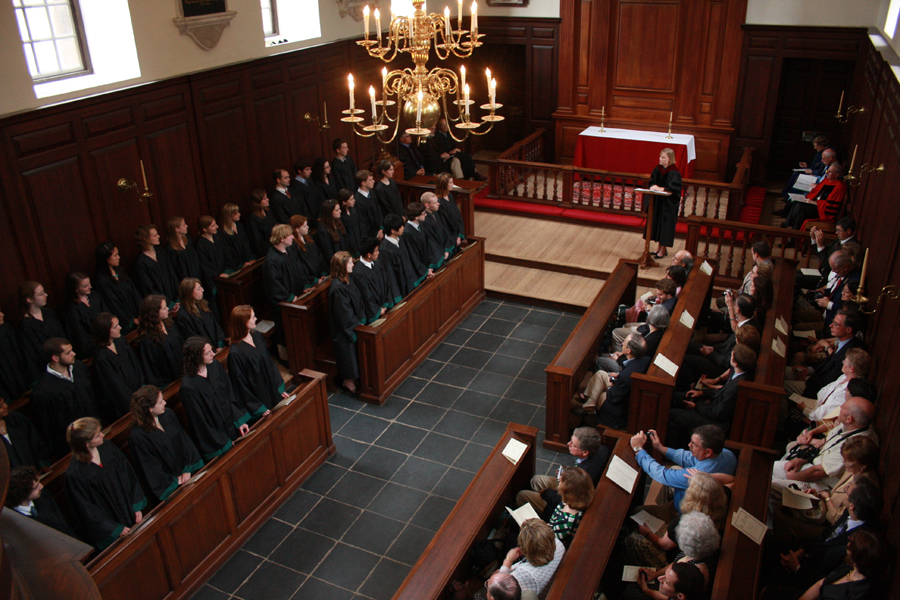
Five William & Mary students led by John Heath gathered on Dec. 5, 1776, to discuss a bold idea: the formation of a fraternity devoted to “attaining the important ends of society.”
What emerged from the Apollo Room of Williamsburg’s Raleigh Tavern that night was Phi Beta Kappa, the nation’s first fraternity and, today, its most prestigious collegiate honor society.
In two weeks, Phi Beta Kappa will return to its birthplace to mark the onset of its 250th year — 249 years-to-the-day later — and to launch an 18-month celebration of its founding.
On Dec. 5, W&M will host a keynote program to kick off the anniversary year, titled “Honoring the Past, Embracing the Future: The Arts & Sciences in Conversation.”
The event will be held, aptly, at Phi Beta Kappa Memorial Hall.
The program will feature a panel discussion with Katherine A. Rowe, president of William & Mary; Frederick M. Lawrence, secretary and CEO of the Phi Beta Kappa Society; and Clifford B. Fleet III ’91, M.A. ’93, J.D. ’95, M.B.A. ’95, president and CEO of The Colonial Williamsburg Foundation. The keynote will be moderated by Ann Marie Stock, presidential liaison for Strategic Cultural Partnerships.
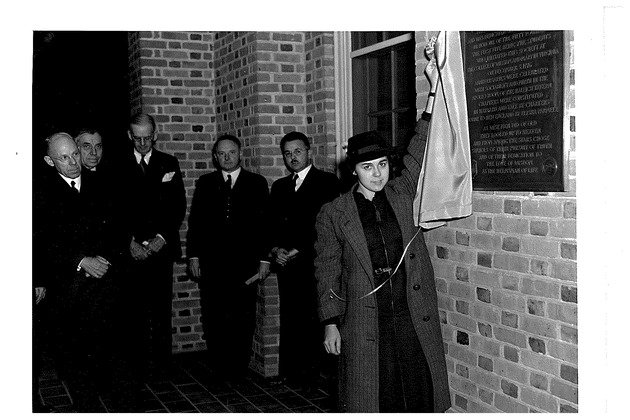
“The Phi Beta Kappa Society is delighted to return to Williamsburg and W&M, to honor our alpha chapter and its essential role in the creation of Phi Beta Kappa,” Lawrence said. “Their commitment to free inquiry, academic freedom and to the love of learning were inspirational then and inspire us still. They understood that liberal arts and sciences education is essential for a thriving democracy and flourishing cultural institutions.”
Together, these three flourishing cultural institutions will reflect on the enduring power of the liberal arts and sciences as the bedrock of American democracy — and W&M as the birthplace of American civic leadership.
A celebration of ideas, where it all began
Williamsburg is where revolutionary thinking took root — not just politically, but intellectually. The same soil that nourished American independence also cultivated the idea that education, inquiry and the free exchange of ideas was fundamental to the republic’s survival.
When PBK formed in 1776, its purpose was to create a distinctly American intellectual heritage. Its very founding represented a revolution against universally prescribed learning traditions based on European modes of thinking.
Unlike the university’s other secret societies — the FHC (the Flat Hat Club) and the PDA (Please Don’t Ask) societies — PBK was an organization with a serious purpose, despite the organization’s genesis in a tavern.
At early meetings, 27 bylaws demanded “four members be selected to perform at each session, two of whom in matters of argumentation and the others in apposite composition.” Oral and written argumentation between members was the central purpose of PBK meetings.

The 250th anniversary of Phi Beta Kappa coincides with the United States’ own semiquincentennial in 2026. The December keynote marks a strategic milestone for William & Mary’s Vision 2026 initiative, advancing the university’s national preeminence to convene important conversations and collaborate with distinguished institutional partners. W&M is leading semiquincentennial efforts across the Commonwealth, leveraging its unique historical and cultural resources to ensure the nation’s origins stories are every American’s shared story.
“W&M convenes people and institutions that strengthen American civic life,” Stock said. “We are honored to bring distinguished partners like PBK and The Colonial Williamsburg Foundation together around consequential questions and model the habits of inquiry, dialogue and shared purpose that sustain a resilient democracy.”
The Alpha Chapter of Virginia — W&M’s own, the intellectual descendant of the original five students — has remained a symbolic heart of Phi Beta Kappa since the society’s revival in the 19th century, continuing to champion the values born in that first Raleigh Tavern meeting: the liberal arts and sciences as essential to citizenship, leadership and to democracy itself.
“The origin story of Phi Beta Kappa is inspiring,” said Jonathan Scheerer, vice president of the Alpha Chapter of Virginia, and Garrett-Rob-Guy, professor of chemistry at W&M. “The core values that emerged with the creation of the society hold meaning today, open discourse and radical thinking about what was needed to make a nation or remake a better one.”

The guide of life
PBK was born in a moment when American democracy itself was an experiment — when free inquiry and reasoned debate weren’t luxuries but necessities. Almost 250 years later, that experiment continues.
On Dec. 5, three institutions will convene where it all began, not just to commemorate five students in a tavern, but to reaffirm what they created: the idea that a democracy could sustain itself through the hard, unglamorous work of listening, thinking and arguing well.
Phi Beta Kappa’s founding motto remains its charge: Philosophia Biou Kubernetes — “the love of learning is the guide of life.” That work continues today in 293 chapters nationwide, in classrooms and communities where rigorous thinking and civil debate still matter. The love of learning isn’t a motto; it’s a mission.
Williamsburg is where that mission became American.
The Dec. 5 program begins at 4 p.m. in the Glenn Close Theatre inside Phi Beta Kappa Hall, 601 Jamestown Rd. The event is free and open to the public, but seating is limited. Please RSVP by Dec. 1, 2025.