
The following story originally appeared on the website for W&M’s School of Computing, Data Sciences & Physics. – Ed.
What happens when students from different academic backgrounds come together for a weekend of creativity, collaboration and coding?
At William & Mary’s annual &hacks competition, the possibilities are nearly endless.
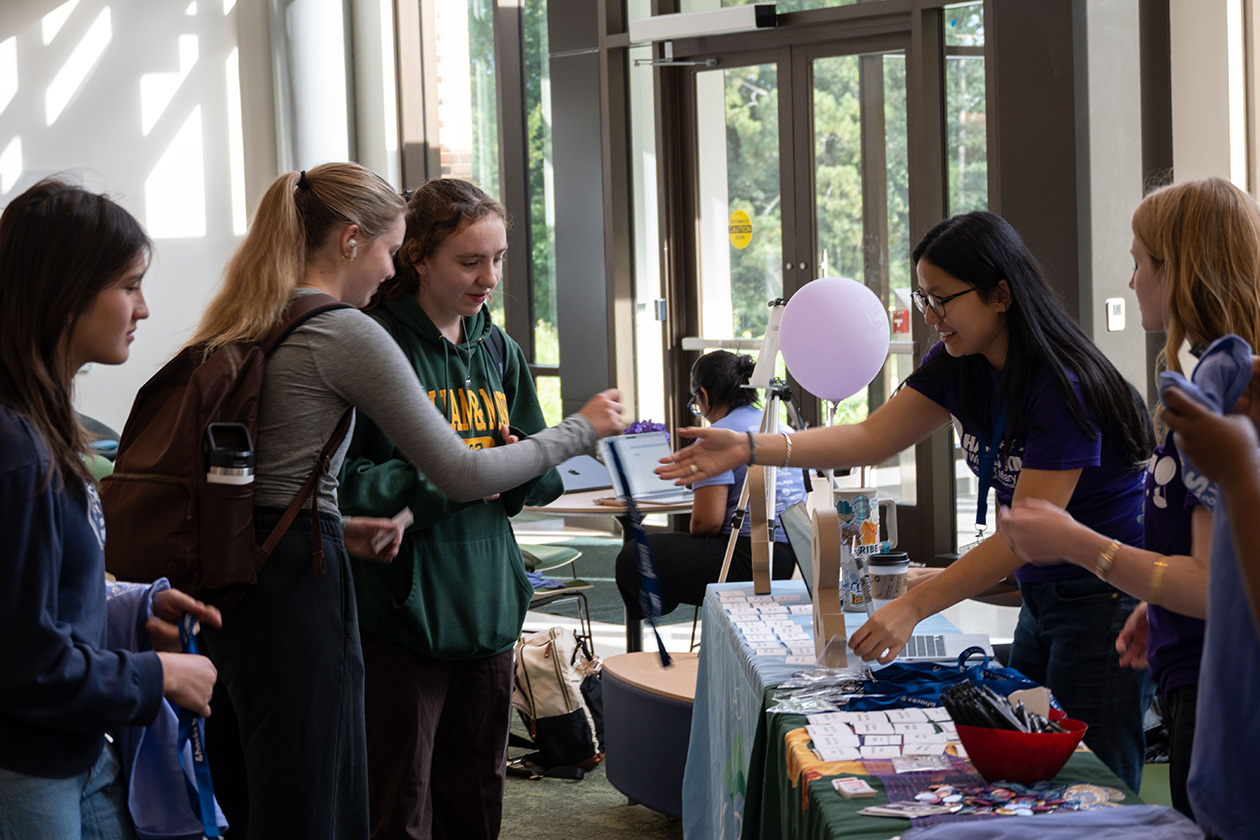
Held in Integrated Science Center 4 from Sept. 26-27, this year’s hackathon brought together students, alumni and faculty to explore how computing and artificial intelligence can transform imaginative ideas into innovative solutions. With a theme of “AI and Imagination,” the event challenged participants to think beyond traditional applications of technology and discover new ways to put AI to work.
The competition attracted students from a wide range of disciplines, including business, computer science, social sciences and linguistics. By the end of the weekend, participants had developed 34 projects spanning everything from health sciences to interactive English language learning games.
For student organizers Lynn Egan and Libby Knight, one of the primary goals was to demonstrate that AI can be more than a tool for generating content.
“Our idea was to not just have AI be this generative thing,” said Knight. Instead, they wanted participants to explore how AI could help them accomplish specific tasks and develop practical applications.
Making computing accessible to everyone
While hackathons traditionally attract students with programming experience, &hacks organizers worked to make this year’s competition accessible to participants of all skill levels.
“People were able to go to (Major League Hacking) mentors, who are our co-sponsor of the event, and we had a social meet with people so you can meet people in other majors,” said Egan.
Special competition tracks, including one focused on linguistics, encouraged students to explore the connections between computing and other fields. Faculty and students from linguistics supported the event throughout the weekend, helping participants discover new ways to apply technology to the study of language.
Reflecting the theme, many teams incorporated AI into their projects.
“I think some people who had computer science foundations were using it to just speed along coding processes by telling it what sort of architecture to build instead of hard coding things,” said Egan. “But I think for beginners, it really walked them through how to set up an API and how to work software, what you need to download, what’s an IDE, and stuff like that.”
Knight said the integration of AI helped lower barriers for students with limited programming experience.
“Even if you’re not super techie, we allowed people to use AI and it allowed them to do a lot more than what they usually would have been able to do without it,” stated Knight.
The result was an environment where students could experiment with new technologies, learn from one another and pursue projects that might otherwise have seemed beyond their technical abilities.
Where computing meets linguistics
One example of this interdisciplinary approach was Etymogle, an etymology-based daily word guessing game created by Bennett Matuszewski, a senior double majoring in computer science and business analytics.
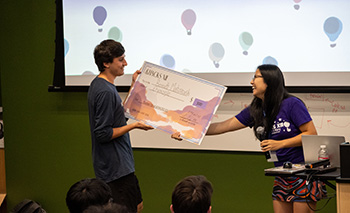
The project, which earned the competition’s overall runner-up award, combined Matuszewski’s programming skills with his personal interest in linguistics and education.
“I think linguistics is an interesting thing, I enjoy learning about it in my free time,” Matuszewski explained. “I figured it’d just be a good opportunity to use my computer science skills and kind of combine them with the linguistics and education route and then just turn it into something that’s just fun to play.”
Like many projects this year, Matuszewski incorporated AI into his development process by pulling online data and then using an AI assistant to help select fonts and shape the visual design of the Etymogle platform.
“I definitely relied on AI to kind of bring my vision to life,” Matuszewski said.
His project illustrated one of the central ideas behind this year’s competition, that combining technical knowledge with interests in other disciplines can lead to creative applications of emerging technologies.
Exploring new possibilities through collaboration
Beyond the projects and awards, &hacks provided students with an opportunity to step outside their academic comfort zones, collaborate with peers from different disciplines and discover new ways to apply their skills.
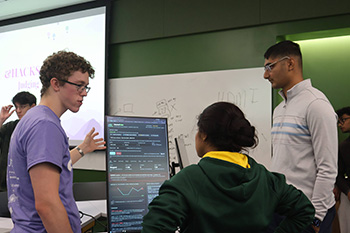
The event also reflected William & Mary’s broader commitment to interdisciplinary learning, demonstrating how the liberal arts and sciences, combined with computing, can help students approach challenges from different perspectives.
For Knight, the experience is especially valuable for students still exploring their academic interests and future career paths.
“I think it’s a great idea for students who don’t really know what they exactly want to do with their major or career,” she said.
By encouraging students to experiment, collaborate and turn their ideas into working projects, &hacks demonstrated that innovation isn’t limited to any one major or field of study. Sometimes, all it takes is a little imagination and a willingness to try something new.