
The following story originally appeared on the W&M Alumni Magazine website as an online exclusive. – Ed.
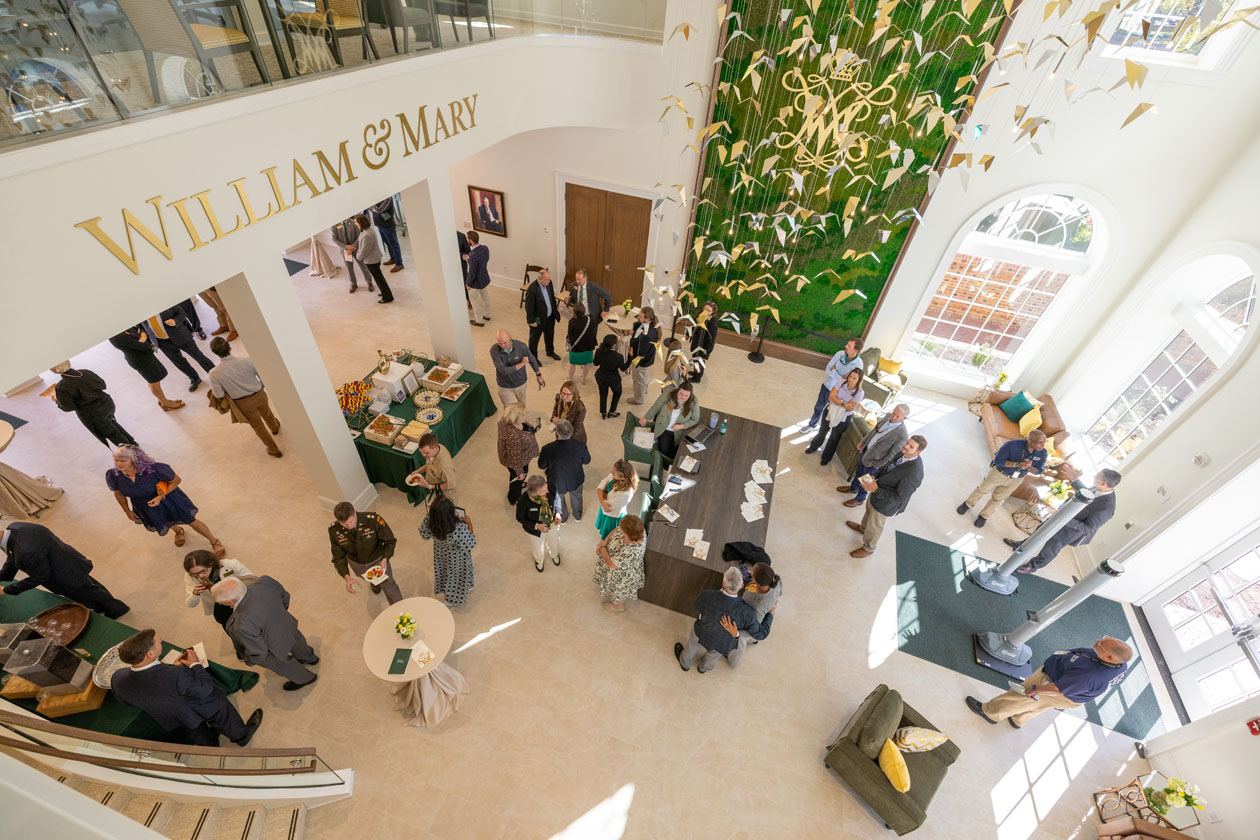
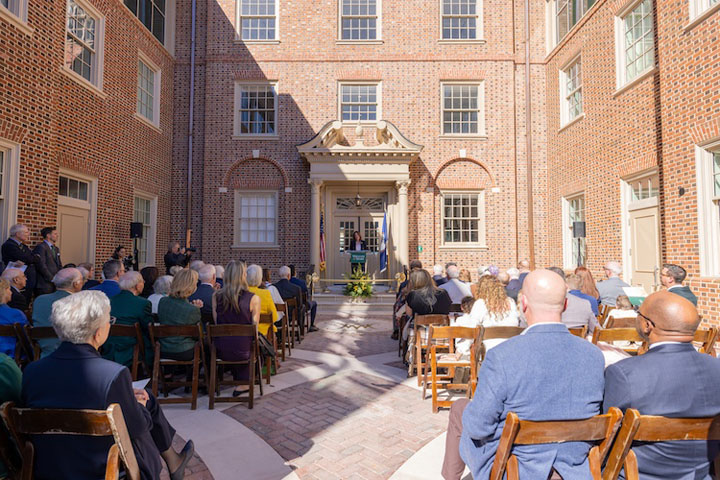
As afternoon sun warmed century-old bricks, over 250 members of the William & Mary community gathered on Oct. 22 to dedicate Robert M. Gates Hall, a historic building with a 21st- century purpose.
Thanks to a $30 million lead gift from an alumna and former W&M Foundation trustee who wishes to remain anonymous — and to the generosity of many other donors — the property has been renovated, expanded and renamed in honor of former U.S. Secretary of Defense and current William & Mary Chancellor Robert M. Gates ’65, L.H.D. ’98. The transformed building, which is owned and operated by the W&M Foundation and formerly known as Brown Hall, will serve as a cutting-edge hub for research and teaching that spans disciplines and addresses critical global challenges.
Gates Hall will be home to five centers and institutes engaged in international development, conservation, national security, foreign policy and statecraft: AidData, the Global Research Institute, Institute for Integrative Conservation, Robert M. Gates Global Policy Center, Robert M. Gates Initiative in American Statecraft and Whole of Government Center of Excellence.
The naming of Gates Hall reflects a commitment to cultivating civic leaders who can look to the building’s namesake as an inspiring role model. As U.S. secretary of defense, Gates was hailed as a strategic problem-solver who transcended politics and cut through bureaucracy to strengthen the nation’s security. He is the only defense secretary in U.S. history to serve in successive Republican and Democratic administrations.
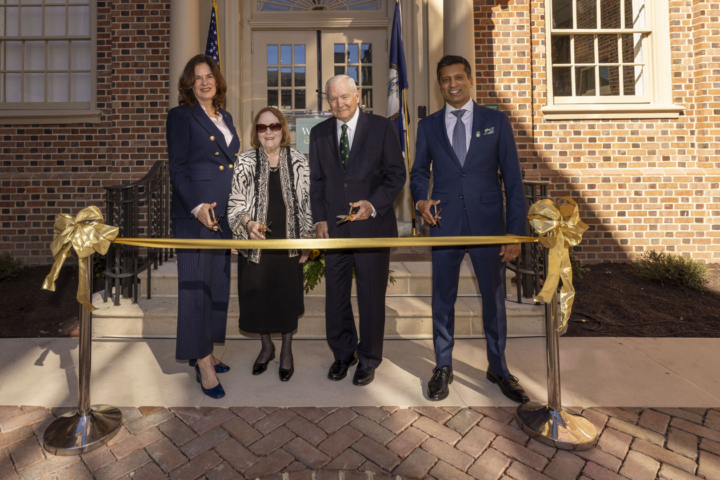
“Years ago, a kid from Kansas used to walk down these streets in the evenings, mulling William & Mary’s legacy in our country,” said President Katherine A. Rowe. “It was during those late-night walks that Robert M. Gates committed himself to a lifetime of public service. He soaked in all the knowledge he could during his time here and spent his life giving back to our nation.”
Gates said it is fitting that the building is opening during William & Mary’s Year of Civic Leadership.
“William & Mary and its students, faculty and graduates have played a formative role in the life of the American republic,” he said. The university’s emphasis on civic leadership, combined with the opening of Gates Hall, “makes manifest that this university will continue to play a leading role in charting America’s future — just as it did in 1776 and has done since.”
W&M Foundation Chair Darpan Kapadia ’95 acknowledged the generosity of the anonymous lead donor in launching the project. Noting that the Foundation has owned the property since 1939, he also lauded the partnership between the W&M Real Estate Foundation and university leaders in making the vision for Gates Hall a reality.
“Gates Hall shows what’s possible when philanthropy, the Foundation’s resources and expertise, and the university’s academic ambitions come together,” Kapadia said. “It’s the role we aspire to play: not simply raising and stewarding capital, but helping advance William & Mary’s highest strategic priorities.”
The revitalized building advances those priorities by bringing students and faculty from various academic fields together with practitioners and industry partners to develop practical, nonpartisan solutions to challenges such as economic development, geopolitical conflict, national security and biodiversity conservation.
The 35 faculty and staff of AidData are looking at the move into Gates Hall as an opportunity to expand their agenda-setting and convening role, amplifying diverse and underrepresented views, and to aid decision-makers in both the Global South and Global North. The team will also draw on its unique sources of data and analysis to speak to hot topics and live debates, challenging conventional wisdom and addressing evidentiary blind spots.
As home to the Gates Initiative in American Statecraft and the Gates Global Policy Center, Gates Hall will host programs that convene leaders from across the political spectrum to reform and strengthen U.S. nonmilitary instruments of power. Those include the next Gates Forum in spring 2027 on the topic of U.S. alliances.
Additionally, the Gates Initiative in American Statecraft is collaborating with AidData— known for its extensive research into China’s international lending — on a working group that pulls together leading experts and invests in research on the future of development assistance to foreign nations. The initiative also partners with the Global Research Institute (GRI) on the American Statecraft cohort of the Global Scholars Program that will be taught in Gates Hall.
For the next three years, GRI will also incubate the Security, Conflict and Peace Evidence Lab — a collaboration between GRI and the College of Arts & Sciences that seeks to leverage data to better understand the effectiveness of policy interventions in the areas of development, intrastate conflict and illicit finance. Among GRI’s other current projects is designing and developing an artificial intelligence-powered assessment system for STEM education that draws upon expertise in W&M’s School of Education and Department of Computer Science. This responds to a yearslong national trend of lagging K-12 student tests scores in math and science.
In February 2027, the Whole of Government Center of Excellence (WGC) will partner with W&M’s Military & Veteran Affairs team to host the Australia, United Kingdom and United States (AUKUS) Summit in Gates Hall, featuring Gates as the keynote speaker. The WGC also will teach the next cohorts for its programs with the U.S. Treasury Department and other federal agencies. Students involved in the center’s National Security Internship Program will have a home base as they start their careers.
Amy Tsanga ’29, a student from Zimbabwe who spoke at the dedication, said that when she learned about AidData’s research on China’s lending and health equity in Kenya, she began to see William & Mary as a place that provides a platform for students from all academic backgrounds to participate in global research.
“Gates Hall will make these kinds of experiences more accessible to students,” she said. “For my team at the William & Mary Global Innovation Challenge, having a dedicated space alongside the Whole of Government Center will be invaluable as we launch our student competition with NATO Allied Command Transformation, inviting students from around the world to develop nuclear deterrence policy solutions and present their recommendations to senior NATO leadership here on campus in the spring.”
Building on relationships established since the launch of the Institute for Integrative Conservation(IIC) in 2020, Gates Hall will provide a hub for bringing partners from across the university and around the world together to advance research for conservation impact. Through collaborative projects that address real-world conservation challenges, students and faculty work directly with partners to develop solutions, from recovering endangered black-footed ferrets in Colorado and Montana to cultivating sustainable agriculture in South Africa and restoring eelgrass in the Chesapeake Bay.
“This hall represents a major William & Mary commitment to the kind of collaborative, multidisciplinary research and teaching so essential to addressing the formidable challenges facing our country and the world,” Gates said. “The work done here will place William & Mary in the vanguard of global problem solving and preparing students for leadership and public service.”
Gates Hall’s new mission revitalizes a building that ended its use as a residence hall in 2021. The structure is located at the corner of Prince George and North Boundary streets, across from William & Mary’s Historic Campus at the outer boundary of Colonial Williamsburg. Named in honor of a Methodist family who helped to fund construction, the former Brown Hall was built in 1930 by the Women’s Missionary Society of the Virginia Methodist Conference. It originally served as an off-campus residence for Methodist women students at William & Mary. Later, it served as men’s housing, Army housing, rented space for service families, upperclassmen residences and most recently a freshman residence hall.
Located on the original site of the Williamsburg Bray School, Gates Hall also will provide an opportunity to further explore the education of enslaved and free Black children in the 18th century. A historical marker at the site commemorates the Bray School’s foundation in 1760 and operation there for several of its 14 years. The surviving Bray School building was moved to a different location on Prince George Street in 1930 and relocated to Colonial Williamsburg property in 2023.
Designed with input from the Bray School’s Descendant Community, exhibits inside Gates Hall honor and tell the story of the Bray School and the children who studied there. Those include a fragment of the foundation that is encased in glass for protection. Students and scholars will have access to many of the artifacts discovered at the site in Colonial Williamsburg’s new Colin G. and Nancy N. Campbell Archaeology Center. Other artifacts are being studied by W&M’s Center for Archaeological Research.
Representatives of the Bray School’s Descendant Community, partners from The Colonial Williamsburg Foundation and local merchants attended the dedication, along with university administrators, board members, supporters, faculty leaders, alumni and friends.
As a LEED Gold-certified, state-of-the-art facility, Gates Hall incorporates bio-design elements that reflect qualities fundamental to the IIC. Using sustainable design principles, the construction project reduced waste by renovating rather than demolishing the building. Gates Hall incorporates gathering spaces and common areas to spark collaboration and redefine how academic structures can help advance big ideas.
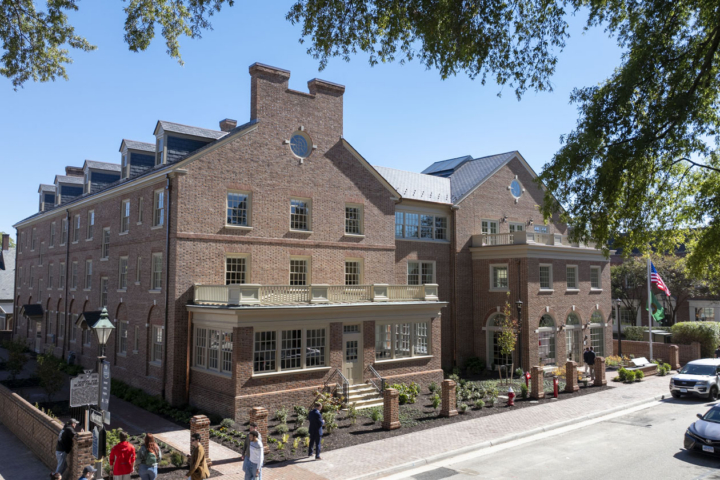
The reimagined structure encompasses two wings with a courtyard in the middle. Through features such as a spectacular atrium, an outdoor balcony and an outdoor learning space, the design connects the built environment with the natural environment, the inside to the outside, people to nature and people to people.
In addition to the lead gift and subsequent donors who have supported the project by naming spaces in the building, endowments have been created to support the academic centers and the long-term care of the building.
Information about giving opportunities and ways to support the work taking place in Gates Hall can be found online.