
The following is an excerpt from a story that originally appeared in the spring 2026 issue of the W&M Alumni Magazine. – Ed.
Bob Wise still has his first computer, a 1979 Apple II that sits in his home office. It’s the same computer on which he taught himself programming as a homeschooled student living on his family’s farm about 20 miles west of Williamsburg. He brought it to William & Mary when he moved into a residence hall at age 16 in the spring of 1983.
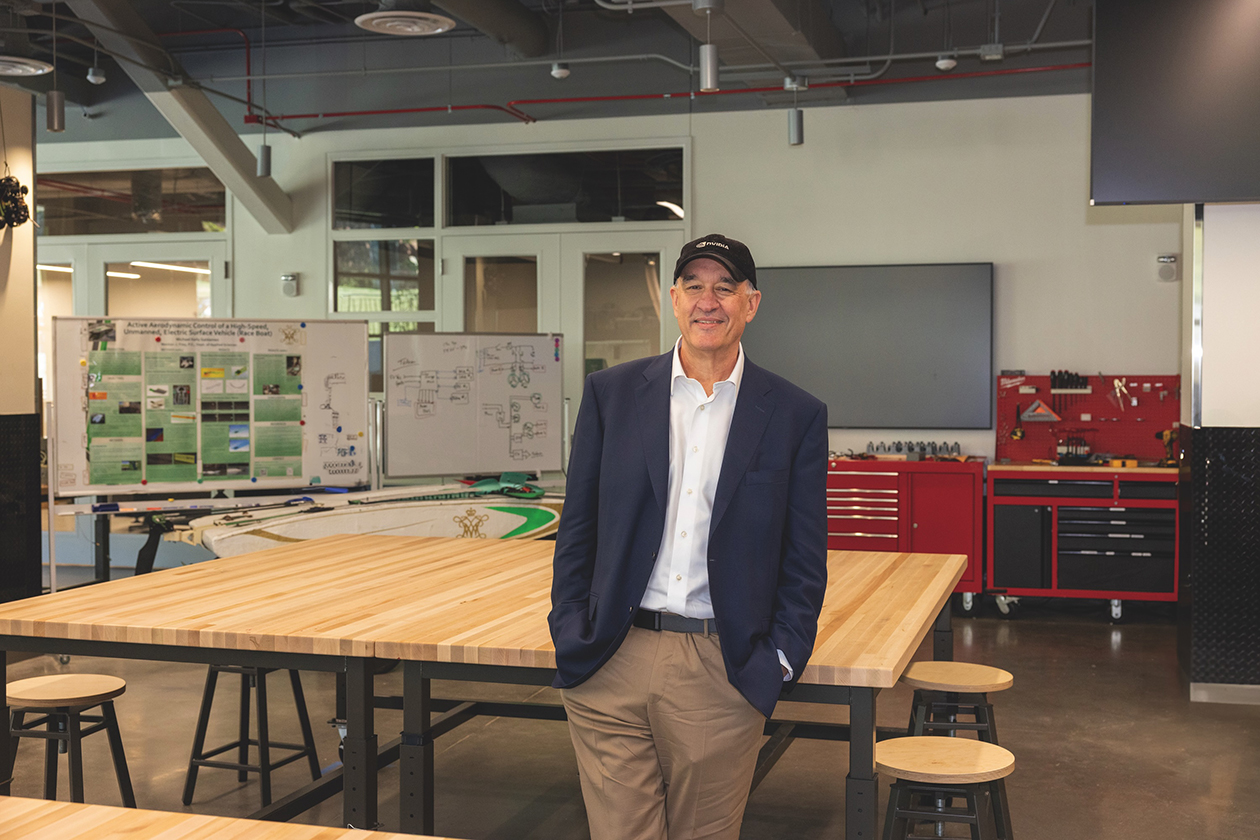
While technology has advanced light years since then, the original equipment holds sentimental value for Wise. He is now vice president for engineering and operations at Nvidia, where he leads infrastructure management for artificial intelligence researchers. The world’s most valuable company, Nvidia is worth more than $5 trillion.
Nvidia designs and sells advanced computer chips, systems and AI software frameworks that allow high performance computing across numerous industries. Its platforms support data centers, large language models, autonomous vehicles, gaming and robotics through hardware and software integration.
“Access to new technology matters,” Wise told the audience at William & Mary’s School of Computing, Data Sciences & Physics Class of 1975 Speaker Series on April 23. For him, access to that first computer opened the door to independent exploration, which then led him to pursue computer science studies at the university.
Wise, who lives in Auburn, Washington, with his wife, Heather, and has four children, credits William & Mary with helping him develop not only his technological capabilities, but also a broad knowledge base and writing, communication and analytical skills that have advanced his career.
“Few technology businesses are only about the technology,” he says. “Every technology business is a global business and a people business. Having a wider understanding of the world is critical. Understanding other cultures, other languages and the way the world works is so important to everyone. A liberal arts education really helps people prepare for that.”
Seek Out Opportunities
By his own description, Wise was a computer nerd when he arrived at William & Mary: “I was very, very young and green.”
Wise’s parents had decided to teach him and his two sisters at home after realizing when they were early elementary school students that they were struggling in school because they were bored. Wise’s mother, Jessie Wise, became a leader in homeschool education and later co-authored the best-selling book “The Well-Trained Mind: A Guide to Classical Education at Home” with his younger sister Susan Wise Bauer M.A. ’94, Ph.D. ’07. Bauer, who lives on the farm where she and Bob grew up, founded the Well-Trained Mind Academy and the Well-Trained Mind Press and taught literature and composition at William & Mary for 15 years.
Wise and his siblings thrived in the homeschool environment, taking trips to the Williamsburg Regional Library and checking out as many books as they were allowed, and later exploring Swem Library at William & Mary. They also went on field trips, including one to visit their state representative, then-Del. George Grayson J.D. ’76, P ’96, who was also a longtime W&M government professor.
But by age 15, Wise wanted a new challenge. He had taken the PSAT and done well, so he met with the dean of admission at William & Mary and asked if he could take some college classes.
“He said, ‘Well, you’re kind of young, but I’ll let you in part time. And if you do OK, then we’ll talk about whether you can come in full time.’ So I took two classes, and I did OK. I went back, and he let me in full time.”
One of those first classes was with Grayson. “I did a thread of government classes after that,” he says. “It was just so amazing to me that someone could be a professor and be involved in state government.”
Despite his parents’ reservations about his age, Wise moved into campus housing and jumped right into a full course load. At the time, computer science was a fairly new program, later splitting off from the math department in 1984.
“I lived for being in the computer labs,” he says. “I programmed all the time, and it was really just the best possible thing for me.”
Find People to Learn From
Wise had taught himself to program on his home computer, using books and magazines as references. His father, James “Jay” Wise Jr., who was a family physician and chief of emergency medicine at a local hospital, bought him a computer in part so that he could help with automating medical office records.
“I was writing lots of spaghetti code and I’d gotten in over my head,” Wise says. “I was trying to build bigger programs than I could really understand.”
He saw an opportunity at William & Mary to take his programming abilities to the next level. As a freshman, however, he had to get permission to take a computer programming class, which typically enrolled more experienced students. Deborah Smith Noonan M.S. ’81, a new faculty member at the time, accepted him into her CS 141 computational problem-solving class based on his enthusiasm and the programming he’d already done on his own.
“We started talking about structured programming, and I know structured programming is kind of an old thing now, but for me, it was amazing,” Wise recalls. “It was like the lights came on — oh, there’s a different way to approach this. I appreciated her for being so kind to me as a pretty immature young student and letting me take the class, and I took other classes with her as well. I would say she had the biggest impact on me.”
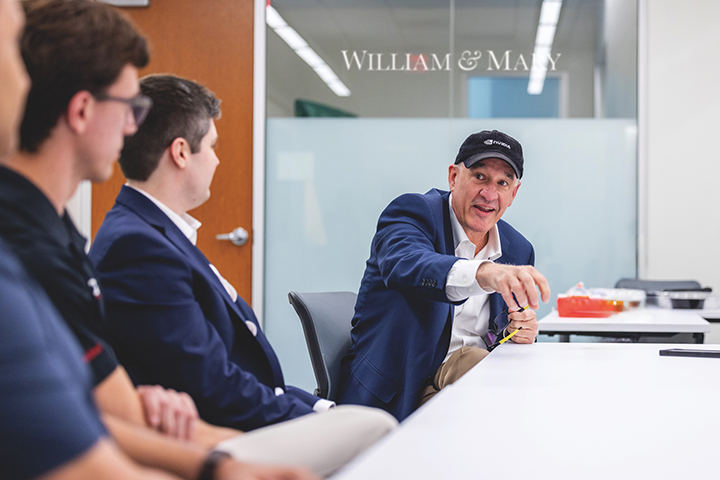
Noonan, now a senior lecturer emerita, attended Wise’s talk in April, which coincided with the dedication of Integrated Science Center 4 (ISC4), home of the new School of Computing, Data Sciences & Physics. She recalls that Wise was an excellent student. She also remembers him as a bit of a practical joker who teamed up with his friend Jim Jones ’82, M.S. ’86 to pull a memorable prank.
“They took magnetic tape and strung it all the way down the main hallway at Jones Hall over the weekend, from side to side, up and down,” she says, laughing. “Then to make matters worse, they put this sign up that said, ‘This is an art project, do not remove.’ The janitors came in and they didn’t know what to do, so they left it. On Monday, no one could get in.”
In addition to the work experience Wise gained by providing information technology support for his father, he assisted William & Mary faculty members with technology needs.
“One of the business professors had written a large amount of Fortran code and needed help optimizing it,” Wise says. “He was doing things that I didn’t even quite understand, but I was able to take his code and help get it smaller and make it run better so that his large analysis jobs were able to run.”
One summer, Wise set up an office in the business school to do IT consulting, and during the academic year, he worked at the computing center help desk in Jones Hall.
“I put my nerdy skills to good use and made money that way,” he says. “One of the jobs I did then, I was making $25 an hour while I was a student doing programming work, which in those days was a lot of money.” For comparison, the hourly minimum wage in Virginia in 1986, the year Wise graduated, was $2.65.
Noonan said she did not know until recently how far Wise’s career has taken him. Prior to his role at Nvidia, he also held leadership positions at Hewlett-Packard, MTN Satellite Communications, Samsung, Amazon Web Services and Salesforce.
“I was blown away,” Noonan says. “I’m very proud.”