
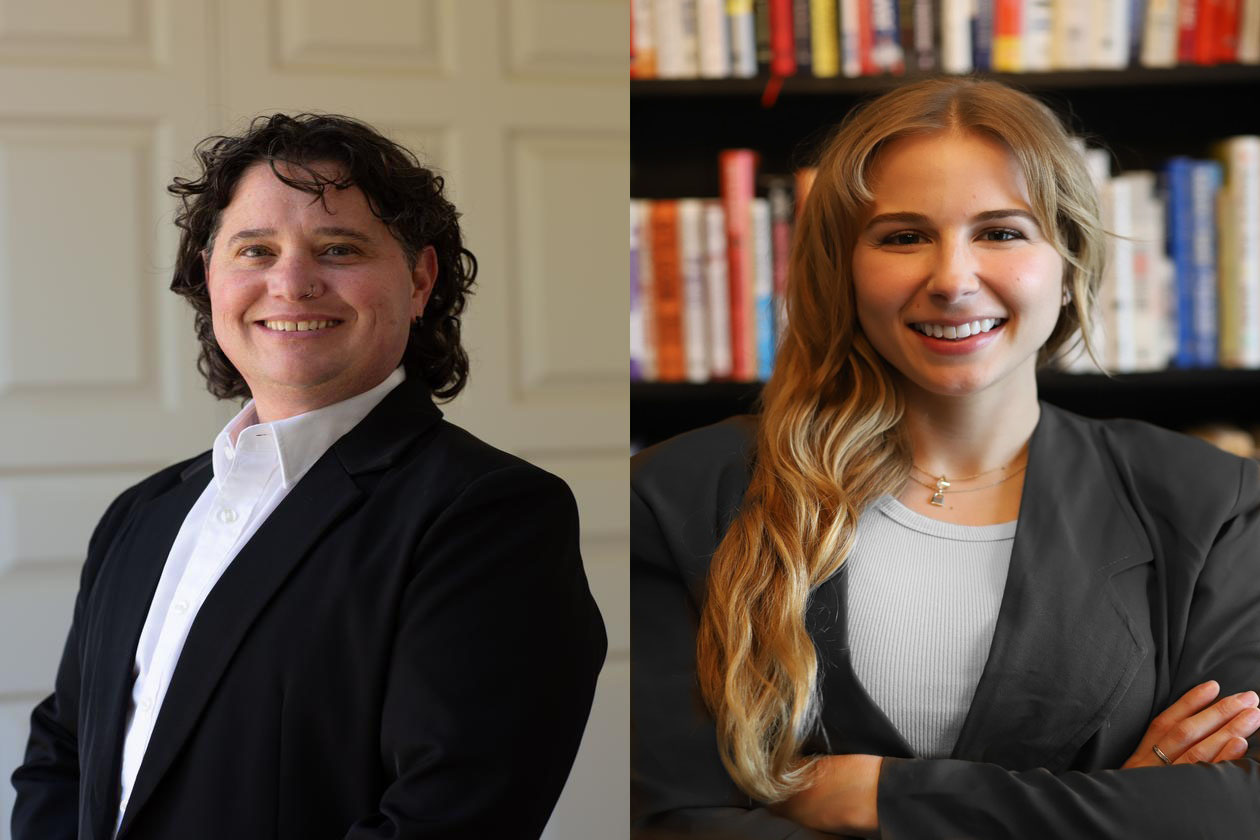
The Values in Action awards recognize staff and faculty at William & Mary who exemplify the qualities the university holds in highest regard: belonging, curiosity, excellence, flourishing, integrity, respect and service.
These awards, established by two anonymous donors with private funds, are awarded in the fall and spring semesters, with each recipient receiving $2,500.
This semester’s recipients are Stephanie Caligiuri, assistant professor of health sciences, and Liz Cascone, senior director for gender-based violence resources and advocacy services. Caligiuri and Cascone will be recognized during the May 15 Commencement ceremony.
Student organizations are separately eligible. To see this semester’s winners, visit the Student Leadership Development website.
Stephanie Caligiuri
If you are what you eat, chances are Caligiuri is trying to figure out why.
“There is a discrepancy between what we know we should do and what we actually do. Why is it that we know we should eat vegetables every day but perhaps we don’t?” said Caligiuiri.
Caligiuri runs the Neurobehavioral Nutrition Lab, where she and a rotating cadre of 20 to 30 student researchers study the intersection of nutrition and neuroscience. She’d be the first to say she couldn’t do it without her students.
“Without their curiosity and passion, there is no discovery. Our students don’t just assist the research, they drive it,” she said.
A native of Canada, Caligiuri has a Ph.D. in physiology & pathophysiology and a master’s in human nutritional science, both from the University of Manitoba. While working on her Ph.D., she realized that behavior modification was one of the most difficult hurdles in patient care. As a result, she focused on behavioral neuroscience to understand how food choices impact the brain and mental health.
That said, the research done in her lab is also driven by what her mentees are interested in. One student is looking at resilience in female Division 1 athletes, another at how creatine supplements might influence levels of fatigue and mood. Under Caligiuri’s direction, students have conducted clinical trials of intermittent fasting, disordered eating and brain activity in dancers.
In her lab, student researchers learn to use advanced techniques such as functional near-infrared spectroscopy (fNIRS), biosensors and metabolomics.
“Dr. Caligiuri fosters a genuine sense of belonging within her lab and classroom,” said Phebe Fahmy ’26. “She intentionally creates spaces where every student feels valued, heard and supported — regardless of background or prior experience. Students are not just assistants — we are respected scholars and contributors.”
Caligiuri was also praised by students for her holistic approach.
“Whether it is making time to set up a meeting to answer questions, assisting students with the post-grad job search by reviewing resumes and cover letters or writing letters of recommendation, Dr. Caligiuri is there to help,” said Carlie Meyerholz ’26. “She takes an active role in student success.”
Caligiuri is sending students into the world to be dietitians, doctors and researchers. “The goal of the lab is to understand the physiology of why we eat the way we do and to use that to our advantage to promote mental health and cardiometabolic health,” she said.
To meet that goal, her students say, she invests deeply in undergraduate mentorship — creating meaningful research opportunities and guiding them through the complexities of academic and professional development.
“What makes her truly exceptional is the consistency of her mentorship — she shows up for her students in moments both big and small,” Fahmy said. “Whether guiding us through graduate school applications or helping us navigate setbacks in research, she approaches every challenge with patience, honesty and encouragement.”
Liz Cascone
As the founding director of The Haven, William & Mary’s strictly confidential support center for students who have experienced gender-based violence, Cascone has laid a foundation for a campus culture that prioritizes compassion, advocacy and survivor support.
“Liz is a wonderful mentor and leader at William & Mary,” said Mary Catherine Slagle ’26, a student volunteer at The Haven. “Her commitment to advocacy shines every day, and I have been so lucky to learn from her. She is the epitome of service.”
Cascone leads a staff of mostly volunteers – called “peer advocates” – like Slagle, whom she trains to work with students who come to The Haven seeking help. Cascone, who has a master’s in social work from Virginia Commonwealth University and has worked in the field for 26 years, says the best part of her job is her interaction with her student volunteers.
“What I love about this job so much is working with our students and helping them understand how to be present with survivors,” she said. “They’re getting real experience and applying it in a practical way. We have a unique student body here, and they really, really care a lot about this issue.”
One of Cascone’s signature achievements has been the recent implementation of the “adaptable resolution,” a process that centers the needs and safety of an impacted party while striving for compliance and accountability.
Adaptable resolution allows complainants and respondents to find an alternate pathway to resolution of the harm that was experienced, one rooted in restorative justice rather than an investigative process.
“This pathway allows students to identify outcomes that feel meaningful to them, whether that includes facilitated dialogue, educational interventions, protective measures or other tailored agreements,” said Candice Fox, assistant director and sexual violence prevention specialist.
When appropriate, respondents are given structured opportunities to reflect, learn and understand the impact of their behavior — an approach that supports behavioral change and helps disrupt cycles of harm.
“Sometimes what is most meaningful to a survivor is an acknowledgment of the impact of the harm that was done to them,” Cascone said. “A true apology acknowledges the impact of the harm, expresses remorse for harm done and includes behavioral changes to ensure that the harm will not occur again.”
While she says the bottom line has always been that abusive behavior of any kind will not be tolerated, Cascone gives the university credit for a willingness to try different approaches.
“The goal is to prevent these things from happening in the first place, but that’s the pie-in-the-sky dream,” she said. “What I’ve been really excited about is the openness of this university to try new things.”
“The campus is undeniably safer, more responsive and more compassionate because of Liz Cascone,” Fox said. “Her leadership has left a lasting imprint on this community, and her continued dedication ensures that resources, support and advocacy grow stronger each year.”
Susan Corbett, Communications Specialist