The following story originally appeared on the website for the School of Computing, Data Sciences & Physics. – Ed.
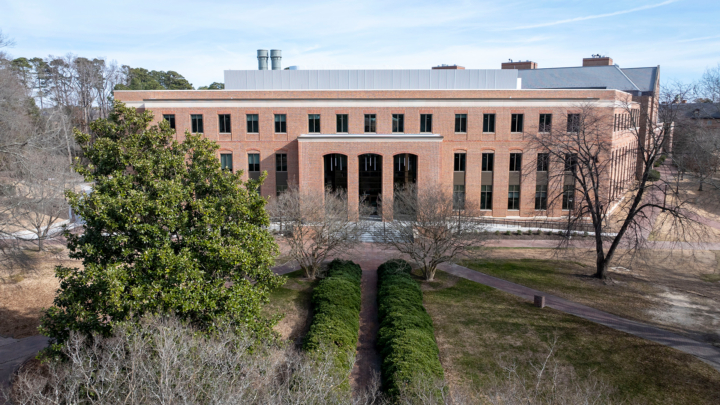
William & Mary’s first new school in more than 50 years takes a major step forward with the opening of Integrated Science Center 4 for the spring 2026 semester. The latest phase of the ISC complex serves as the home for the School of Computing, Data Sciences & Physics.
The school’s computer science and data science departments will also move to ISC4, while some offices and labs from the school’s applied science department will relocate from ISC3 to the new facility. Physics will continue to be housed in Small Hall, which is directly across from ISC4 through the sundial in front of Swem Library.
“ISC4 is a major step forward for William & Mary’s academic vision,” said Provost Peggy Agouris. “By bringing these departments together in one purpose-built space, we are expanding what interdisciplinary research and education can achieve. This facility gives our faculty and students the tools and collaborative environment they need to drive discovery and innovation in a rapidly evolving world.”
Built on the former site of Millington Hall, the 124,000-square-foot building, along with 10,000 square feet of renovated space connecting it to the existing ISC complex, strengthens William & Mary’s ability to support teaching, research and collaboration in some of STEM’s most rapidly evolving fields.
“This new facility is more than a building for undergraduate and graduate courses — it’s a catalyst for learning, research and innovation,” said Douglas C. Schmidt, dean of the School of Computing, Data Sciences & Physics. “Cutting-edge infrastructure like ISC4 and a collaborative research ecosystem empowers students and faculty to explore transformative ideas and create solutions that impact the world.”
A new home for innovation
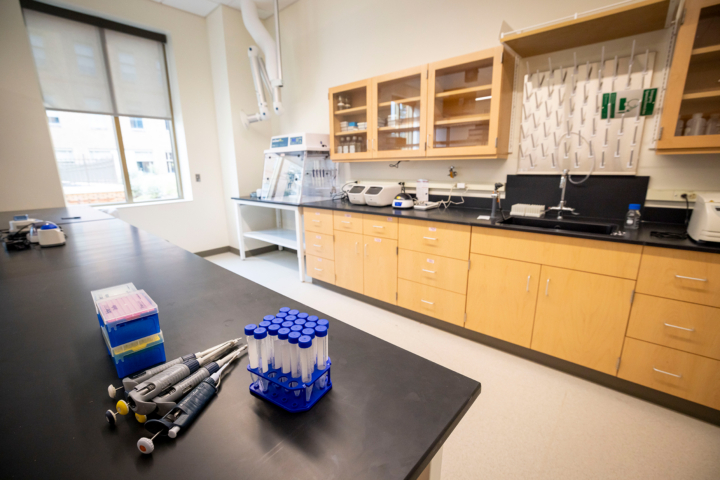
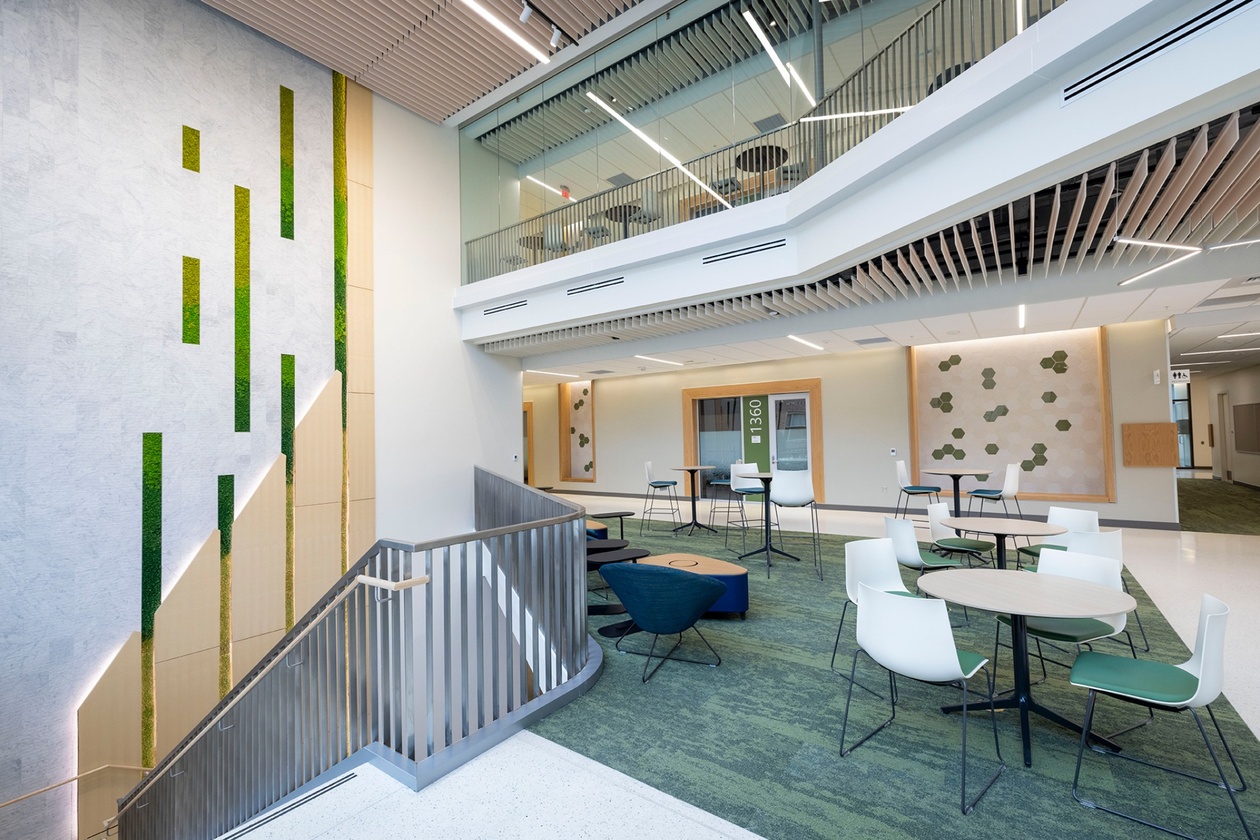
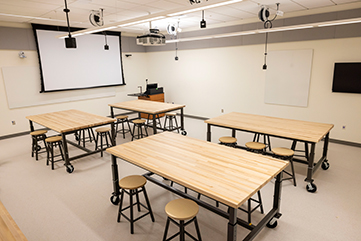
ISC4 features numerous small- and medium-sized classrooms, a large interactive classroom, a 150-seat lecture hall, multiple collaboration spaces and more than 35 instructional and research labs, including several glass-front display labs that allow those passing by to watch research taking shape.
“ISC4 strengthens the university’s commitment to hands-on learning, collaborative inquiry, and innovation that serves society,” added Agouris. “The opportunities this building creates for students, from hands-on research to collaborative problem‑solving, will shape their academic journeys and the impact they make long after they leave William & Mary.”
The ground floor of ISC4 will also be home to the university’s new makerspace, opening later this spring, with more than 8,000-square-feet for hands-on design, experimentation and creative problem-solving. The expansive design lab will be supported by dedicated rooms for processing hard, soft and hot materials, along with rooms for laser cutting and 3D printers. Together these spaces will provide students and faculty with the resources to move ideas from concept to prototype, supporting innovation across campus.
Eric Bradley, the chair for the Department of Applied Science, has been working on the ISC4 project since 2019 and said it has been one of the most rewarding milestones of his career.
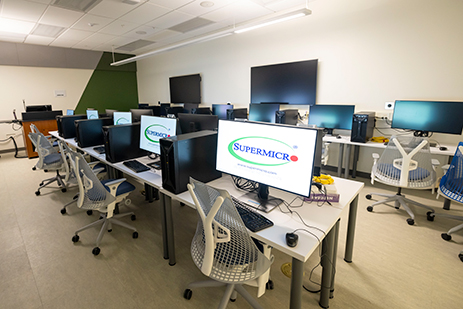
“From vision to completion, this building represents a powerful investment in the future of discovery and impact,” stated Bradley. “ISC4 unites computational and the applied sciences in a single, dynamic environment — featuring state-of-the-art computational programs, exceptional makerspaces, core labs and engineering facilities. It will empower faculty, staff and students to pursue novel, applied research that directly addresses pressing local and global challenges, transforming bold ideas into real-world solutions.”
Continued momentum
ISC4’s opening comes at a time of remarkable growth within the school’s departments, reflecting increasing national demand for expertise in areas such as software development, data analytics, artificial intelligence, cybersecurity, computationally driven scientific research and bioengineering.
That growth is reflected in enrollment trends over the past decade.
Between 2015 and 2025, the number of computer science majors more than doubled, increasing by 117%, while enrollment in physics grew by 36%. Since the launch of the bachelor’s degree in data science in 2021, enrollment in the program has risen by 167%, underscoring the expanding role of data-driven approaches across the sciences.
The data science minor is the most popular at W&M, with more than twice as many declared minors as the next most popular option, and a new minor in AI was introduced in fall 2025.
William & Mary’s computer science program has surged 28 places in the past two years to reach 54th in the U.S. News & World Report, now the university’s highest-ranked undergraduate program.
The school continues to explore additional undergraduate and graduate degree offerings to better prepare students for rapidly evolving careers at the intersection of technology, health and science while equipping them with the analytical, technical and ethical skills to lead in research, innovation and global problem-solving.
“ISC4 represents the energy and ambition of the School of Computing, Data Sciences & Physics and the extraordinary faculty and students who are driving its success,” said Schmidt. “By reaching across departments and disciplines, we are creating an environment where innovation thrives, discovery accelerates and students gain hands-on experience that prepares them to lead in a rapidly changing world.
“This building helps ensure our undergraduate and graduate students leave William & Mary as the adaptable, creative thinkers our future demands.”