
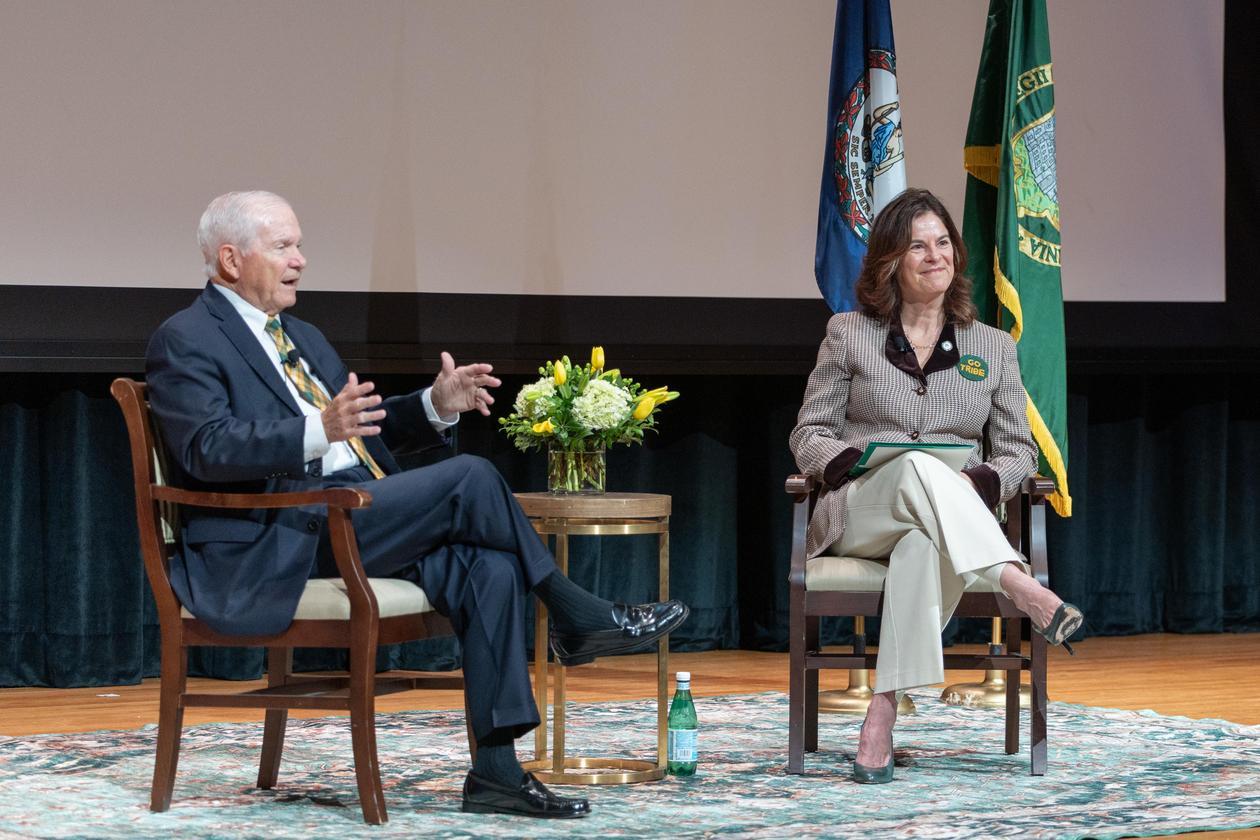
As William & Mary marks both its Year of Civic Leadership and the nation’s 250th anniversary, President Katherine A. Rowe and Chancellor Robert M. Gates ’65, L.H.D. ’98 returned to a question that has shaped the university since its founding: What role does the Alma Mater of the Nation play in preparing the next generation of leaders?
That question framed a wide-ranging Homecoming & Reunion Weekend conversation at the Sadler Center on Saturday. The discussion covered global security challenges, the changing nature of American leadership, the promise and risk of artificial intelligence, and the importance of a liberal arts & sciences education in equipping graduates to succeed.
“During the Year of Civic Leadership, we have been thinking deeply about what it means to be the Alma Mater of the Nation,” Rowe told the audience. “The ideals that animated our founders are homegrown here.”
The discussion came just days after the dedication of Robert M. Gates Hall, the first building in the nation to bear the former secretary of defense’s name.
Recalling his arrival at William & Mary as a 17-year-old. His initial intention was to become a doctor before encountering a significant obstacle.
“I started out as pre-med,” Gates joked. “But I didn’t do so well in calculus.” He changed his major to history in his sophomore year, a decision that ultimately launched one of the most distinguished government careers in modern American history.
“My path toward public service began here,” he said.
Gates spent nearly three decades at the Central Intelligence Agency, including service on the National Security Council, and eventually as director of central intelligence. He served as secretary of defense under presidents George W. Bush and Barack Obama — the only defense secretary in American history to serve in Republican and Democratic administrations.
Rebuilding the tools of American statecraft
Much of the discussion centered on how William & Mary can help its graduates restore America’s place in an evolving global order.
Gates said that during the Cold War, the United States successfully deployed a broad range of soft power tools including diplomacy, economic development assistance, strategic communications and technological innovation. But many of those initiatives have since been reduced or eliminated.
While military strength remains important, Gates said the outcome of future competition with nations such as China may depend largely on the effective use of soft power.
The aim of the new Gates Initiative in American Statecraft, is to help students understand how those tools work together and how they can be applied to advance American interests and values. The initiative, a signature center for foreign policy teaching and research, was launched in the spring by William & Mary and the Robert M. Gates Global Policy Center.
“How do you reimagine statecraft?” Gates asked. “How do you integrate all these tools to a huge historical end?”
Equally important, he said, students must learn beyond disciplinary silos, so the initiative will emphasize experiential learning, collaboration and practical problem-solving rather than traditional classroom instruction, Gates said.
The value of a liberal arts & sciences education
Asked about the skills future national security leaders will need in an era shaped by artificial intelligence, Gates stressed the importance of broad intellectual preparation.
“Increasingly, no single discipline is enough,” he said.
Future leaders, he argued, will need exposure to fields ranging from history, economics and foreign languages to communications and AI.
Rowe noted that such demands make a liberal arts & sciences education more valuable than ever. Gates agreed, particularly when it comes to language study.
“You cannot learn a language without learning about the culture and the history of the region where it’s spoken,” he said. Although AI tools can translate words, he said they cannot replace the cultural understanding needed to navigate diplomacy and international relations.
“If you’re negotiating with the Persians and you don’t know the history of Persia and you don’t know the history of Persian negotiators and how long these guys have been around, you don’t know how to negotiate with them,” Gates said. “The language is a door that opens onto a whole new culture.”
Principled leadership
Throughout the discussion, Gates returned to lessons learned during more than four decades in public service.
Asked by Rowe how policymakers should balance principle and compromise, he distinguished between ethical conduct and policy disagreements.
He recalled advising Obama against attempting to repeal “Don’t Ask, Don’t Tell” through executive action. Lasting change required legislative support.
“The only way you get lasting change in Washington is through bipartisan support,” Gates said. “And what’s required to get bipartisan support is compromise.”
That understanding has become increasingly important, he said, at a time when trust in government institutions has eroded.
The rewards of public service, he added, go beyond professional achievement.
“There is a joy in it and a sense of fulfillment of being able to go home at night and say, ‘I moved the ball down the field a little ways,’” he said.
Susan Corbett, Communications Specialist