
William & Mary’s AidData research lab today released a new flagship report and massive dataset that comprehensively tracks China’s lending and grant-giving activities worldwide.
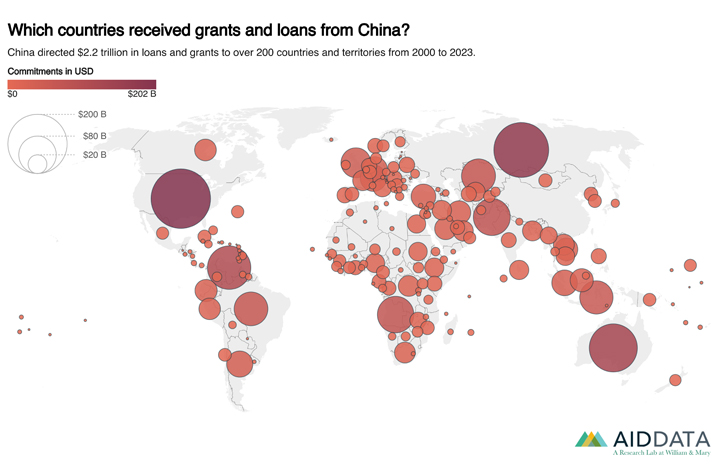
The report, based on data collected by William & Mary students, reveals that the scale and scope of Beijing’s portfolio is vastly larger than previously understood: $2.2 trillion of aid and credit spread across 200 countries in every region of the world.
“The overall size of China’s portfolio is two-to-four times larger than previously published estimates suggest,” said Brad Parks, AidData’s executive director and the lead author of the report.
The report underscores William & Mary’s ability as an R1 institution to produce nonpartisan, globally consequential research that shapes policy and strengthens the university’s national preeminence.
While AidData’s previous reports and datasets have focused on developing countries, this report also includes detailed and comprehensive information about China’s secretive lending and grant-giving activities in high-income countries for the first time. This includes the United States, the United Kingdom, Western European countries, Japan and Australia.
The 300-plus page publication — “Chasing China: Learning to Play by Beijing’s Global Lending Rules” — finds that more than three-quarters of China’s overseas lending operations now support projects and activities in upper-middle income and high-income countries.
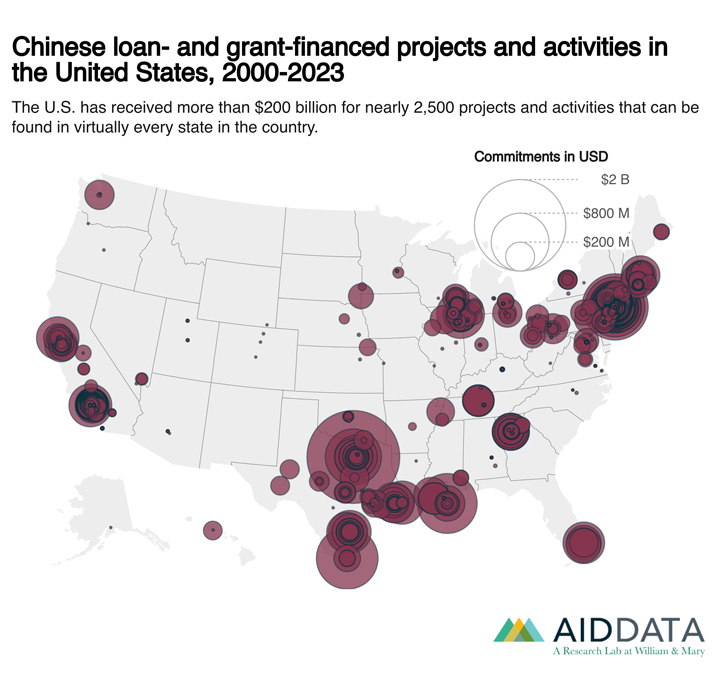
“Much of the lending to wealthy countries is focused on critical infrastructure, critical minerals and the acquisition of high-tech assets, like semiconductor companies,” said Parks.
Among the findings:
- The U.S. has received more than $200 billion for nearly 2,500 projects and activities that can be found in virtually every state in the country.
- The United Kingdom received $60 billion.
- The European Union’s 27 member states received $161 billion for nearly 1,800 projects and activities.
- Top deal-making countries include Germany ($33.4 billion), France ($21.3 billion), Italy ($17.4 billion), Portugal ($11.7 billion) and the Netherlands ($11.6 billion).
The BBC’s “Panorama” program ran a major television story on the report’s U.K. findings yesterday, and more major news outlets also covered the report.
From aid provider to political influencer
China is pulling back from its role as an aid provider that champions philanthropic causes. Instead, AidData researchers find increasing alignment between China’s cross-border lending activities and the policy priorities of the party-state, including those related to national security and economic statecraft.
Meanwhile, its financial operations are becoming more opaque and complex, with many transactions using shell companies in pass-through jurisdictions with strict banking secrecy rules.
The results of the AidData’s 36-month effort have relevance beyond high finance, with implications for geoeconomic and national security strategy.
The report touches on topics as sensitive and varied as the vulnerability of strategic commodity reserves, the reliability of power plants and transmission grids, the control of international maritime choke points, the resilience of global supply chains and national competitiveness in high-tech sectors.
Although governments and alliances (like NATO and the G7) are in open competition with Beijing, AidData finds that many Western or Western-led financial institutions have chosen to collaborate with Chinese state-owned creditors — and many Western companies have borrowed large sums from the same institutions.
According to AidData’s research team, increased competition among the world’s great powers is spilling over into the aid and development finance sector.
“We are witnessing a fundamental reorientation away from the promotion of economic development and social welfare in recipient countries — as a primary goal — and towards the promotion of the economic competitiveness and national security of aid and credit providers,” said Brooke Escobar, associate director of AidData’s Tracking Underreported Financial Flows team and a coauthor of the report.
“Beijing is not seeking to burnish its reputation as a global do-gooder: The percentage of its overseas lending and grant-giving portfolio that qualifies as aid (ODA) has plummeted. It is focused on cementing its position as the international creditor of first — and last — resort that no one can afford to alienate or antagonize.”
A dataset like no other

The new dataset, also available as a searchable online dashboard at China.AidData.org, is based on a massive effort involving 142 William & Mary student fact-finders and financial analysts.
It tracks more than 30,000 projects and activities from 1,193 Chinese donors and lenders via grants and loans worth $2.2 trillion across 217 countries and territories between 2000 and 2023. During this 24-year period, 200 countries and territories received at least one grant or loan from a Chinese donor or lender.
AidData researchers also identified 2,610 co-financing institutions — including Western and non-Western commercial banks, multilateral financial institutions, and bilateral development finance institutions and export credit agencies — that collaborated with Beijing on overseas projects and activities.
It is the most comprehensive dataset of its kind, anywhere, according to AidData researchers. At the same time, it is becoming increasingly difficult for AidData and other research institutions and think tanks to uncover what China is bankrolling — and how it is doing so.
Read the full release on the AidData website.