
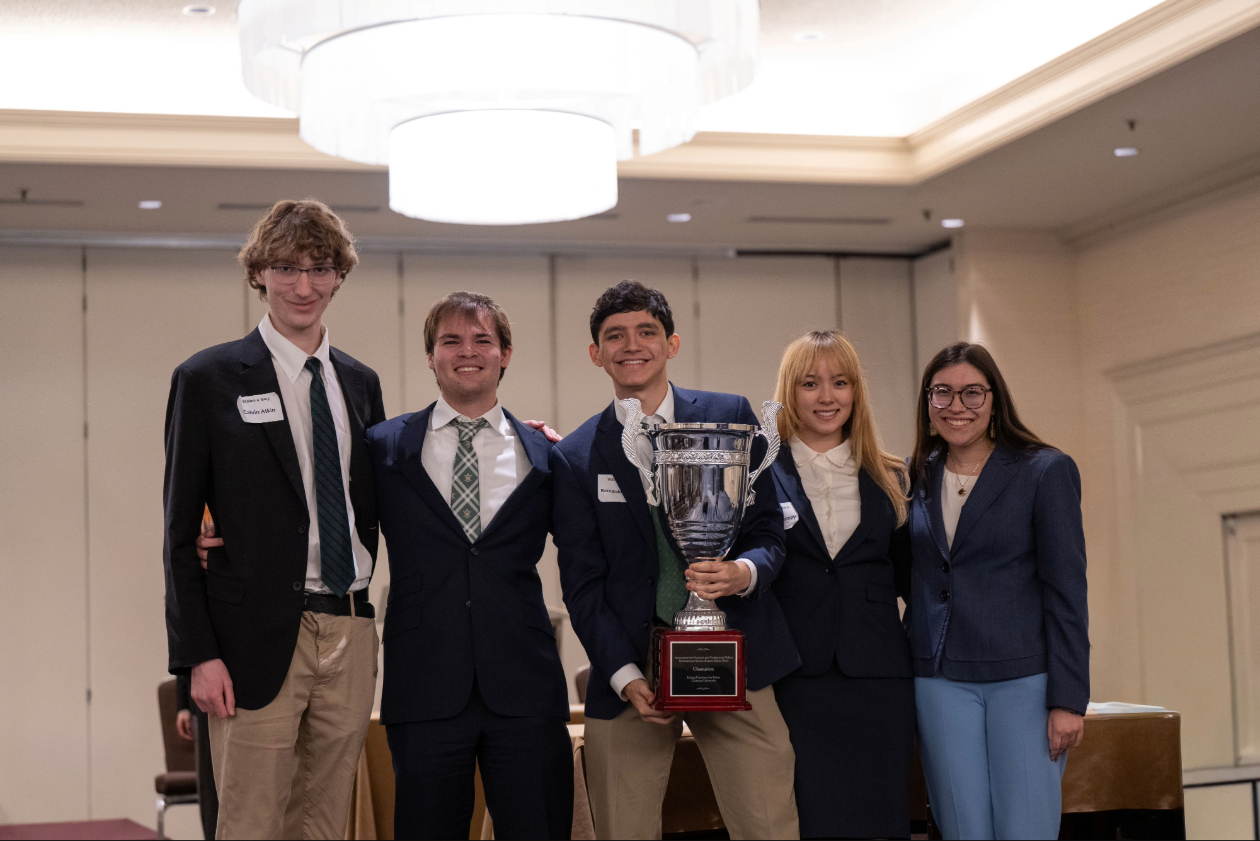
In a historic first, William & Mary’s Ethics Club won the 30th Annual Association for Practical and Professional Ethics Intercollegiate Ethics Bowl, besting 36 undergraduate teams from across the country.
The teams met in St. Louis, Missouri, March 7-8 for the event, in which they debated challenging ethical dilemmas. William & Mary beat Seattle University in the final round to be crowned as this year’s champion.
The national competition is held in conjunction with the annual international conference of APPE, an international non-profit membership organization founded in 1991 dedicated to advancing scholarship, education and practice in practical and professional ethics, according to a press release.
Developing students’ ability to have difficult conversations across differences is part of several William & Mary initiatives, including the Democracy pillar of the Vision 2026 strategic plan and the Year of Civic Leadership.
“If you asked our team before the bowl, we couldn’t have imagined anything better,” said student leader and ethics club founder Bernardo Jimenez ’26. “It’s hard to describe the feeling.”
Preparing for competition
William & Mary’s team was led by coach Tim Sommers, visiting assistant teaching professor in philosophy, and Jimenez. The team members included Calvin Atkin ’29, Griffin Bennett-Nguyen ’28, Chaewon Kang ’29, Nicholas Leonard ’27, Alanna Lopez ’29 and Victoria Phinizy ’28.
Two months before the competition, the teams received a set of committee-written cases created to explore a variety of topics within practical and professional ethics. Cases can draw from a variety of areas, including the classroom, personal relationships, professional ethics or social and political ethics.
Teams were not judged specifically by their answers, but by the ability to identify and analyze the dimensions of each case clearly and concisely, taking into consideration different perspectives.
The case William & Mary’s team was posed focused on medical assistance in dying (MAID), with the question asking what safeguards, if any, should be put in place regarding mental illness in patients for MAID to be morally permissible.
The W&M Ethics Club was founded in 2022 by Jimenez, an economics major who has been competing in ethics competitions since high school. He was initially the only member, competing in his first regional competition by himself in December 2022. His classmate and close friend, Sam Roach ’25, a philosophy major, joined him in January 2023, with the pair participating in nationals both that year and in the 2024 competition in Cincinnati, Ohio. They placed 10th out of 36 teams in 2024, a considerable feat given that teams usually consist of four to five members.
Today, the club has roughly 20 members across disciplines. The team regularly met two to three times a week for several hours, discussing cases, crafting logical and sound viewpoints and providing supporting details to back their arguments.
“I’m not going to pretend it’s not a lot of practice; there’s definitely some discipline and hard work that is required in doing the cases,” Jimenez said. “You kind of have to infer what they might ask you about.”
To get them in fighting shape, Jimenez had Sommers to assist the club and coach the team. Previously a debater himself, Sommers was excited to take on the role and ensure everyone was doing deep analysis.
“It’s a big deal to me to feel like I’m contributing to the department,” he said. “I felt like this was a way for me to do service for the university. … It’s quite addictive, just to make the students feel good, because they’re so full of passion about this.”
A full-circle moment
In total, 17 cases were presented at the championships, with teams not knowing which topic they might get until their competition began. Teams were then given two minutes to build their argument, while the opposing team took the opportunity to find areas to challenge the opposing team on ethical pitfalls on the topic.
“It took a lot of work to get there,” Jimenez said. “We faced some fantastic teams on the way to winning the championship – we had to go through last year’s national champions and then the other team in the final was a national semifinalist that year. So I think a big part of the challenge was just how good all these teams we faced were.”
Jimenez said that finally winning the ethics bowl felt “almost like a fantasy.” It was such a full-circle moment that the judge who announced William & Mary’s win was the first person Jimenez ever contacted about the College Ethics Bowl.
“You couldn’t have written it better,” he said. “To beat the level of quality opponents we had in those knockout rounds was unbelievable. And not just to win, but to win against such amazing teams that we had already known about beforehand … it was like a movie.”
Jimenez is graduating this semester and is in the midst of passing the torch, divvying up duties for the remaining members. As the only senior on the team, however, and with the other teammates in the finals ranging from freshmen to juniors, the club still has the numbers to fill out a strong cohort.
As for Sommers, he’s ready to continue his coaching duties and defend William & Mary’s new title. In April, other members of the team will participate in the National Bioethics Bowl, which is being held on April 11 at the University of Pittsburgh. For anyone interested in ethics, he encourages students to show up to club meetings. He’s confident students will stick around for the year ahead, ready to tackle even the most ethical conundrums.
“I want that (trophy) for another year,” he said. “One year is not enough for us. We’ve got a whole squad here.”
William Oster, Communications Specialist