
Social media is a common facet of everyday life. But has it become a threat to American democracy?
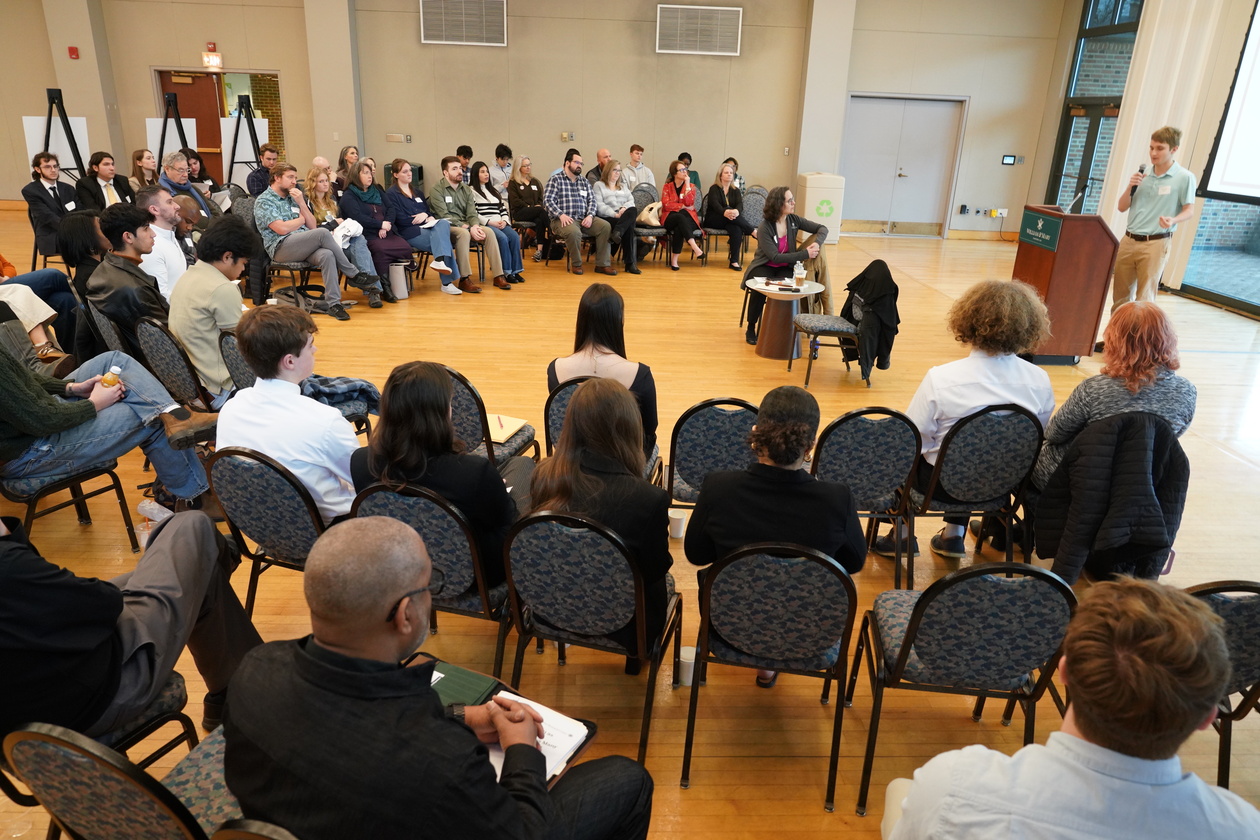
That was the central question of the Public Square Debate, sponsored by William & Mary’s Office of Student Engagement and Leadership and held on Feb. 27 in the Sadler Center.
College and high school students alongside multigenerational community members engaged in the discourse, hosted by Doug Sprei, director of the College Debates and Discourse Alliance, and Jodi Fisler, applied learning program director for the university registrar.
The event is part of the university’s ongoing efforts to strengthen civil discourse. All students learn about the Better Arguments framework during orientation, and faculty and staff participate in Professional Development Days on related topics each summer. Democracy is one of the core initiatives of W&M’s Vision 2026 strategic plan, and the university launched the Year of Civic Leadership at the beginning of February.
Before the discussion began, Sprei laid down the ground rules to ensure balance among positions: Listen to listen; don’t interrupt; speak your personal truth; and critique the perspective, not the individual.
“Consider yourself part of a groundswell across the nation, from coast to coast, on college campuses, community college campuses, community churches – we’re bringing these debates and dialogues everywhere we can,” Sprei said. “This is the holy grail for us. It’s not just students. … It’s across all generations, and that makes me very happy.”
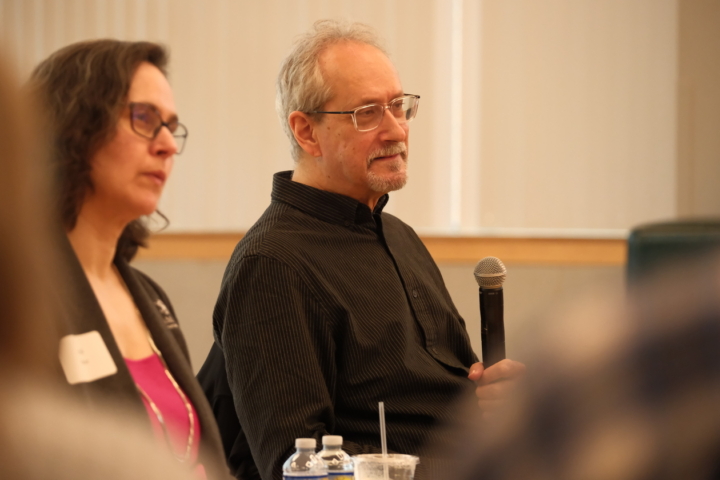
In total, five speakers had three minutes each to say whether they were for or against social media and why. Audience members flanking the speaker and moderators in the center of a semicircle then addressed any counterpoints to the moderator, who would then direct the question to the speaker to defend.
One debater, a retired teacher, set the tone, arguing that social media is a net negative, saying the onslaught of artificial intelligence has made it “not human anymore.”
“I think democracy is in trouble because if you can’t believe anything, your instinct is to no longer look for what others are saying,” he said. “Regardless of what you’ve seen or heard, you have to then put time into parsing out what the reality is. … Democracy cannot survive.”
Another speaker said that social media is actually one of democracy’s greatest strengths, given how it expands participation, accountability and access to information.
“Democracy only works when citizens are engaged,” he said. “Social media changed that. Widespread access allows millions of people to follow elections, learn about issues and engage in public debate, something that was much harder just a decade ago.”
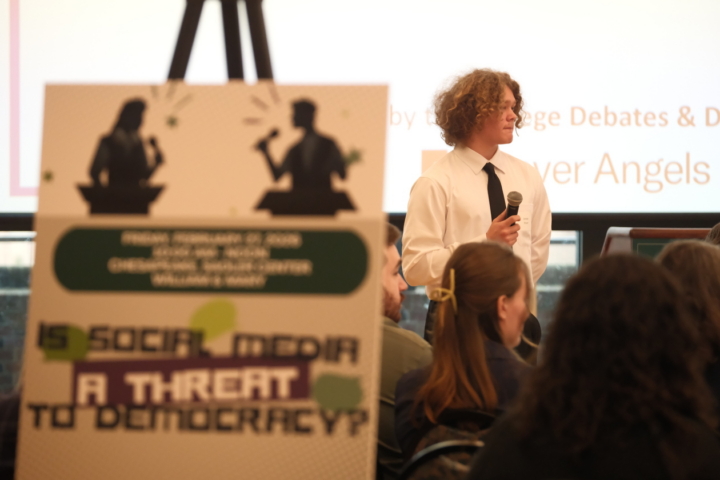
Some speakers used research and data to back up their claims; others relied on personal anecdotes. But each used their allotted time to articulate their vision of a democracy that works properly for its people.
“Are we moving toward perfecting democracy? For me, yes,” said one professor, who argued that social media is neither bad nor good, but a tool that needs reworking. “We shouldn’t take away social media, but we need information literacy. … To me, that is the bigger problem. Some people can’t discern between verified and non-verified information.”
After the speakers finished, the discussion opened to the entire audience, allowing others to voice different opinions. It also let spectators comment on their overall experience listening to a civil discussion.
“I appreciate the discourse of just being here,” said one attendee. “Nobody yelled. Nobody got mad. It allowed us to communicate and understand each other more.”
Throughout the discussion, conversation remained civil, level-headed and intensely curious, noted Sprei. No attendees took a hardline stance. Rather, everyone who spoke shared a similar understanding that there is potential for change in either direction.
As the debate concluded, Fisler reflected on how this ambiguity is actually an ideal model to discuss hard topics.
“What we saw today is that even when people are staking oppositions on one side of the issue or the other, there is a lot of gray area,” Fisler said. “Things like this are just great ways to model how you can have a conversation. People can feel you, and you hear a variety of perspectives.”
As part of the Braver Angels, a group dedicated to bridging partisan divides, Fisler works to promote more civil discourse. The group will travel to the University of Mary Washington, Radford University and Virginia Commonwealth University, with a culminating event in October in the House of Delegates, with the hope of involving students from prior debates to discuss the significance of government.
“We can continue these debates and discourse to create better campus dialogue,” she said. “We can’t do that unless we talk to each other.”
William Oster, Communications Specialist