
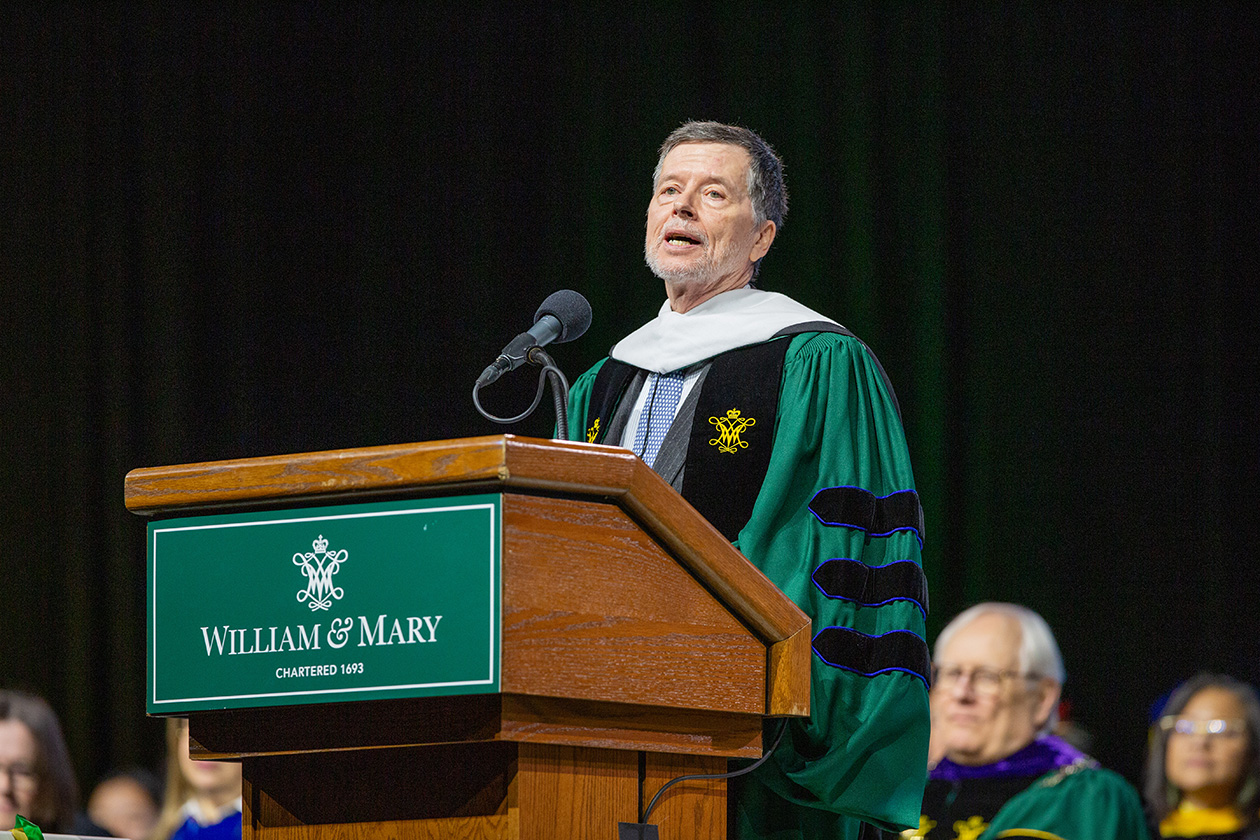
As the United States celebrates its 250th anniversary this year, its citizens should listen to the past to help shape its future, award-winning filmmaker Ken Burns told the William & Mary community on Friday.
“As a culture, we have ignored this difficult but often joyful historical noise, becoming in the process blissfully ignorant of the power those past lives and stories … have over our vast unknown future,” he said.
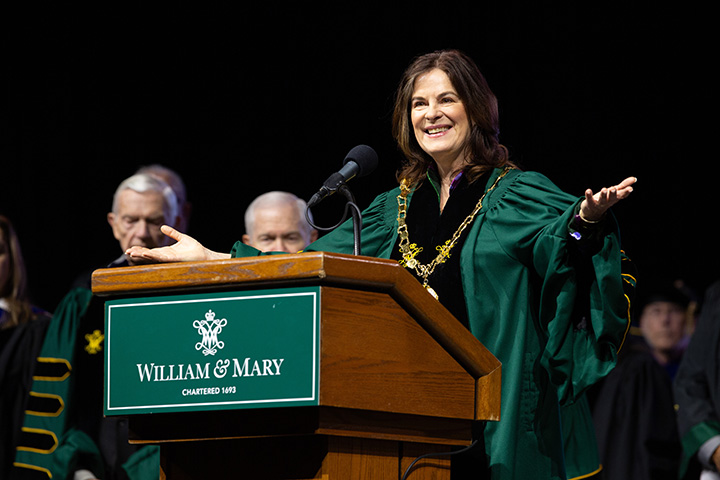
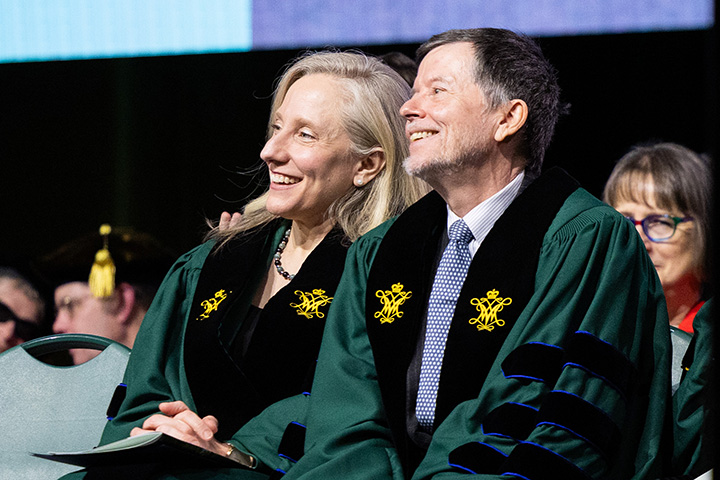
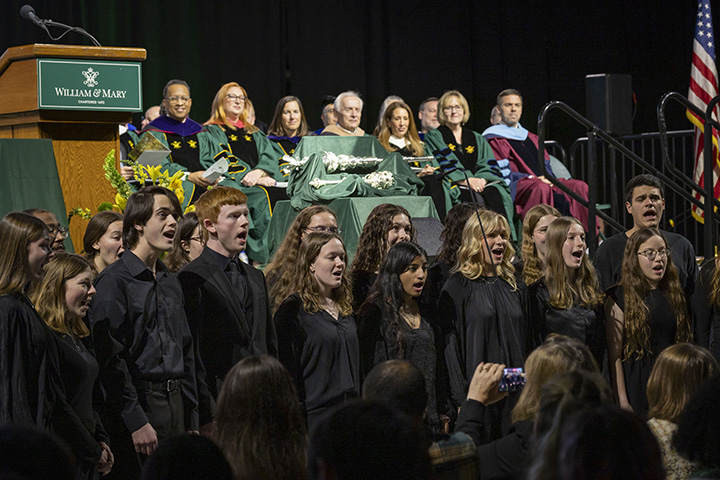
Burns, who recently released a documentary on the American Revolution, spoke at the university’s annual Charter Day ceremony. Held in Kaplan Arena, the annual tradition celebrates William & Mary’s founding in 1693 by royal British charter. During this year’s event, the university launched its Year of Civic Leadership, which builds on William & Mary’s commitment to preparing civic leaders and celebrates its foundational role in establishing democracy in the United States.
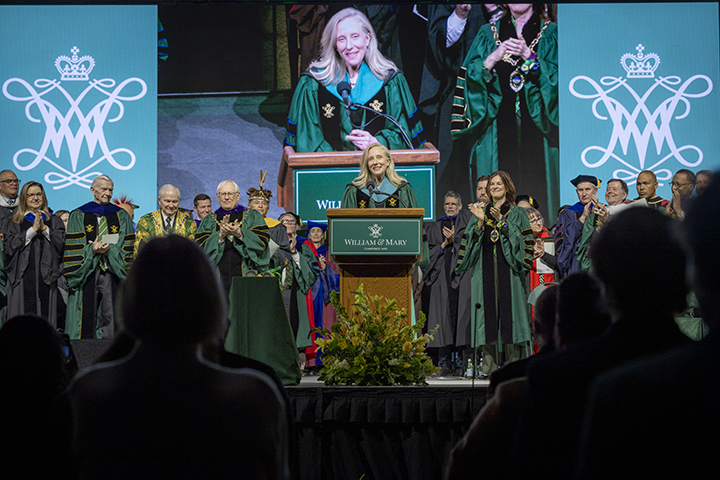
In addition to Burns, Virginia Gov. Abigail Spanberger spoke at the event and emphasized the need today for civic leadership.
“We have faced greater hardships, and we have always found a way forward,” said Spanberger, who was inaugurated in January. “It requires political leadership, yes, but it also takes something stronger than that. It takes people. It takes civic leadership. It takes engaged, informed citizens choosing service to one another over self interest — everyday Americans choosing community over chaos and division.”
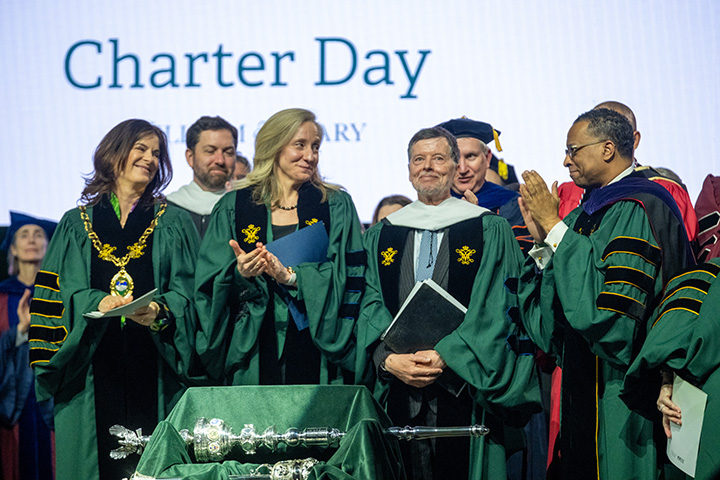
Both Burns and Spanberger received honorary degrees — and standing ovations — during the ceremony, which nearly 5,000 people attended. In addition, Robert M. Gates ’65, L.H.D. ’98, whose life has exemplified civic leadership, was reinvested as the university’s chancellor for a historic third term.
“This university community has a special role and a special obligation to be part of the solution, as leaders, as public servants, as citizens,” said Gates. “I’m proud and honored to continue to serve as chancellor of this great university, truly the Alma Mater of the Nation, as it helps determine our country’s future course, as it has been doing for more than three centuries.”
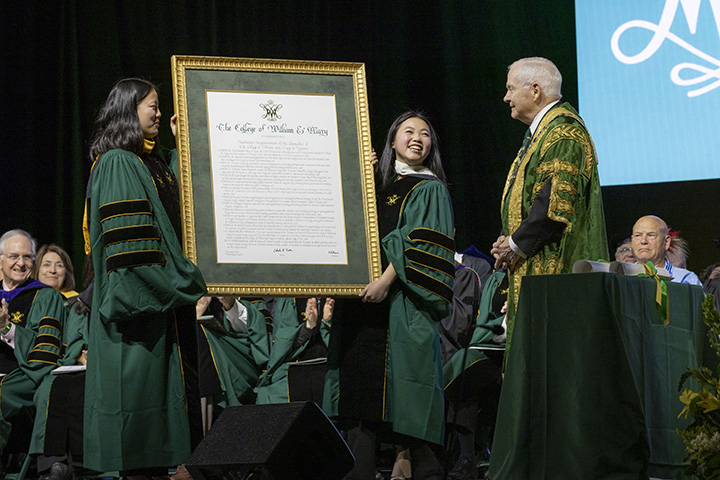
Alma Mater of the Nation
Throughout its 333 years of existence, William & Mary has played a special role in shaping the nation and its leaders.
“Our students carry a strong sense of duty,” said W&M President Katherine A. Rowe. “They come here seeking a community that grows through civil debate and service. Our responsibility as the Alma Mater of the Nation is to teach them how powerful those qualities are and to prepare them to use them as citizens and professionals throughout the rest of their lives.”
Civic leadership takes many forms, and that’s what the Year of Civic Leadership aims to embrace, said Spanberger.
“There is no better place to launch an effort like this than here,” she said. “American democracy was born here, and we’re working to perfect it still today — in Virginia, in Williamsburg, on this very campus. For more than three centuries, this university has sent its graduates into the world to think, to act, to serve. It is the Alma Mater of the Nation. It is the Alma Mater of our Nation.”
‘Do something that will last and be beautiful’
While that legacy is something to celebrate, Spanberger noted that the nation’s history isn’t all celebration. Burns concurred, quoting journalist I.F. Stone and saying that history isn’t melodrama; it’s tragedy.
“In melodrama, all villains are perfectly villainous, and all heroes are perfectly virtuous. But life isn’t like that — you know that in your guts — nor is our history,” he said.
Today, people are more focused on the individual than the collective good, and it is hard not to wonder what actually endures, said Burns.
Early in his career, Burns interviewed playwright Arthur Miller for a documentary about the Brooklyn Bridge. Miller had written “A View from the Bridge,” which carried a photo of the famed structure on every edition. Right before the interview, Burns was mortified to learn that the bridge was just a backdrop in the play, and Miller soon confirmed he didn’t know a thing about it.
Miller still obliged the young filmmaker with a short interview, and while Burns doesn’t remember the one question he asked, he’ll never forget the response. Miller said that while the city was always a “practical, utilitarian invention,” the bridge was a piece of “steel poetry.”
“It puts everything to shame, and it makes you wonder what else we could have done that was so marvelous and so unpresumptuous. It carries its weight. It does what it’s supposed to do, and yet, they could have built another Manhattan Bridge and (John) Roebling didn’t. He really aspired to do something gorgeous. So it makes you feel that maybe you, too, could add something that would last and be beautiful,’” Miller told Burns.
“I could not help but think of his words again as we gather together today,” said Burns. “It applies to all of us, young or old: Do something that will last and be beautiful. It doesn’t have to be a bridge or a symphony or a book or a business or the United States of America, as Jefferson, Washington, Madison and Henry could claim. It could be the look in the eye of a child you raise with love, or in this simple garden you tend, but above all, do something that will last and be beautiful.”
A weekend of celebration
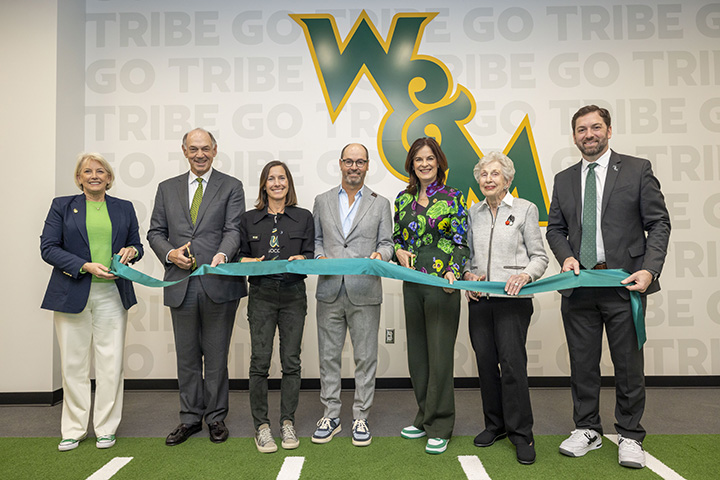
In addition to Friday’s ceremony, Charter Day weekend included a number of events, including two involving major construction projects. On Friday evening, the university celebrated the completion of the Mackesy Sports Performance Center (or the Mack) and upgrades to Kaplan Arena. The Mack, part of the W&M Athletics Complex, includes strength and conditioning areas, study spaces, a sports medicine area, practice court and team locker rooms. A special edition of Director of Athletics Brian Mann’s “Mannuscript” newsletter this week will highlight the dedication ceremony and share additional videos and photos that are also available on the W&M Athletics social media accounts, including Facebook.
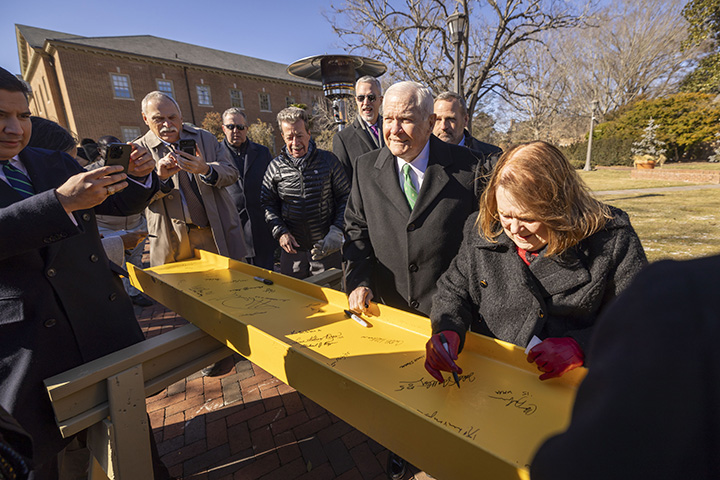
On Saturday, a topping out ceremony marked a milestone in the renovation of Robert M. Gates Hall. Formerly known as Brown Hall, the building will serve as a hub for four research centers: AidData, the Global Research Institute, the Institute for Integrative Conservation and the Whole of Government Center of Excellence. It is expected to be completed this year.
Multiple members of the university community were also honored throughout Charter Day weekend. During Friday’s ceremony, the recipients of this year’s Jefferson Awards and Monroe Prize were acknowledged. On Saturday, this year’s Alumni Medallion recipients were celebrated.
Other events throughout the weekend included a conversation about leadership with university presidents, two opportunities to participate in the Ancestral Remembrance Tribute at Hearth: Memorial to the Enslaved, sponsored by the Lemon Project; a Student Innovation Showcase, hosted by the Global Research Institute; and the Green & Gold Bash, hosted by Alma Mater Productions and the Student Assembly.
Earlier in the week, four of William & Mary’s primary boards met and participated in their annual joint meeting. The groups included the Board of Visitors, W&M Foundation Board of Trustees, Alumni Giving Board of Directors and the Alumni Association Board of Directors.
Erin Jay, Senior Associate Director of University News